
Jumping into new experiences
For senior Héctor Javier Vázquez Martínez, studying and teaching abroad has brought new friendships, new research interests, and a new outlook.
For senior Héctor Javier Vázquez Martínez, studying and teaching abroad has brought new friendships, new research interests, and a new outlook.

Study uncovers language patterns that AI models link to factual and false articles; underscores need for further testing.

Researchers pinpoint the “neurons” in machine-learning systems that capture specific linguistic features during language-processing tasks.

Approach developed by MIT engineers surmounts longstanding problem of light scattering within biological tissue and other complex materials.

Undergraduate researchers discussed their projects at a well-attended poster session.

Device made from flexible, inexpensive materials could power large-area electronics, wearables, medical devices, and more.

Neural network assimilates multiple types of health data to help doctors make decisions with incomplete information.
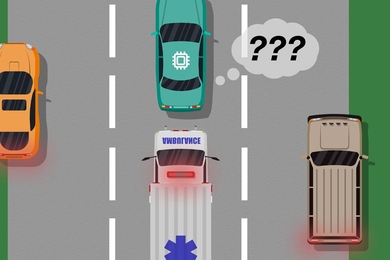
Model identifies instances when autonomous systems have learned from examples that may cause dangerous errors in the real world.

Design reduces by 99 percent the data users need to join the network and verify transactions.
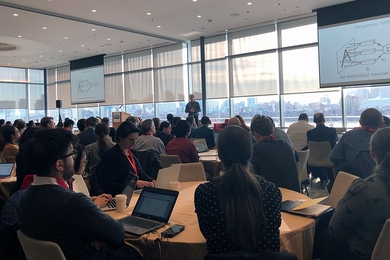
MIT “Policy Congress” examines the complex terrain of artificial intelligence regulation.
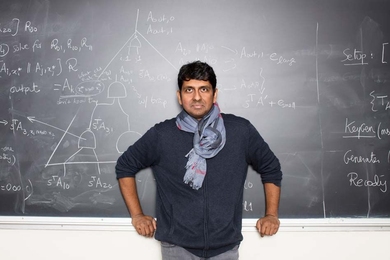
Vinod Vaikuntanathan aims to improve encryption in a world with growing applications and evolving adversaries.

A critical gel-like structure in the inner ear moves according to a sound’s frequency, researchers find.

Tool for nonstatisticians automatically generates models that glean insights from complex datasets.
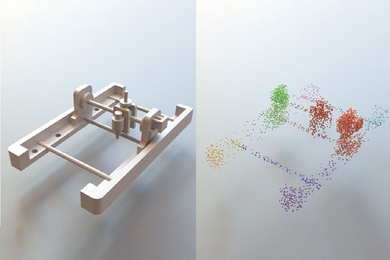
System breaks down complex designs into easily modifiable shapes for custom manufacturing and 3-D printing.