Skip to content ↓

📬 Want a dose of MIT in your inbox? Subscribe to the MIT Daily and/or MIT Weekly newsletters.

Top News

Looking for audio? Listen to the MIT News podcast →

Recent Highlights

More MIT News articles

In the Media

The Boston Globe

Margaret Hamilton, who developed the software that helped the Apollo 11 mission land safely on the moon and “whose historic accomplishments focused attention on the work of software engineers,” died on Sept. 30, reports Bryan Marquard for The Boston Globe. “She gave me, from the get-go, this notion that I could do anything, that there were absolutely no gender barriers,” says Hamilton’s daughter, Lauren. Hamilton’s life and work conveyed to her great-granddaughters “that very clear idea that they could have whatever future they wanted to create for themselves.” 

Bloomberg

In an interview with Bloomberg, Prof. Justin Solomon discusses how mathematicians are responding to advances in AI in the wake of an AI platform solving the Navier-Stokes problem. “The really interesting part [of proof writing] is the modeling and figuring out which questions to ask and what insights they bring us to the universe, and the AI tools are not doing that,” says Solomon. “Writing the prompts is very much what we’ve been teaching our students to do for centuries now, and that skill, I think, persists.” 

Smithsonian Magazine

In an interview with Smithsonian Magazine’s Diane Tedeschi, alumnus Mike Massimino SM ’88, PhD ’92 discusses working on NASA’s space shuttle as a mission specialist and repairing the Hubble Space Telescope. “Nothing can really prepare you, though, for the overwhelming beauty that you see—the emotion of it [space],” says Massimino. “When you see the beauty of Earth and the stars and the Moon and everything around you, it’s so inspiring. But as far as your job goes, you’re 100-percent ready.”  

The New York Times

For The New York Times, reporters Carolyn Y. Johnson and Kenneth Chang spotlight the late computer scientist Margaret Hamilton and her role in the development of the field of software engineering, highlighting her work as a “trailblazing woman who played a crucial, largely unseen role.” MIT Presidential Advisor Maria Zuber shared: “When you see someone like her who went for it and lived her dream it makes it a little easier for the rest of us to dare to reach for the moon as well.” 

The Wall Street Journal

Prof. John Urschel speaks with Wall Street Journal reporter Andrew Beaton about his career in mathematics, from his time as an NFL lineman to the publication of his latest research, which proves a “decades-old mathematical conjecture.” “I feel like I bet on myself in a big way,” Urschel says. “I’m living my best life right now.”  

Physics

Prof. Frances Ross and Research Scientist Julian Klein speak with Physics reporter Akashni Raghubar Latchanna about an electron microscopy technique they developed to move atoms within a material, creating new possibilities for engineering electrical, optical, and quantum properties. “If we can control the electronic or optical functions of the materials, we might potentially make those devices more brain-like, more portable, and less power-hungry,” Ross said. 

The Guardian

The Guardian’s Uwa Ede-Osifo spotlights the life and legacy of the late Margaret Hamilton, “the computer pioneer whose software powered the first moon landing,” at MIT’s Instrumentation Lab. Prior to the Instrumentation Lab, Hamilton worked “on the software that could detect enemy aircraft,” at MIT’s Lincoln Laboratory,” writes Ede-Osifo. “When the institute received a Nasa contract to develop the Apollo onboard flight software, she jumped at the opportunity.”  

CNN

“Groundbreaking researcher,” Margaret Hamilton, “whose code helped land NASA’s Apollo astronauts on the moon to win the 20th-century space race has died,” reports CNN’s Jackie Wattles. “Through her work, Hamilton is also credited as one of the founders of the field of software engineering — a term she coined — by helping to establish it as a professional practice,” writes Wattles.  

TechCrunch

TechCrunch’s Amanda Silberling highlights Tony Fadell, the “father of the iPod,” and Designer in Residence at MIT’s Morningside Academy for Design, exploring what he learned from working with the first wave of agentic AI technology, in his presentation at the inaugural MIT Future Fest. “It took me a couple of years first to understand how best to utilize [an assistant], and then to trust them with the most sensitive data, and have them be an agent where they’re setting up meetings with people,” says Fadell. “Trust and safety are going to be paramount with anything that we turn over to some kind of intelligence.” 

Financial Times

Hertha Metals, a startup founded by alumna Laureen Meroueh SM ’18, PhD ’20, “has developed a way to produce high-purity iron needed in the magnets used in everything from electric vehicles to humanoid robots,” writes reporter Stephanie Findlay for the Financial Times. “Hertha is breaking ground on a 10,000-tonne-a-year commercial facility today on the outskirts of Houston to produce the metal,” Findlay highlights. “The company plans to produce the first steel-grade iron in the fourth quarter of next year and start producing the high-purity iron by 2028.” 

The Washington Post

Prof. John Urschel, a former NFL player, found that the Gaussian elimination algorithm, used to calculate shared solutions to a group of equations, specifically linear equations, was close to 100 percent reliable, writes reporter Miriam Waldvogel for The Washington Post. “It just seems so interesting that the most fundamental algorithm we have in the field, we do not fully understand,” says Urschel. “I really love this question of why versus how, and this idea of understanding what’s going on.” 

The Washington Post

In an opinion piece for The Washington Post, Senior Fellow Brian Deese and his colleague Anna Pasnau outline a potential framework for maintaining battery energy storage systems efficiently. Batteries “can reduce the need to run the expensive natural gas ‘peaker’ plants that are used only when demand is high,” Deese and Pasnau write. “And batteries can be deployed quickly—often in months, compared with the years it can take to build new stand-alone electricity generation—meaning they can meet surges in demand.”  

Fox News

MIT astronomers have discovered a “star slowly and steadily consuming material from another low-mass object,” writes Catherine Stoddard for Fox News. “At the rate which the star is feeding, it’ll take likely hundreds of thousands, or maybe even billions of years for it to completely consume its nearby neighbor,” notes Stoddard.  

Community Updates

Featured Multimedia

Video thumbnail

Alex Slocum, the Walter M. and A. Hazel May Professor of Mechanical Engineering at MIT, has a serious message for students in Fundamentals of Precision Product Design, but a famously fun way of delivering it. Students describe the course as “creative chaos,” an approach that drives home the importance of precision and repeatability in engineering design.

Video thumbnail

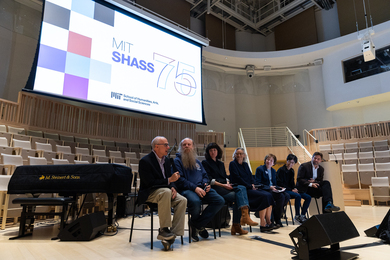
Founded in 1950, MIT’s School of Humanities, Arts, and Social Sciences encourages students to think broadly about the world and their place in it, while examining what it means to be human and the social, ethical, and economic dimensions of today’s greatest challenges.

Video thumbnail

Drawing on research he began at MIT, AJ Perez ’13, MEng ’14, PhD ’23, is finding new uses for the world’s growing plastic waste. His company, Atlas, 3D prints building materials from recycled plastic, giving discarded material a new purpose.

Video thumbnail

A fast-paced look at the people, ideas, research, and experiences that make MIT what it is. From groundbreaking discoveries and hands-on learning to a vibrant campus community, see the curiosity, creativity, and innovation that drive the Institute. This is MIT.

Video thumbnail

Meet Paula Hammond, MIT Institute Professor and Dean of the School of Engineering—the first woman and first Black scholar to lead MIT's Department of Chemical Engineering. Discover how her pioneering research in nanotechnology and ovarian cancer has shaped her career, the barriers she broke along the way, and what it means to change what leadership looks like in STEM.

More News