


This interview is part of a series of short interviews from the Department of Electrical Engineering and Computer Science, called Student Spotlights. Each Spotlight features a student answering their choice of questions about themselves and life at MIT.
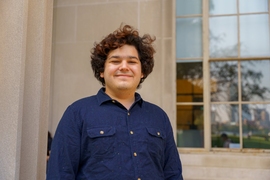
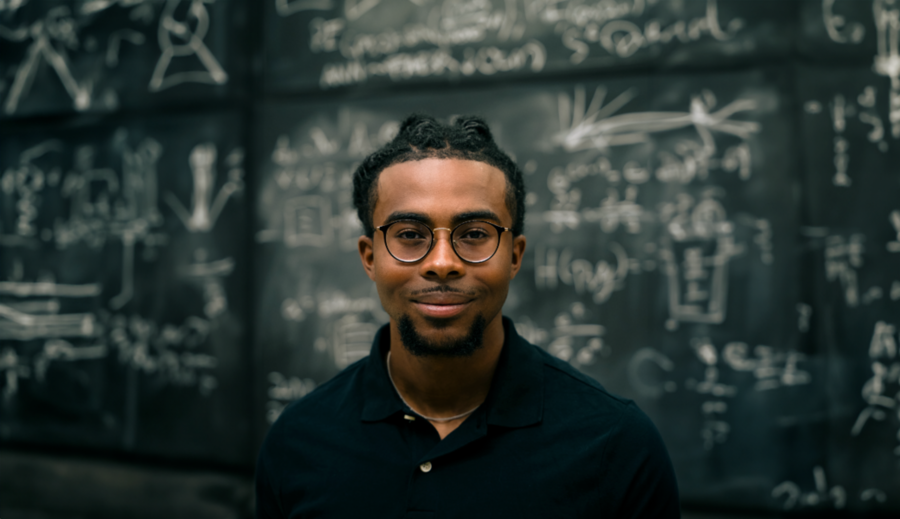
Nathaniel Morgan, from Atlanta, Georgia, is a senior majoring in Course 6-4 (Artificial Intelligence and Decision Making). A seasoned undergraduate researcher, Morgan has participated in the Undergraduate Research Opportunity Program since his first year, conducting research with the Computer Science and Artificial Intelligence Laboratory’s Spoken Language Systems group — first on natural language processing reasoning and resource-augmented generation, and now, with Assistant Professor Omar Khattab, on improving the capabilities of large language models to process lengthy and complex environmental policy documents. Morgan is secretary of the Student Information Processing Board (SIPB) and founder of its ArkOS Project; additionally, he is a member of the AI@MIT Reading Group, and has served as a student board member for the Harvard + MIT COOP Board of Directors for the past two years.
Q: Tell me about one teacher from your past who had an influence on the person you’ve become.
A: There are many teachers I would like to acknowledge, including Ms. Herdliska, Ms. Greene, Mrs. Mondessier, Mr. McVeigh, Dr. Morgan, and Mr. Thurston. One teacher, however, stands out most clearly in my memory: Mrs. Straus, my second grade language arts teacher. At a time when I already enjoyed writing, she helped nurture that interest by nominating one of my essays for a district writing award. That experience was formative in shaping my early relationship with reading and writing and helped cultivate my lasting love for books, learning, and creating, which I carry into every one of my endeavors.
Q: What’s a special MIT tradition, event, club, or class you wish more people knew about? What makes it so special?
A: The Missing Semester of Your CS Education is an MIT SIPB-supported program that teaches the practical skills rarely covered in computer science (CS) classes, including the command line, Git, editors, and modern AI-assisted workflows. I highly recommend it for anyone who wants to become more fluent with version control and development tools. MIT SIPB also hosts Independent Activities Period “Cluedumps,” short classes led by students, alums, and MIT affiliates on topics like Lean, Nix, and more.
Q: Who’s your favorite artist?
A: Tie between Slawn and Ozy.
Slawn brings a postmodern interpretation of the world informed by graffiti and street culture, with a pop-art sensibility reminiscent of Jean-Michel Basquiat and Keith Haring. It is direct, in your face, and unapologetic. When you see a Slawn piece, you know it is a Slawn piece.
Ozy Worldy’s work is contemporary, while still pulling from realist and impressionist influences of past movements. He maintains a balance of subtlety and statement that guides your attention across different parts of the composition, rather than forcing a single focal point. The smaller choices can feel quietly unsettling once you notice them. That unease is part of the beauty I find in the work, a deliberate deviation from the norm.
Q: What’s your favorite TikTok, Instagram, or YouTube video?
A: I’d pick Ken Block Slays the Donut Garage in his 650HP Fiesta. In my free time, I work on a 2010 six-speed Camaro SS, a project that began with a problem car from Facebook Marketplace.
Q: What’s one technology you hope is developed or perfected within your lifetime?
A: Time travel without paradoxes would be ideal, mostly because I could use more hours in the day. In the meantime, I hope to see continued progress not only in reducing the quadratic complexity of attention mechanisms, but also in improving how models represent, retrieve, and reason over long contexts. Capturing long-range dependencies at the scale of hundreds-of-millions to a billion tokens would make it possible to build truly lifelong systems that can grow and adapt alongside changing world conditions, supporting scientific development and broader societal advancement.
Q: If you won the lottery, what would you spend some of the winnings on?
A: After taking care of my family and friends, I’d start something like a venture capital fund for emerging artists. There’s so much talent that never gets visibility because the economics don’t work early on. I would love to help bridge that gap.
Q: If you had to teach an in-depth class about one niche topic, what would you pick?
A: It would be about living when things go wrong. Life is often unfair, messy, and seemingly indifferent to effort. What matters is not avoiding that reality, but learning how to carry it and keep going anyway. If you are reading this, you are still here, which means your goals are still within reach, no matter how distant they may seem.