Zora Neale Hurston remains one of America’s best-known authors. Charles Henry Turner developed landmark studies about the behavior of bees and spiders. Brian Wilson founded the Beach Boys. George Nissen invented the trampoline. What do they all have in common?
Well, for one thing, they were all innovative Americans — creators and discoverers, producing work no one anticipated. For another, they are all now celebrated as such, in verse, by Joshua Bennett.
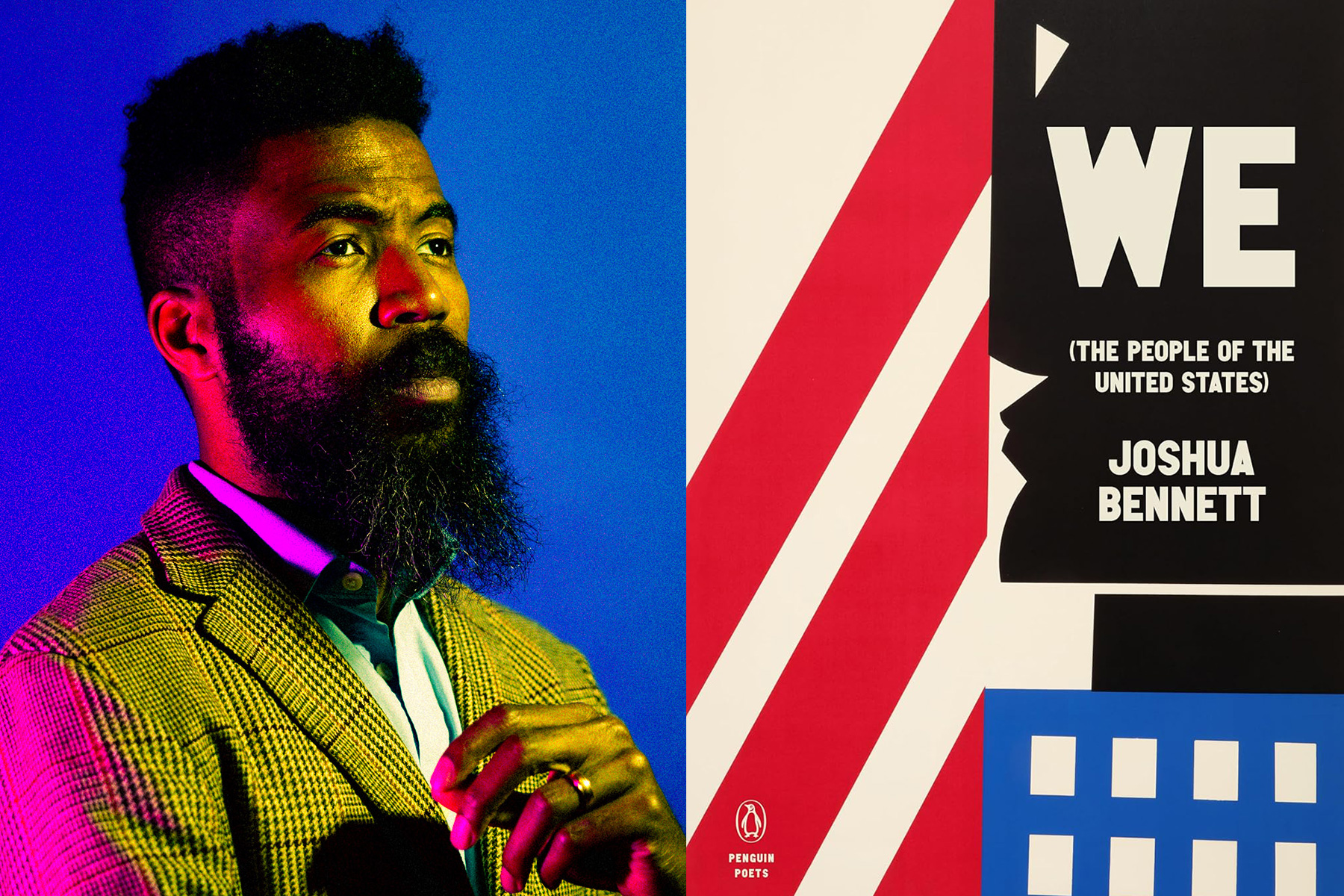
That’s right. Bennett — an MIT professor, lauded poet, and literary scholar — is marking the 250th anniversary of the founding of the U.S. with a book-length work of poetry about the country and some of its distinctive figures. In fact, 50 of them: Bennett has written a substantial work featuring remarkable people or inventions from each of the 50 states, meditating on their place in cultural fabric of the U.S.
“There’s so much to be said for a country where you and I are possible, and the things we do are possible,” Bennett says.
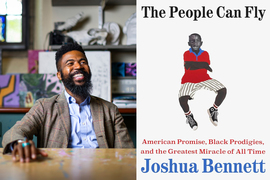
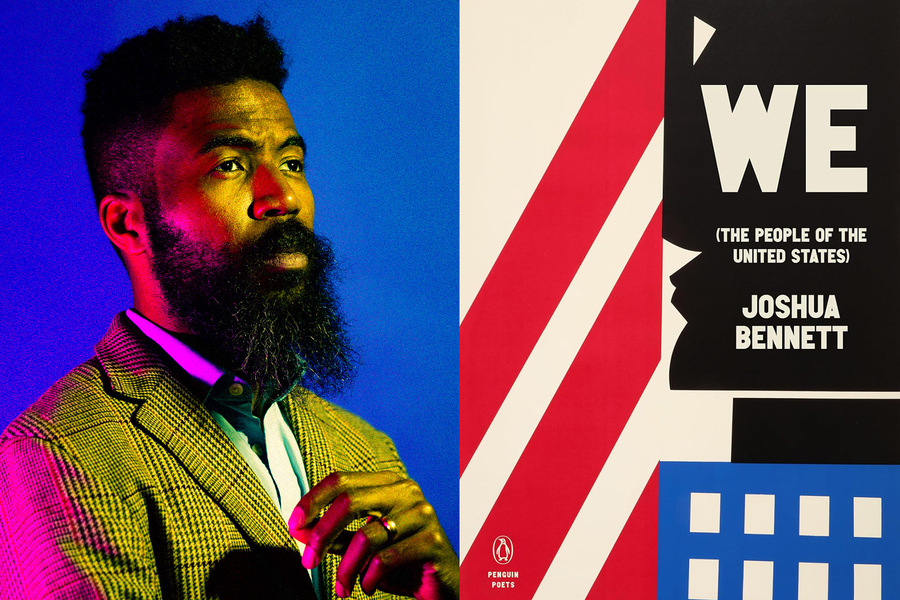
The book, “We (The People of the United States),” is published today by Penguin Books. Bennett is a professor and the Distinguished Chair of the Humanities at MIT.
Bennett’s new work has some prominent Americans in it, but is no gauzy listing of familiar icons. Many of the 50 people in his book overcame hardship, poverty, rejection, or discrimination; some have already been rescued from obscurity, but others have not received proper acclaim. Few of them had a straightforward, simple connection with their times.
“It’s about feeling that you have a life in this country which is undeniably complex, but also has this remarkable beauty to it,” Bennett says of the work. “A beauty you helped to create, and that no one can take away from you.”
The figures that Bennett writes about are sources of fascination, and inspiration, demonstrating the kinds of lives it is possible to invent in the U.S.
“We’re in a moment that calls for compelling, historically grounded stories about what America is, what it has been, and what it can be,” Bennett adds. “Can we build a life-affirming vision for the future and those who will inherit it? I’m trying to. I work on it every day.”
Taking flight
“We (The People of the United States)” is inspired, in part, by Virgil’s “Georgics,” pastoral poems by the great Roman poet. Bennett encountered them while a PhD student in literature at Princeton University.
“The poet Susan Stewart, my professor at Princeton, introduced me to Virgil’s Georgics,” Bennett says. “I eventually started to think: What would it look like for me to cover Virgil?” Adding to his interest in the concept, one of his favorite poets, Gwendolyn Brooks, had spent time recasting Virgil’s ancient epic, “The Aeneid,” for her Pulitzer Prize-winning work, “Annie Allen.” She also translated the original work from Latin as a teenager. Moreover, Bennett’s writing has long engaged with the subject of people working the land in America.
“I decided to start writing all these poems about agriculture,” Bennett says. “But then I thought, this would be interesting as an epic poem about America.” As he launched the project, its focus shifted some more: “I started to think about the book as an ode to invention.”
Soon Bennett had worked out the structure. An opening section of the work is about his own family background, becoming a father, and the process of building a life here in Massachusetts.
“Where does my influence, my aspiration, end and the child begin?” Bennett writes in one poem. That section prefigures further themes in the collection about the domestic environments many of its figures emerged from. For the rest of the work, with one innovator or innovation for each of the 50 states, Bennett adopted a regular writing schedule, producing at least one new poem per week until he was finished.
Hurston, one of several famous authors and artists featured in the book, represents Florida. From Ohio, entomologist Charles Henry Turner was the first Black person to receive a PhD from the University of Chicago, in 1907, before conducting a wide range of studies about the cognition and behavior of spiders and bees, among other things.
George Nissen, alternately, was a University of Iowa gymnast who built the first trampoline in the 1930s in his home state — something Bennett calls a “magical device” that brings to life “the scene in your mind of the leap/and of the leap itself, where you are airborne, illuminated/quickly immortal.” Whether these innovations appear through rigorous academic exploration or became mass-market goods that produce flights of fancy, Bennett has a keen eye for people who break new ground and fire our own feelings of wonder.
“We actually are all bound up in it together,” Bennett says. “These different figures, from various fields, eras, and lifelong pursuits are in here together precisely because they helped weave the story of this country together. It’s a story that is still unfolding.”
Bennett is straightforward about the struggles many of his subjects faced. His choice to represent North Carolina is the poet George Moses Horton, an enslaved man who not only learned to read and write in the early 1800s — the state later made that illegal for enslaved persons, in 1830 — but made money selling poems to University of North Carolina students. Indeed, Horton’s work was published in the 1820s. Bennett writes that Horton’s public performance of his poetry was “an ancient art revived in the flesh of a prodigy in chains.”
Bennett’s unblinking regard for historical reality is a motif throughout the work. “To me it’s not only about exploring a history that a reader might feel connected to or want to learn more about,” he says. “It’s about honoring those who lived that history, who helped make some of the most beautiful parts of the present possible, through an engagement with the substance of their lives.”
Just my imagination
Many figures in “We (The People of the United States)” are artists, but of many forms. From watching VH1 as a child, Bennett got into the Beach Boys, and he devotes the California entry in the poem to them. Or as Bennett puts it, he was “newly initiated into a sound/I do not understand until I am old enough to be nostalgic/for windswept locales, and singular moments in time/I never lived through.”
Bennett was learning about the Beach Boys while growing up in Yonkers, New York, far from any California beaches. But then, Brian Wilson wasn’t a surfer either — he grew up in an industrial suburb of Los Angeles. Imagination was the coin of the realm for Wilson, something Bennett understood when Beach Boys songs would veer off in unexpected directions.
“I’ve always been drawn to moments of great surprise, or revelation, in the works of art I love,” Bennett says. “Which is part of why I’ve dedicated my life to poetry. You think one thing is happening in a poem, and suddenly that shock comes, that unexpected turn, or volta. Brian Wilson always had a great understanding of that. It works in pop music. Surprise, sometimes, is a shift in register that takes you higher.”
Various poems in the collection have down-to-earth origins. Bennett remembers his father often fixing things in the family home, from toys to the boiler, saying, “Pass me the Phillips-head,” when he needed a screwdriver. Thus Oregon appears in the book: Portland is where the Phillips-head screwdriver was invented.
In conversation, Bennett notes the hopeful disposition of his father, who after living through Jim Crow and serving in the Vietnam War, worked 10-hour shifts at the U.S. Postal Service to support his family. Even with all the difficulty he experienced in his life, Bennett’s father always encouraged his son to pursue his dreams.
“I’m grateful that I inherited a profound sense of belonging, and dignity, from my parents,” Bennett says. “There was always this feeling that we were part of a much larger story, and that we had a responsibility to tell the truth about the world as we knew it.”
And that’s really what Bennett’s new book is about.
“We can reckon with our history in its fullness and work, tirelessly, toward a world that’s worthy of the most vulnerable among us,” Bennett says. “Like Toni Morrison, we can ‘dream the world as it ought to be.’ And then make it real. That’s my vision.”