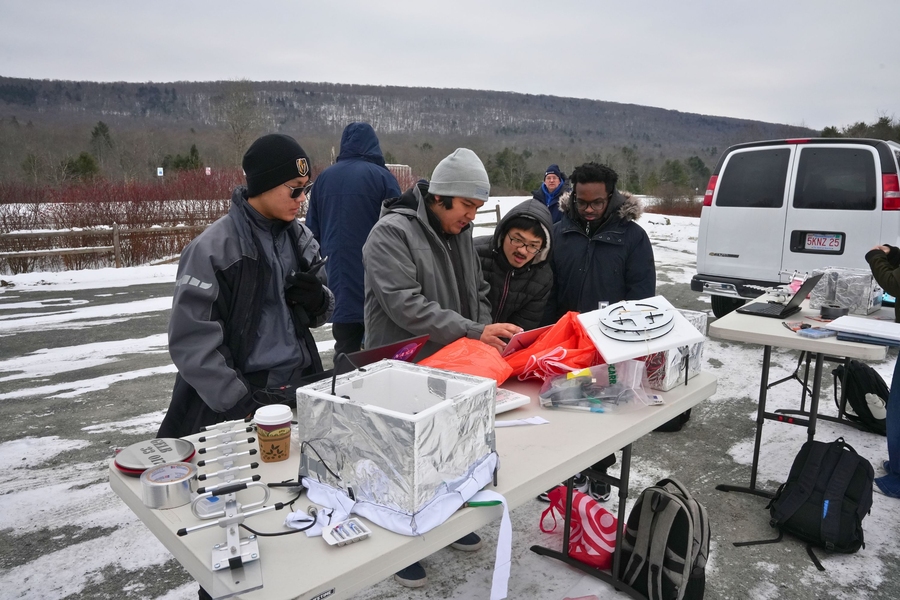
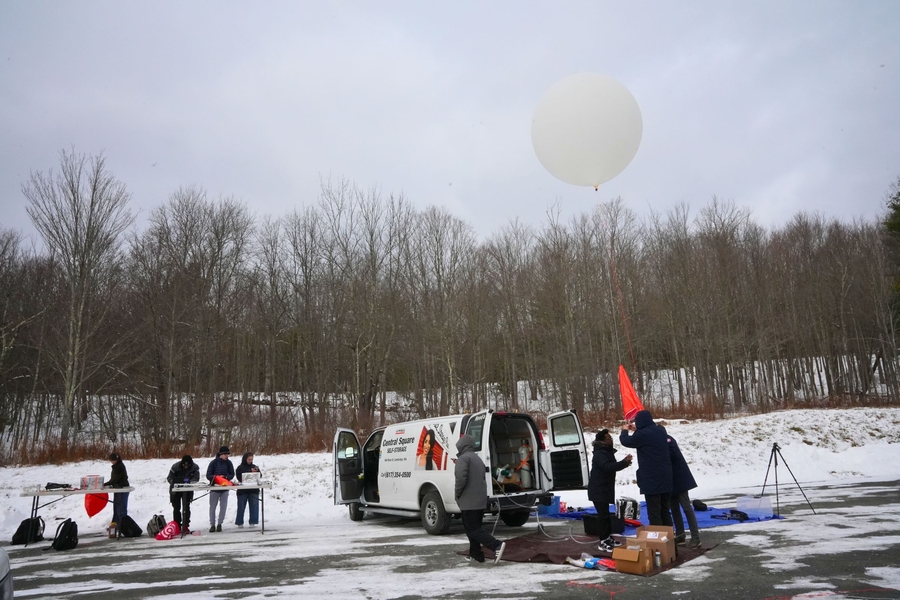
All the ingredients to leave the first layer of the atmosphere were laying on a picnic table. T-minus 30 minutes before launch from the New York Catskills, students in MIT's reborn 16.00 (Introduction to Aerospace Engineering) course tore open hand warmers to fight the December morning chill. One hot pack for cold hands. One for the electronics payload, which would need the warmth on the way up. This series of balloon launches rose to more than 20 kilometers above the surface.
Five student teams completed stratospheric balloon launches for a final project in the MIT Department of Aeronautics and Astronautics (AeroAstro) first-year exploratory course. This fall semester was the first iteration of the reimagined 16.00. The course was co-taught by MIT professors Jeffery Hoffman, a former NASA astronaut, and Oliver de Weck, Apollo Program Professor of Astronautics and Engineering Systems. The course was reintroduced to the curriculum in 2025 to give first-year students a design-build experience from the very start, says de Weck, who is also AeroAstro's associate department head.
"This course had been taught for more than 25 years. And then the pandemic came," he explains. "We felt that it was time to bring the course back, to revive it, give it new life."
De Weck taught a version of this hands-on project from 2012 to 2016 in Unified Engineering, with 20 balloon launches over that time. Hoffman taught a version that focused on blimps, indoor flights, and achieving neutral buoyancy and control. Those prior courses inspired the new program. The current 16.00 course is an early introduction to design-build flying, offered before the well-known Unified Engineering course for Course 16 sophomores.
"Students don't want to sit through long lectures, with lots of PowerPoints and notes and blackboards," says de Weck. He referenced feedback from students that is framing the department's upcoming strategic plan. "Those hands-on visceral experiences is what we want to provide them."
The AeroAstro program adds about 60 undergraduates per year. Future students can expect to see different versions of the 16.00 course, including those focused on fixed-wing aircraft, quadcopter drones, and rockets. Future balloon courses will be called 16.00B. A fixed-wing remote-controlled aircraft course will be 16.00A.
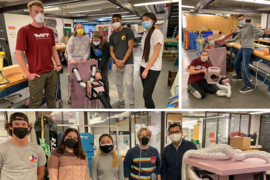
Over 13 weeks, the students attended lectures on subjects including atmospheric composition, radio waves, and flight planning and regulations. In labs, they practiced building Arduino-based pressure and temperature sensors, and testing communication systems.
On that cold launch day, Jackson Lunfelt kept his grip against the pull of an oversized helium balloon moments before his team's launch. His team worked for weeks configuring GPS and radio communications and testing balloon buoyancy. Among their trials and errors, they had to find the right weight for a 3D printed frame to attach the balloon and parachute. It was too heavy at first. They figured out how to reduce the weight of the plastic to keep the payload buoyant.
"Fortunately, a lot of preparation had helped us," he says.
Lunfelt, a first-year student, grew up just a few hours away from the Catskills in upstate New York. In high school, he was active in Future Farmers of America, welding, and robotics. On launch day, his team was worried their onboard GoPro would shut off from the cold high-altitude temperatures. They got the green light to add a battery bank. They would need to re-calculate the weight and helium needed at the final hour.
"It was one of those things that if you don't do this, you're not gonna launch,” says Lunfelt.
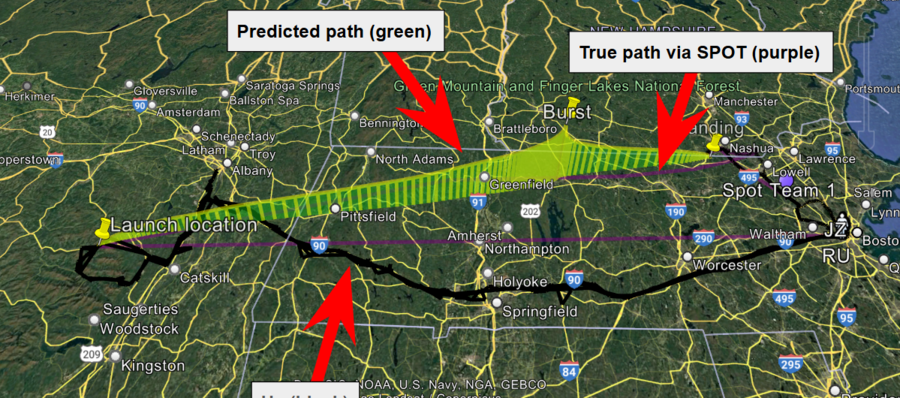
That first week of December brought frigid air, gusts, and wind patterns that meant the class would have to rethink its launch site. The team aimed to fly east, over Massachusetts, and land before reaching the ocean. The new weather pattern pushed the team even farther west across the New York border.
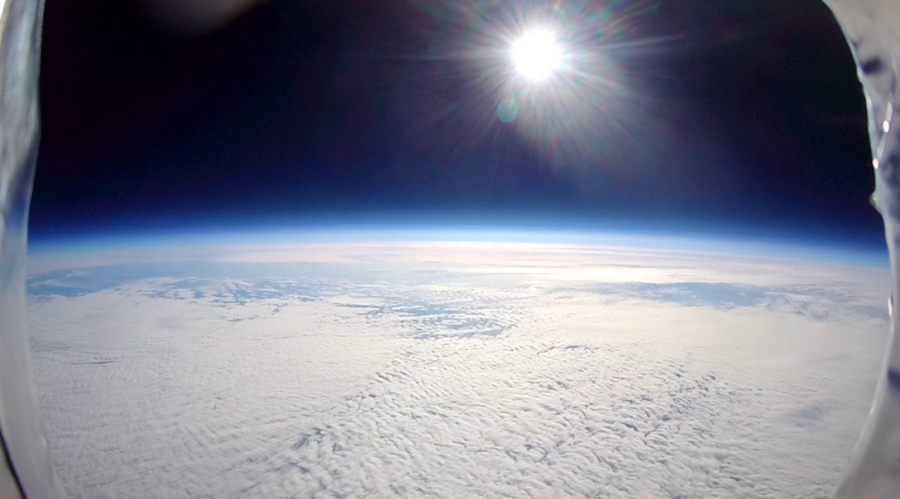
The balloon lifted the 3.5 pound payload from the Catskills while the mission control group monitored progress from Cambridge, Massachusetts. It rose hundreds of feet per minute. It passed the troposphere and flew across Western Massachusetts at 100 miles an hour, pushed by the strong upper-level winds of the jet stream. It climbed to an estimated 22 kilometers above the surface. At that height, an onboard GoPro camera recorded the curvature of the Earth.
"Every single moment of that video was amazing. It was truly a story in itself," says Lunfelt.
Then the latex balloon burst, as designed, and descended back down — aided by a parachute. The GoPros captured that spectacular moment, too. The winds carried them just north of the Massachusetts-New Hampshire border. They landed in a neighborhood around Nashua, New Hampshire. Locals saw the MIT identifiers written on the side of the payloads and helped the teams recover them. The landing made it onto the local news.
After a very early morning and late evening monitoring the launch returns, de Weck, alongside teaching assistant Jonathan Stoppani and Senior Technical Instructor Dave Robertson, agreed that the feeling of pride from the whole class was palpable. The payloads all came back in one piece, a test of successful design-builds and last-minute adjustments. The AeroAstro flying tradition is back for first-year students.