The electrons that power our society flow left and right through the circuitry in our electronics, back and forth along the transmission lines that make up our power grid, and up and down to light up every floor of every building. But the electrons in newly discovered “moiré crystals” move in much stranger ways. They can move left and right, back and forth, or up and down in our three-dimensional world, but these electrons also act as if they can teleport in and out of a mysterious fourth dimension of space that is perpendicular to our perceivable reality. Physicists have found that this strange, newly discovered quantum behavior has nothing to do with the electrons themselves and everything to do with the strange material environment in which they live.
The electrons in moiré crystals leap into a fourth dimension through a process called “quantum tunneling.” While a soccer ball sitting at the bottom of a hill will stay put until someone retrieves it, a quantum particle in a valley can jump out all on its own. Quantum tunneling may seem magical to us, but it is quite commonplace in the microscopic quantum world, on the length scales of atoms. Quantum tunneling is also important on larger length scales, particularly in large superconducting circuits that underlie an emerging landscape of quantum technology, as recognized by the 2025 Nobel Prize in Physics.
However, quantum tunneling in moiré crystals is different, in that once an electron tunnels, physicists have now measured that it acts as if it had tunneled into a completely different world and come back again, as if it had been transported through a fourth “synthetic” dimension.
In a paper published recently in the journal Nature, a team of MIT researchers realize a long-anticipated scalable technique for producing high-quality moiré materials as moiré crystals, overcoming a materials bottleneck for next-generation electronic applications. In addition, the electrons in these crystals act as if they can teleport through a fourth dimension of space, unlocking a realistic materials approach for realizing numerous theoretical predictions of higher-dimensional superconductivity and higher-dimensional topological properties in the laboratory.
The study’s co-lead authors are Kevin Nuckolls, a Pappalardo postdoc in physics at MIT, and Nisarga Paul PhD ’25, and the study’s corresponding author is Joe Checkelsky, professor of physics at MIT. In addition, the study’s MIT co-authors include Alan Chen, Filippo Gaggioli, Joshua Wakefield, and Liang Fu, along with collaborators at Harvard University, Toho University, and the National High Magnetic Field Laboratory.
Crystal perfection
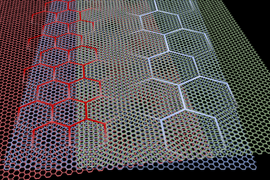
To make a moiré material, physicists first start with atomically thin two-dimensional (2D) materials, like the thinnest sheets of carbon known as graphene. Moiré materials can be created by combining individual sheets of the same 2D material and twisting them back and forth with respect to one another. Moiré materials can also be created by combining two different 2D materials that are very similar, but not quite the same, which ensures that they can never perfectly match one another even when carefully aligned. Both of these methods create intricate interference patterns where the individual layers of moiré materials are nearly aligned in some areas and visibly misaligned in others. Physicists call these patterns “moiré superlattices,” named after historical French fabrics that show similarly beautiful patterns generated by overlaying two different threading patterns.
For more than a decade, moiré materials have completely reshaped how physicists design and control quantum material properties, and the physics labs at MIT have been the hotbed of transformative discoveries in this ever-growing research field. Pablo Jarillo-Herrero, the Cecil and Ida Green Professor of Physics at MIT, and Raymond Ashoori, professor of physics at MIT, were early adopters of new techniques for fabricating moiré materials. Together in 2014, their labs discovered that electrons in moiré materials made from graphene and the 2D material boron nitride live in an intricate quantum fractal known as “Hofstadter’s butterfly.” In 2018, Jarillo-Herrero’s lab discovered that moiré materials made from twisting two sheets of graphene were fertile grounds for unconventional superconductivity that, by some metrics, is one of the strongest superconductors ever discovered. Long Ju, the Lawrence C. and Sarah W. Biedenharn Associate Professor of Physics, and his lab discovered in 2024 that moiré materials made from multilayer graphene and boron nitride cause electrons to split apart into fractional pieces, a quantum phenomenon previously thought to be exclusively confined to extremely high magnetic fields, but now realized without the need for a magnetic field.
Common across all of these experiments, and those performed around the world, were the tireless efforts of students and postdocs in carefully assembling moiré material devices by hand, one at a time. To make a moiré material device, 2D materials like graphene are peeled using Scotch tape from rock-like crystals, such as graphite. Then, sticky polymer films and microscopes enable researchers to pick up different 2D materials one by one with a precise sequence of twist angles. Finally, these stacks of 2D materials are etched into individual devices that allow researchers to investigate their properties in the lab.
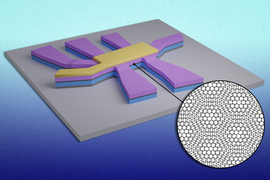
In their new study, Joe Checkelsky and his lab have discovered a new technique for generating moiré materials that skips over all of these laborious steps. Their new method takes an entirely different approach, and it’s one that can assemble moiré materials by the tens of thousands. Instead of assembling samples one by one and layer by layer, Checkelsky and his lab have found new chemical synthesis routes that enlist Mother Nature’s help to grow “moiré crystals” with high-quality moiré superlattices built into each of their layers. By analogy, if one were to think of previous generations of moiré materials like two stacked sheets of paper with different line spacings, Checkelsky has figured out how to generate entire libraries of encyclopedias whose odd-numbered pages and even-numbered pages have two different line spacings.
“It feels incredible for our team to have made this materials discovery, particularly at MIT,” says Nuckolls, co-lead author on the work. “Moiré materials have become a central focus of quantum materials research today in large part because of the work of our colleagues just down the hallway.”
In the end, it turns out that nature is by far the best at assembling moiré materials when given the right tools. The MIT team discovered that naturally grown moiré materials are nearly perfect and highly reproducible. This offers a long-anticipated proof-of-concept demonstration of a potentially scalable route to using moiré materials in next-generation electronics. Although there are many more obstacles to be overcome to transform these fundamental science results into usable technology, the team has demonstrated a crucial first step in the right direction.

4D in 4K
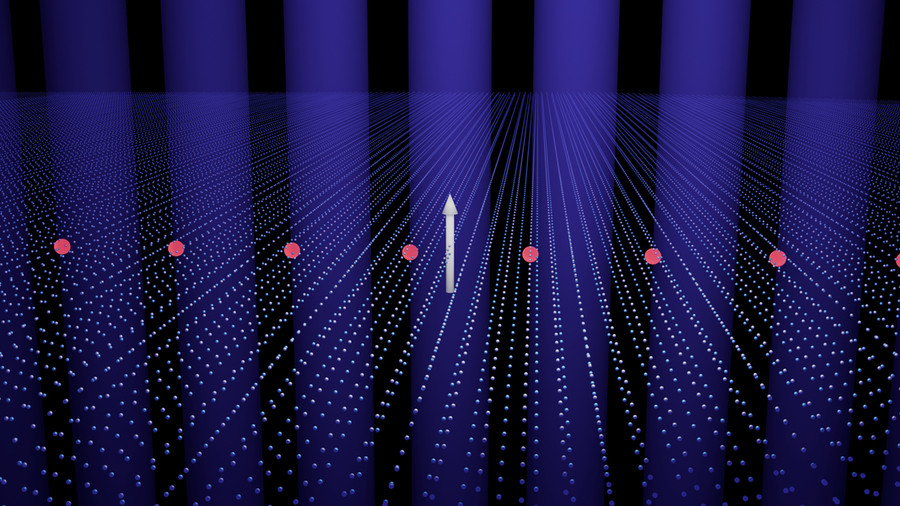
After discovering how to grow and manipulate moiré superlattices in moiré crystals, the team began to investigate their properties. Initially, the team found that the metallic properties of these materials were surprisingly complicated, but they soon shifted their perspective to think from a higher-dimensional point of view, an idea inspired by theoretical proposals made roughly half a century ago. To peer into this prospective four-dimensional quantum world, the team performed detailed studies of the electronic and magnetic properties of moiré crystals at very large magnetic fields. The electrons in common metals move in tight circular orbits when placed in a magnetic field. However, something very special happens when they move in moiré crystals with two different interfering lattices. This interference generates a moiré superlattice that is mathematically equivalent to an emergent four-dimensional “superspace” lattice. Guided by this new 4D superspace lattice, the team discovered that these electrons could now move through this fourth dimension when their motion aligns to the direction where the two competing lattices interfere the most.
“Metaphorically, our measurements uncover ‘shadows’ of emergent 4D landscape upon which the electrons live,” says Nuckolls. “By carefully analyzing these 3D silhouettes from different angles and perspectives, our measurement reconstructs the 4D landscape that guides electrons in moiré crystals.”
Although this extra synthetic dimension is fictitious and the electrons in moiré crystals are actually still stuck in our 3D reality, they simulate a four-dimensional quantum world so closely that the measured properties of moiré crystals appear as if the researchers had actually performed their experiments in 4D. It seems like moiré crystals aren’t particularly bothered by whether the fourth dimension is fictitious and synthetic or if it’s real. It’s all the same to them.
“Mathematically, the equations describing the electron dynamics in these crystals are four-dimensional,” says co-lead author Nisarga Paul. “The electrons propagate in the synthetic dimension just as they do in our world’s three physical dimensions. It’s hard to detect this motion, but one of the striking realizations was that a magnetic field can reveal fingerprints of this synthetic dimension in experimentally measurable electronic properties known as quantum oscillations.”
Going forward, the team will explore how a wide variety of material properties might benefit from extra synthetic dimensions, which now could be within reach of realization.
“It’s fascinating to consider what may be possible next,” Checkelsky says. “There are long-standing theoretical predictions for higher-dimensional conductors and superconductors, for example — materials of this type may offer a new platform to examine these experimentally in the laboratory.”
This research was supported, in part, by the Gordon and Betty Moore Foundation, the U.S. Department of Energy Office of Science, the U.S. Office of Naval Research, the U.S. Army Research Office, U.S. Air Force Office of Scientific Research, MIT Pappalardo Fellowships in Physics, the Swiss National Science Foundation, and the U.S. National Science Foundation.
This work was also carried out, in part, through the use of MIT.nano’s facilities.