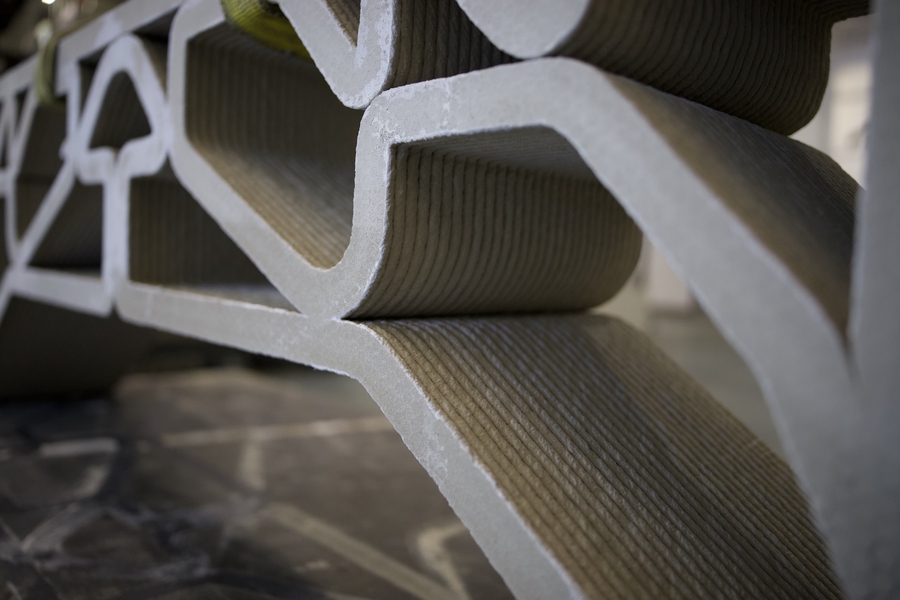
Concrete is the most widely used building material on Earth, and producing it is one of the largest single sources of carbon emissions. One promising way to reduce its environmental footprint is to 3D-print concrete, laying it down bead by bead like a giant icing-piping robot. This process eliminates the labor-intensive formwork of pouring it into molds, and places the material only where a structure needs it.
But many of the most efficient designs created by computers are impossible for today’s printers to build. Engineers use a technique called topology optimization to find the strongest structure that uses the least amount of material. But those mathematically ideal designs, with their intricate, spider-web shapes, don’t account for the physical limitations of large-scale concrete printers with their thick nozzles, limited turning, and need to print in one continuous motion.
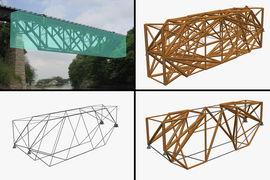
Now a team of MIT researchers has developed a way to close that gap. Their framework, described in a new article in Additive Manufacturing, bakes a printer’s real fabrication limits directly into the optimization, so the design that comes out is one a machine can build and print with little or no manual redesign. They demonstrated it by designing, printing, and load-testing a 2.3-meter concrete bridge and found that today’s printing hardware, not the concrete itself, limits how light a structure can be.
“We were finding a lot of cracks you can fall through when it comes to translating these super-optimal designs into manufacturable designs,” says co-first author Hajin Kim-Tackowiak PhD ’26, a postdoc in MIT’s Department of Civil and Environmental Engineering (CEE). “Those cracks were like chasms.”
Designing for what can be built
Those conversations surfaced three key limitations: how thick each printed bead must be, how sharply the nozzle can turn, and the need to print in a single continuous line. The researchers translated each constraint directly into the mathematical rules of their framework.
Existing 3D-printed structures are typically produced with older methods that optimize the shape first, and then require “a massive amount of post-processing,” taking days to run, Kim-Tackowiak explains. By contrast, the team’s framework generated fully printable designs in about two minutes on a laptop. When the team needed to slightly reduce the bridge’s size on the day of printing, they simply reran the optimization and had an updated design five to 10 minutes later.
“Reaching that speed at all is recent,” says co-first author Zane Schemmer, a PhD student in CEE. The math the method relies on, mixed-integer optimization, was long considered too hard to use. “You go back five, 10 years ago, the solver we used, even three years ago, could not solve these problems,” he says. “This field has been avoided, because everyone thinks that’s not an avenue we can go down. But with new algorithms and resources, it’s becoming a way we can start to frame problems.”
A bridge reveals the real limitation
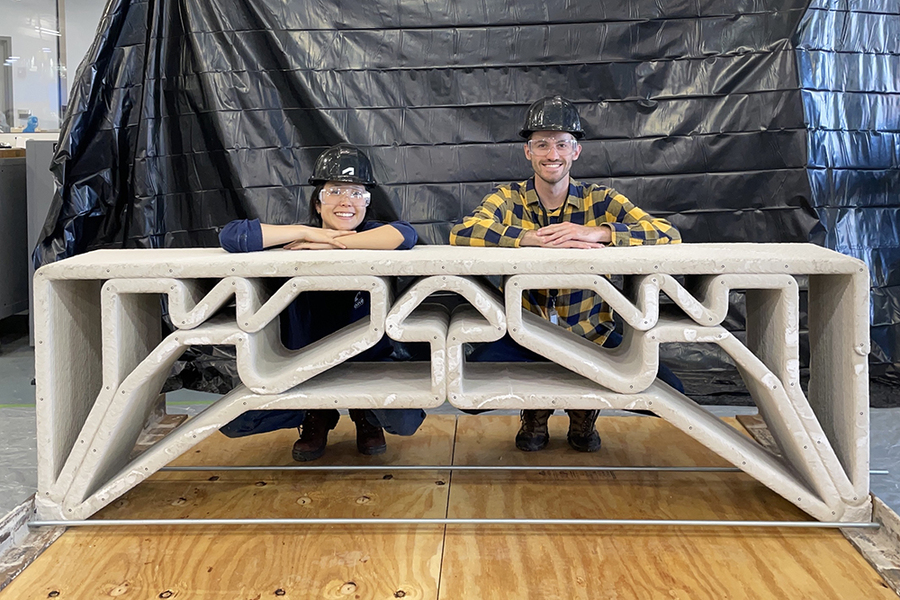
To validate the framework, the researchers went back to Autodesk’s facility to print a 2.3-meter-long concrete bridge.
“The bridge took about 30 minutes to make and was built from off-the-shelf mortar,” says senior author Josephine Carstensen, the Gilbert W. Winslow (1937) Career Development Professor in Civil Engineering.
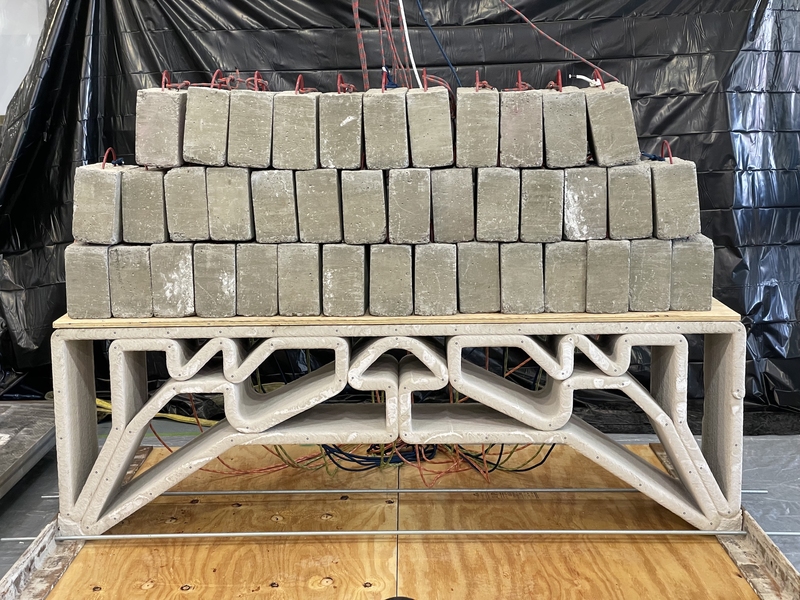
In testing, the roughly 900-pound structure held more than 2,000 pounds spread across it with virtually no measurable bending, closely matching the team’s simulations.
But the test also revealed the study’s biggest surprise. “What we found was our result was super over-engineered,” Kim-Tackowiak says. “From zero to 200,000 pounds, your design is entirely driven by these 'can I build it or not' constraints. And then, after 200,000 pounds, you can start to think about the physics.” In other words, the limits of current printing technology, not the strength of concrete, were dictating how efficient the structure could be.
A roadmap for better printers
Because the framework finds the mathematically best possible design, the researchers could measure exactly how much each hardware limitation costs in material.
“With mixed-integer optimization, we can find the global optimum, the best solution there is, as opposed to just a good solution,” Carstensen says. “Because we know we’re finding the best solution out there, we can also quantify: If we had a machine that could do other things, what would that mean for how much material we’re using?”
The single biggest lever was the width of the printed bead. The bridge used a 4 centimeter bead. The analysis showed a machine that was able to lay a 1cm bead could cut material use by as much as 76 percent while staying “well within safety margins,” Carstensen says. The result surprised her. “I thought the continuous path would be the problem, the one that had the highest effect,” she says. “But it wasn’t. It was the bead width.”
The result is a roadmap for printer-makers showing that modest hardware improvements could unlock large gains in efficiency and cut concrete’s carbon footprint.
Part of what made the bridge possible is that every piece is in compression. “With concrete, it’s really good when you push on it, really bad when you pull on it,” Schemmer says. “We're able to guarantee that every piece of concrete that you see is in compression, there’s no part that’s being pulled on.”
The savings come not only from using less material, but from skipping molds entirely, an advantage that grows for one-off shapes. Carstensen sees early promise in disaster relief, “You can quickly put up new infrastructure without needing to make formwork.”
The bridge’s compression-only nature showed itself dramatically after testing. It had held more than 2,000 pounds without budging, but when a worker lifted one corner a few inches to sweep beneath it, it broke. The failure wasn’t a design flaw so much as a demonstration of the principle behind it: Concrete is weak when pulled, and the lift put parts of the bridge in tension they were never meant to carry. “It’s optimal in one way, but it’s definitely not optimal in every way,” Kim-Tackowiak says.
That points to the team’s next step of reinforced concrete. “We know a pure concrete structure is not necessarily going to be the most optimal thing, so we’re moving it more into the world we live in today, which is reinforced concrete,” Kim-Tackowiak says, “though working out how to feed rebar into a printed concrete structure,” she adds, “is proving its own challenge.”
The work was funded by the National Science Foundation and supported by the MIT Center for Advanced Production Technologies. Joining Kim-Tackowiak, Schemmer, and Carstensen on the paper are co-authors Pittipat Wongsittikan, a PhD student in the MIT Building Technology Architecture program, and Jackson Jewett MEng ’18, PhD ’25, a former MIT postdoc.