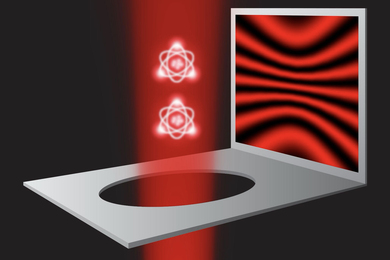
Famous double-slit experiment holds up when stripped to its quantum essentials
MIT physicists confirm that, like Superman, light has two identities that are impossible to see at once.
MIT physicists confirm that, like Superman, light has two identities that are impossible to see at once.

An oft-ignored effect can be used to probe an important property of semiconductors, a new study finds.

Longtime MIT solid-state physicist brought theoretical insights to an experiment-driven discipline — and later, to film.
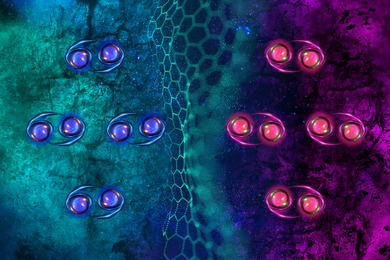
The “one-of-a-kind” phenomenon was observed in ordinary graphite.
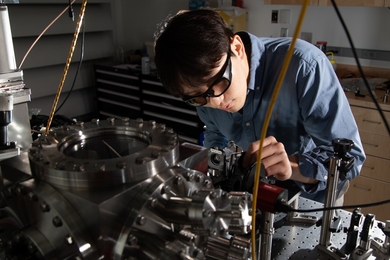
A technique developed at MIT enables a new class of experiments that could finally let physicists test whether gravity needs to be described by quantum theory.

The 17-year-old student from Spain uses MIT resources to deepen her understanding of math and physics.
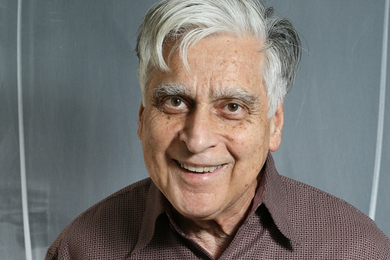
On the physics faculty for nearly 40 years and a member of the Center for Theoretical Physics, he focused on the interactions of hadrons and developed an R-matrix formulation of scattering theory.

Rhombohedral graphene reveals new exotic interacting electron states.
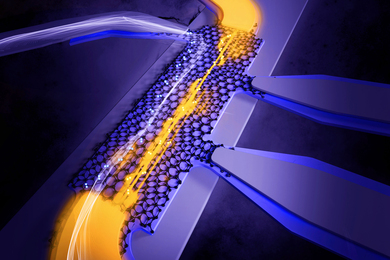
By determining how readily electron pairs flow through this material, scientists have taken a big step toward understanding its remarkable properties.
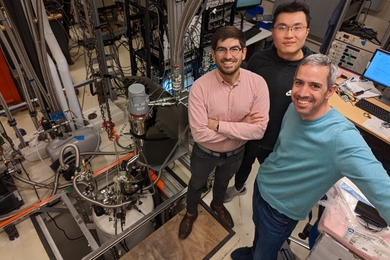
The work introduces a new platform for studying quantum materials.

With their recently-developed neural network architecture, MIT researchers can wring more information out of electronic structure calculations.
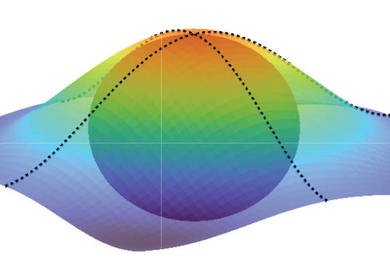
The work opens new avenues for understanding and manipulating electrons in materials.
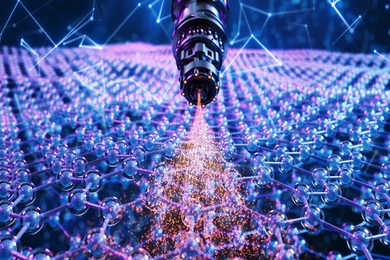
An MIT-led group shows how to achieve precise control over the properties of Weyl semimetals and other exotic substances.
Physics professor will use the award to develop a new kind of microscopy.

She says one question drives her work: “Which pillars of gravitational physics are just not true?”