
Sitting still or going hunting: Which works better?
If you’re a microbe floating in the ocean, there’s no single best strategy for getting food, MIT research shows.

Q&A: Michel DeGraff on teaching STEM in Kreyòl
A model for reaching science-hungry students around the world who speak local languages

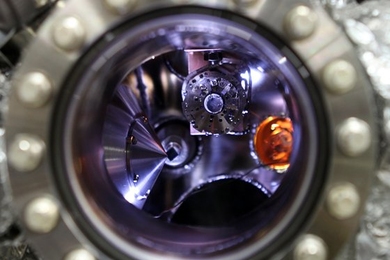
New technique reveals lithium in action
Fundamental reactions behind advanced battery technology, revealed in detail by advanced imaging method, could lead to improved materials.
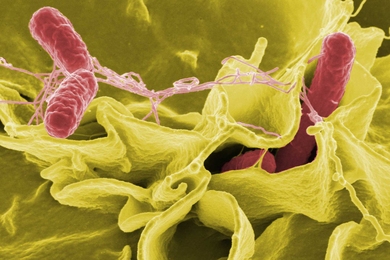
MIT team builds most complex synthetic biology circuit yet
New sensor can detect four different molecules, could be used to program cells to precisely monitor their environments.

DeGraff awarded $1 million NSF grant to continue linguistics research in Haiti
Funding will help develop classroom tools to teach science and math in Creole for the first time.

Measuring the universe’s ‘exit door’
For the first time, an international team has measured the radius of a black hole.

Weapon-wielding marine microbes may protect populations from foes
In some populations, natural antibiotics are produced by a few individuals whose closest relatives carry genes conferring resistance.

A one-way street for spinning atoms
Work correlating ultracold atoms’ spin with their direction of motion may help physicists model new circuit devices and unusual phases of matter.

Single-photon transmitter could enable new quantum devices
Long-sought goal for quantum devices — the ability to transmit single photons while blocking multiple photons — is finally achieved.

Research update: Chips with self-assembling rectangles
New technique allows production of complex microchip structures in one self-assembling step.

Dripping faucets inspire new way of creating structured particles
Researchers find new method for making spherical particles, from nanoscale to pinhead-sized — including complex beach-ball-like shapes.

Researchers explain how dye-based nanotubes can help harvest light’s energy
Tiny cylinders help reveal how natural-light-harvesting antennae collect light with exceptional efficiency.
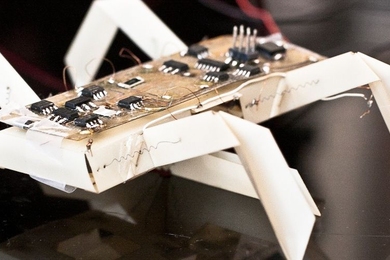
All in a day’s work: Design and print your own robot
MIT project, funded with $10 million NSF grant, could transform robotic design and production