
Hospital rankings hold up
Some basic metrics do effectively diagnose care quality, according to MIT economists.
Some basic metrics do effectively diagnose care quality, according to MIT economists.

A week of learning with MIT Bootcamps sparked ideas that Jal Panchal and Maria Hahn are taking forward to solve problems in health care.

Computer scientists’ new method could help doctors avoid ineffective or unnecessarily risky treatments.
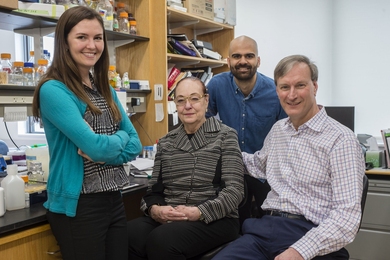
Gift establishes the Brit Jepson d’Arbeloff Center on Women's Health.

Models that map these relationships based on patient data require fine-tuning for certain conditions, study shows.

Study shows no effect from program intended to reduce repeated hospitalizations by targeting high-cost patients.

Economists analyze how patients and health care providers value Medicaid.

Startup co-founded by alumna Suelin Chen helps people share their end-of-life wishes with loved ones.
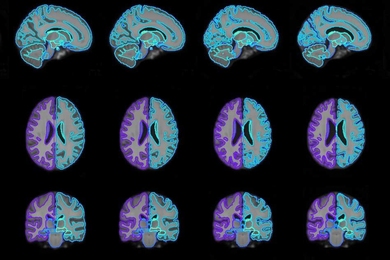
Model quickly generates brain scan templates that represent a given patient population.

Finding could help overturn the prevailing notion that men and women experience angina differently.

MIT economist Nikhil Agarwal analyzes the efficiency of markets that match suppliers and consumers but don’t use prices.

Senior Kristy Carpenter aims to leverage artificial intelligence and other computational tools to develop new, more affordable drugs.

Model could recreate video from motion-blurred images and “corner cameras,” may someday retrieve 3D data from 2D medical images.

Move over, Alexa and Siri. Talking Mabu robot provides one-to-one support while relaying information to doctors.

New technique stretches out MRI scans of placentas so they can be more accurately analyzed, and shows the potential of MRI for pregnancy monitoring.