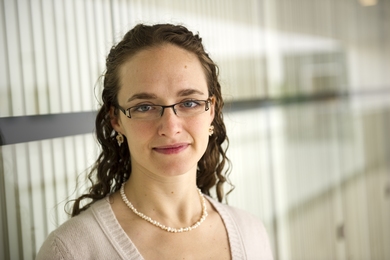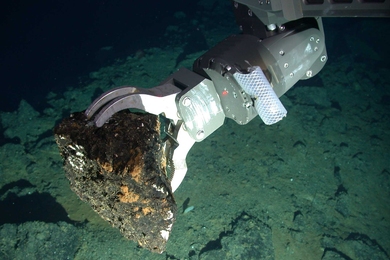
Two from MIT named Goldwater Scholars
Undergraduates receive top honor in collegiate math, science and engineering education.
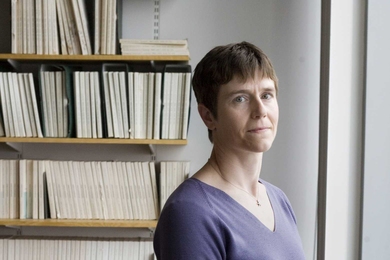
Predicting how proteins will partner
Amy Keating models critical interactions that underlie most cellular functions.
MIT graduate students head to Capitol Hill to deliver research-funding petition
More than 10,000 signed petition in support of science and engineering work.
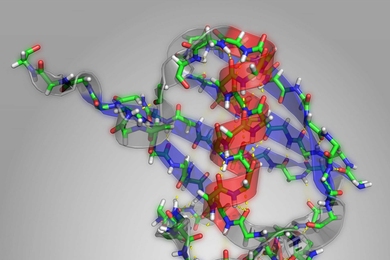
Faster way to probe proteins
Infrared spectroscopy allows scientists to analyze protein structure on an ultrafast timescale.
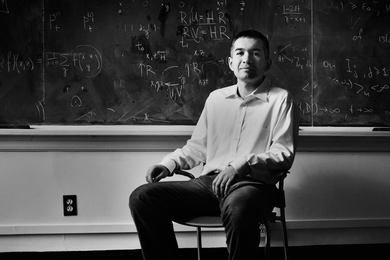
On the hunt for mathematical beauty
Alexei Borodin uses sophisticated tools to extract information from large groups.
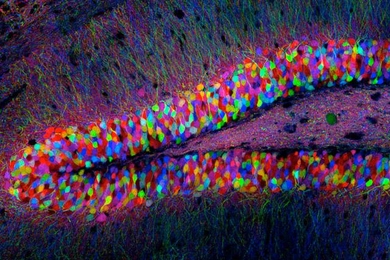
Researchers show that memories reside in specific brain cells
Simply activating a tiny number of neurons can conjure an entire memory.

The power of being heard
When it comes to intergroup conflict, the group with less power benefits more from sharing its perspective.
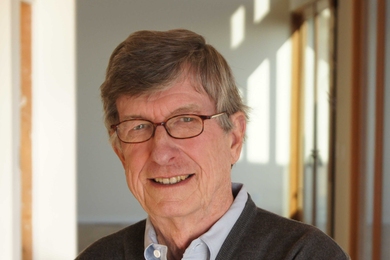
McGovern Institute to honor synapses expert Roger Nicoll
Named winner of the 2012 Edward M. Scolnick Prize in Neuroscience.
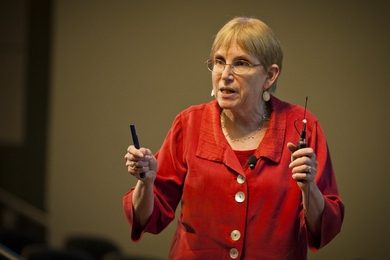
Freeing radicals from their negative connotations
Killian Award recipient JoAnne Stubbe says some free radicals can be good for you.