Neuroscientists identify key role of language gene
Mutation that arose long ago may be key to humans’ unique ability to produce and understand speech.
Mutation that arose long ago may be key to humans’ unique ability to produce and understand speech.


New math explains dynamics of fluid systems that mimic many peculiarities of quantum mechanics.

Discovery might ultimately lead to new, more energy-efficient transistors and microchips.

After tracking seismic shifts, researchers say a major quake may occur off the coast of Istanbul.
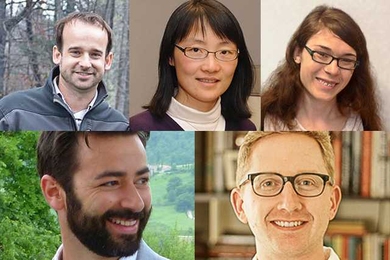
New faculty members will join the departments of Chemistry, Mathematics, and Earth, Atmospheric and Planetary Sciences.
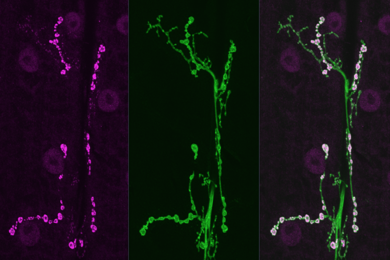
Patients with a rare neuromuscular disorder and those with nerve damage tied to autoimmune disorders may share the same faulty synapses.

Award given to outstanding scientists for their lifetime achievement in chemical research.
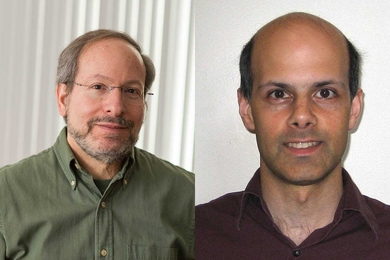
Rick Danheiser and Bjorn Poonen are lauded for their outstanding teaching.

MIT study also identifies the brain circuit that links feelings to memories.

Study finds big snowstorms will still occur in the Northern Hemisphere following global warming.
Chemist pioneered development of NMR spectroscopy, allowing study of molecular structures of solids.

According to MIT researchers, ocean circulation explains why the Arctic feels the effects of global warming much more than the Antarctic.
Graduate student Wade Hsu and colleagues confine light to a crystal surface and design a transparent display using nanoparticles.