
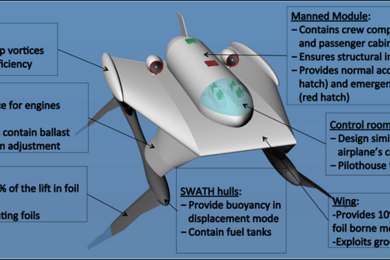
Three graduate students honored for hydrofoil research
Led by MIT researcher Stefano Brizzolara, the team earned second place in this year's Mandles Prize for Hydrofoil Excellence competition.

Inventor creates tiny technologies for medicine; awarded $500,000 Lemelson-MIT Prize
Sangeeta Bhatia combines clinical and engineering perspectives to tackle complex health challenges.

MIT ranked as nation’s No. 7 university by U.S. News
Undergraduate engineering program is again No. 1; undergraduate business program is No. 2.
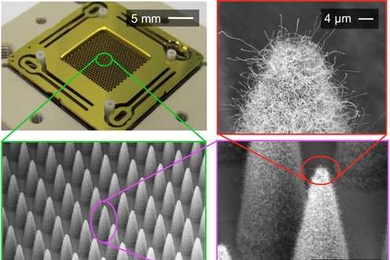
Mass spectrometry in your hand
Electrospray arrays can dramatically downsize systems and costs for onsite chemical analysis — and many other applications.
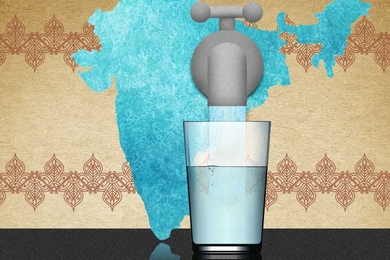
Sun-powered desalination for villages in India
Off-grid Indian communities with salty groundwater could get potable water through a proposed solar technique.
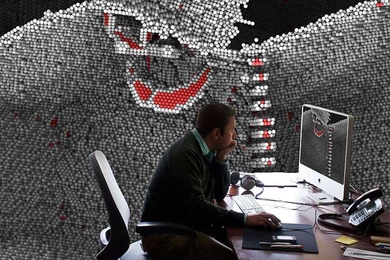

A lifelong relationship with the Institute
Newly tenured Evelyn Wang — whose parents met at MIT — studies heat transfer in materials.

The thrill of the ride
Brandon Holloway ’14 was inspired by a roller coaster and had his passions fueled by MITES.

The connector
Munther Dahleh’s expertise in mathematical modeling gives him profound insight into people, and MIT.
Re-inventing the grid
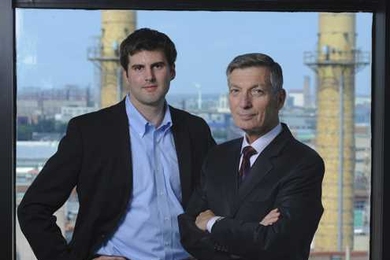
Cambridge-based MIT startup Ambri is building a novel liquid metal battery for grid-level storage to revolutionize energy in the 21st century.
Pioneering bioelectronic interfaces
Flexible polymer probes and magnetic nanoparticles promise breakthroughs for treating paralysis and brain disease.

Nature’s tiny engineers
Coral organisms use minuscule appendages to control their environment, stirring up water eddies to bring nutrients.