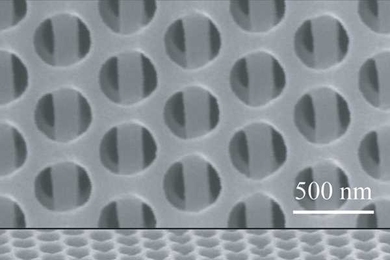
A new way to build nanostructures
Combining top-down and bottom-up approaches, new low-cost method could be a boon to research with a variety of applications.

Safer skies
A new algorithm could help prevent midair collisions, which involve 10 to 12 small aircraft every year.

A ‘sensing skin’ for concrete
New type of sensor could immediately detect tiny cracks in structures and relay their exact location.
MIT strengthens ties with France for energy research
France-MIT Forum on Energy unveils new joint laboratory, explores other potential collaborations.

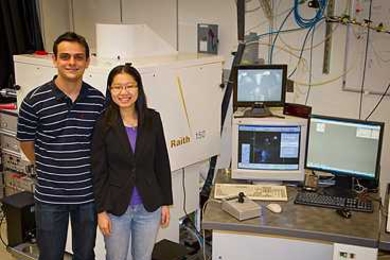
The future of chip manufacturing
MIT researchers show how to make e-beam lithography, commonly used to prototype computer chips, more practical as a mass-production technique.

The math of the Rubik’s cube
New research establishes the relationship between the number of squares in a Rubik’s-cube-type puzzle and the maximum number of moves required to solve it.

MIT faculty selected to attend NAE's Frontiers of Engineering
Two from CEE and one from EECS to participate in symposium for young engineering innovators.

Layer upon layer
Method holds promise for making two- or three-tier graphene films that could be used for new electronic devices.
Three from MIT named Fulbright scholars
One student, two recent graduates to travel to Japan, Ghana and the Dominican Republic.

CEE's Buyukozturk receives lifetime achievement award from Swiss Federal Labs
Award honors his contributions to materials science and engineering in the domain of civil engineering.

Scientists reveal HIV weakness
Vaccines that target newly identified viral protein sequences could be more effective than previous efforts.
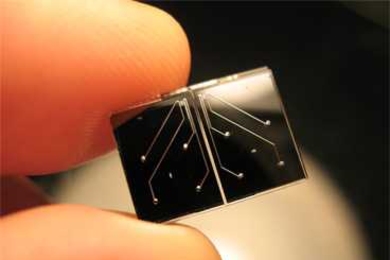
How dense is a cell?
Combining an ancient principle with new technology, MIT researchers have devised a way to answer that question.