In 2021, MIT set campus decarbonization goals as part of its Fast Forward climate action plan. Five years later, many of those goals have been met or are on track for completion, including efforts to make the Institute’s buildings more efficient, expand rooftop solar installations, and attain net-zero emissions.
“Decarbonizing our campus goes hand-in-hand with MIT playing a leadership role in promoting carbon reduction and climate resilience through its research, innovation, and efforts to inform public policy in this area,” says Glen Shor, executive vice president and treasurer. “Our teams are leveraging that same innovative spirit to meet our campus climate goals.”
Creating an energy-efficient campus
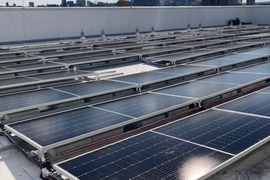
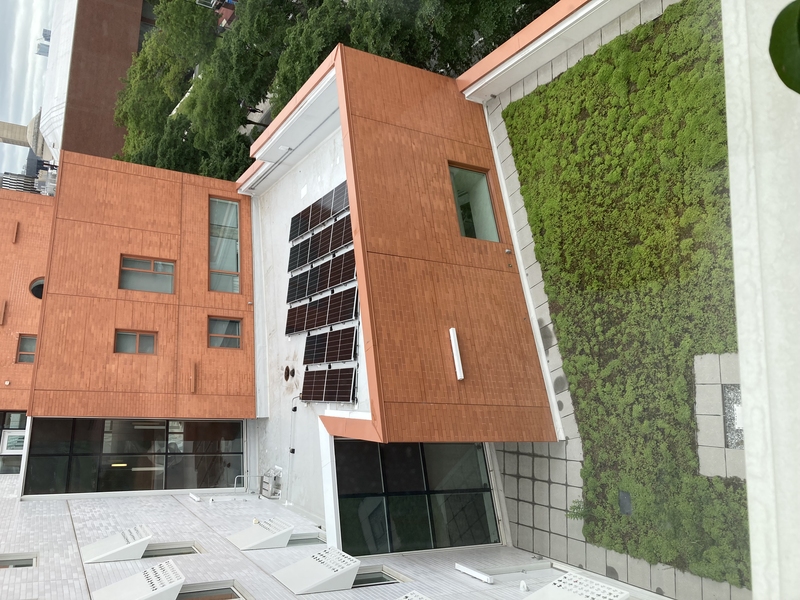
Over the past decade, the Institute has decreased energy use per square foot by more than 10 percent, even as the campus has grown and research activity has intensified. Rooftop solar power generation has increased by more than five times in the same period, with installations added to the Stratton Student Center (Building W20), the Dewey Library (Building E53), the New Vassar undergraduate residence hall (Building W46), Graduate Junction (Buildings W87 and W88), and the theater arts building (Building W97). Thirty-three MIT building projects have earned Leadership in Energy and Environmental Design (LEED) certification. And in May, the Tina and Hamid Moghadam Building (Building 55) became MIT’s first Living Future Zero Carbon Certified building.
“We’ve completed more than 300 energy-efficiency projects across campus, focusing on our most energy-intensive research buildings, and ultimately touching nearly every corner of MIT,” notes Joe Higgins, vice president for campus services and stewardship.
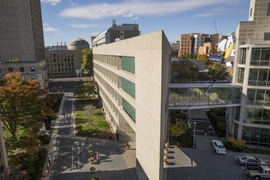
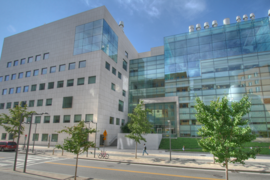
Case in point: Building 46, home to the Brain and Cognitive Sciences Complex, and the Metropolitan Storage Warehouse (Building W41), newly home to the School of Architecture and Planning.
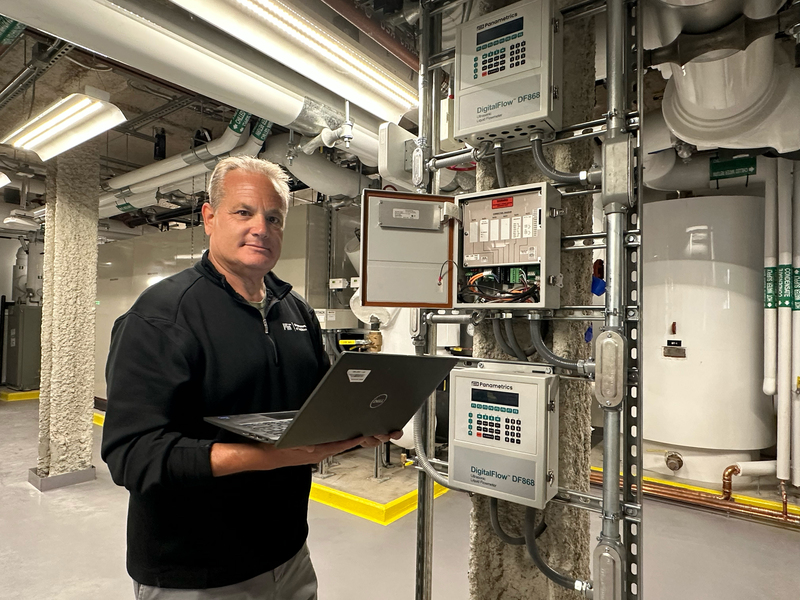
Building 46 was identified as one of MIT’s biggest energy users and the building with the greatest carbon-reduction potential. In 2024, the Institute completed a lab-by-lab renovation and improved Building 46’s mechanical systems infrastructure. The result: a 35 percent reduction in building energy use and carbon emissions — roughly a 2 percent reduction in overall campus emissions.
The newly renovated Met Warehouse, which opened in August, features an innovative heat-recovery system, capturing heat rejected from the campus cooling system and using electric heat pumps to generate heat for the building. Higgins says the system will help inform the design of larger, campus-level heat-recovery systems.
Since 2014, 101 of the 168 buildings on MIT’s Main Campus have undergone energy-efficiency upgrades. The Institute’s 2030 Capital Plan will continue to invest in projects to reduce energy consumption and make efficiency upgrades a core element of all comprehensive building renewal projects. Examples of new projects include further optimizing heat-recovery systems; deploying more sophisticated controls to better manage ventilation, heating, and cooling; and using artificial intelligence to set classroom and office temperatures based on weather forecasts, occupancy patterns, and the forecasted carbon intensity of the regional power grid.
The renovation of Building 39, which is set to be home to a next-generation quantum research laboratory, will incorporate energy-saving features and technologies, including advanced insulation and windows, a smart ventilation system, LED lighting with automatic controls, and heat-recovery systems to maximize efficiency. These integrated systems are projected to dramatically reduce energy use and carbon emissions — cutting them by approximately 70–80 percent relative to the existing building baseline.
Similarly, the McCormick Hall (Building W4) undergraduate residence hall renovation, which began this summer and is expected to be ready for students by the fall 2028 semester, will add high-performance windows, LED lighting, ventilation energy recovery, and low-flow plumbing fixtures. The project will replace gas cooktops with electric induction, use low-carbon flooring, improve stormwater management, and enhance the courtyard with native plantings, which require less water and maintenance while supporting local biodiversity.
On the path to net zero
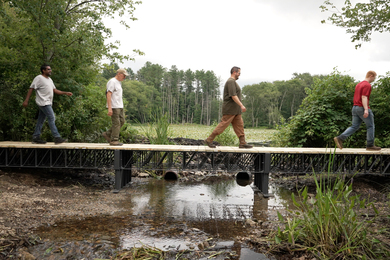
MIT’s decarbonization efforts extend well beyond its campus. In recent years, the Institute has entered collaborations to create several large-scale renewable energy projects in regions of the United States where electric grids are still heavily reliant on fossil fuels. Together, these projects avoid over 200,000 tons of carbon dioxide per year, about equal to MIT’s annual direct campus emissions.
“These projects, within a very short window of time, have had a significant impact on reducing emissions,” says Higgins. “They also put us on track to reach our net-zero target this year.”
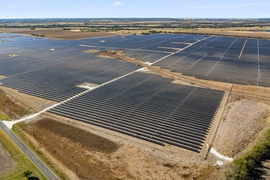
The first of these projects, the Summit Farms 60-megawatt solar farm in North Carolina, went online in 2016. Big Elm Solar in Texas, a 200 MW facility, followed in 2024, and Bowman Wind, a 208 MW wind farm in North Dakota, began operation in December 2025. Together, Big Elm and Bowman represent a landmark collaboration between MIT and 11 Massachusetts nonprofit and public sector organizations, including the City of Cambridge.
“It’s a new market model that allows smaller organizations and government agencies to achieve greater reductions in carbon emissions that wouldn’t be possible on their own,” says Julie Newman, MIT director of sustainability.
To capture the broader benefits of these projects, the Office of Sustainability worked with Institute researchers to develop a framework that assesses not only avoided emissions, but also economic and health outcomes. The team found that the projects generate economic benefits comparable to 7,000 one-year construction jobs and 189 maintenance jobs over 20 years. The projects’ annual health benefits are equivalent to 640 people quitting smoking for life, or nearly 200 premature deaths avoided each year for 20 years.
“Greener power sources are one of the building blocks we need to decarbonize our cities and campuses for the long run,” says Higgins. “That’s why we have made decarbonizing regional electricity grids a priority.”
The building blocks of campus decarbonization
To fully decarbonize MIT’s campus, the Institute will need to significantly change how it produces and distributes energy.
Currently, MIT’s Central Utilities Plant (CUP) burns natural gas to create electricity and steam-based heat, while also getting a small amount of electricity from the power grid. Electricity, heat, and air conditioning are distributed to campus buildings through a network of underground power lines and pipes.
To move away from burning natural gas, and to take advantage of electricity from a greening grid for making heat, MIT is exploring creating a large-scale electric heat pump plant adjacent to the CUP on Vassar Street. The plant, a key building block for a long-term campus decarbonization strategy, will produce hot water and distribute it to campus buildings through a hot water-based heating system.
“We’re starting the design process now, and in the coming year, we should know more about the scale and phasing of the heat pump plant we would construct, how it would interface with our existing district energy system, and the implementation timetable,” says Vasso Mathes, senior campus planner in the Office of Campus Planning, who is the campus decarbonization program manager. The heat pump plant will aim to recapture waste heat from existing cooling systems, supplying source energy to meet 30 to 40 percent of campus heating needs.
Another critical building block is transitioning MIT’s existing steam-based infrastructure to a hot-water system. That work — already underway — includes replacing steam distribution pipes to buildings with more efficient, easier-to-maintain hot-water pipes and converting buildings from steam to hot-water heat.
The third building block of a campus decarbonization strategy will be MIT’s ability to rely on the power grid for electricity instead of the CUP. “The electricity generated by the CUP is 15 to 20 percent lower in carbon emissions than the New England grid,” says Mathes. “We expect this to change over time as more and more renewables are added to the grid.” Even then, the CUP would be maintained as a backup system for use during peak heating and cooling days and grid stress events.
Finally, “the fourth building block is to go bigger, and look at shared infrastructure and coordinated planning with neighboring institutions and municipal partners,” says Higgins.
In that vein, earlier this year MIT became an anchor institution in the BosTEN Project, a year-long study to explore the feasibility of creating what could become the first city-scale thermal network in the United States. The network would help decrease the carbon footprints of major buildings across Boston and Cambridge, Massachusetts, by harnessing heat from the soil and rock under the Charles River and Boston Harbor, as well as waste heat from buildings and industrial facilities. It would also provide a renewable source of energy that can stabilize and even reduce the costs to heat and cool buildings.
“We’re thinking through how we can not only decarbonize our campus, but also how to use our work as a catalyst for broader strategies and technologies that others could readily employ,” Higgins says. “The unit of change needs to be at the city scale.”