How urban design leads to better wellness
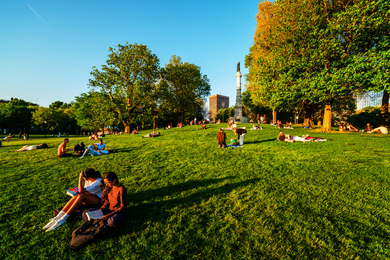
An extensive study of U.S. cities identifies walkable neighborhoods, urban greenery, and access to amenities as key contributors to residents’ health.
Using modern tools, they also determined that carbon tetrachloride, used as a dry-cleaning and degreasing agent as early as the 1930s, was at the root of early ozone loss.
A new study suggests flexibility in the timing of electricity consumption could lower consumer costs.
A new model links Earth’s mass extinctions to mismatches between rates of environmental change and biological adaptation.
MIT researchers developed an approach for generating more buildable structures, bridging the gap between optimized design and real-world construction.
Fourth-year PhD candidate Perrin Davidson studies the carbon cycle to understand how the planet responds to global disturbances.
The MIT professor’s groundbreaking work on atmospheric chemistry helped lay steps towards recovery of the ozone layer and demonstrated the lasting impacts of carbon emissions on Earth’s climate.
A new impact report shows how the MIT Environmental Solutions Journalism Fellowship has brought community-centered climate coverage to nearly 3 million readers and listeners.
Low-cost personal cooling and emissions-free air conditioning among ideas studied with MIT’s Climate Project seed funding.
MIT researchers present a promising new approach to efficient, flexible carbon capture and removal.
The low-temperature process could unlock cleaner lithium from America’s abundant hard rock while minimizing waste.
Living Climate Futures Symposium explores climate challenges and solutions at the community level.
The MBA student and entrepreneur is learning to lead a more resilient future with her renewable energy company.
Students developed and pitched local climate stories, then worked with visual journalists from the AP over an intensive four-day weekend.
When it comes to emissions, individual driving patterns matter as much as how “green” the regional electricity mix is, MIT researchers report.