Two physicists and a curious host walk into a studio…
On GBH’s new show The Curiosity Desk, MIT LIGO researchers revel in the beauties of fundamental discovery science and MIT astronomers talk planetary defense.
With warmer ocean temperatures, the composition of marine plankton could shift from protein-rich to carb-heavy, a new study suggests.
The Institute also ranks second in seven subject areas.
A new model shows how levels of the “atmosphere’s detergent” may rise and fall in response to climate change.
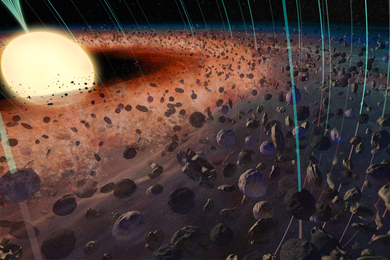
MIT astronomers are developing a new way to detect, monitor, and mitigate the threats posed by smaller asteroids to our critical space infrastructure.
A new study finds hitchhiking bacteria dissolve essential ballast in ubiquitous “snow” particles, which could counteract the ocean’s ability to sequester carbon.
New research by MIT geophysicists could assist efforts to remove carbon from the atmosphere and store it underground.
In research that could help elucidate humans’ role in global warming, scientists showed how three major natural events impacted global atmospheric temperatures.
These ricocheting ruptures may be more common than previously thought.
A new study suggests aerobic respiration began hundreds of millions of years earlier than previously thought.
New research may explain the striking differences between the two planets’ polar vortex patterns.
As these events become more common at midlatitudes, a phenomenon called an atmospheric inversion will determine how long they last.
Global Change Outlook report for 2025 shows how accelerated action can reduce climate risks and improve sustainability outcomes, while highlighting potential geopolitical hurdles.
Eleven new professors join the departments of Biology; Brain and Cognitive Sciences; Earth, Atmospheric and Planetary Sciences; Mathematics; and Physics.
Cutting air travel and purchasing renewable energy can lead to different effects on overall air quality, even while achieving the same CO2 reduction, new research shows.