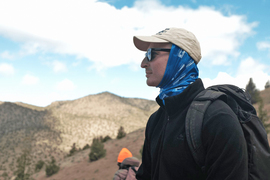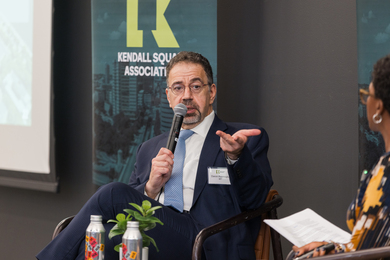
Sai Ravela, principal research scientist in MIT’s Department of Earth, Atmospheric and Planetary Sciences (EAPS), works with a team of researchers, local partners, and community collaborators to develop game-based computer models to help local communities find solutions to their unique geographical and environmental challenges.
Ravela came to MIT as a postdoc in 2002. Prior to that, he had been working on robotics and computer vision, but he was excited by the idea of studying the climate system and wanted to work in the field of sustainability. “Suddenly, overnight, I became a climate person,” Ravela says.
His project, funded by a 2025 Abdul Latif Jameel Water and Food Systems Lab (J-WAFS) India Grant, explores how agricultural decision-making occurs under climate stress. Using localized climate projections and a participatory approach, the project aims to help communities discover ways to improve their collective agricultural resilience.
EAPS postdoc Anamitra Saha is a key contributor on the grant, working with Ravela and local collaborators to combine downscaled climate modeling, participatory decision-making, and community-based adaptation planning. Other team members include Myisha Ahmad (Carthago Consultancy), Jayanta Basu (University of Calcutta), Anusree Ghosh (Bangladesh Open University), Showmitra Sarkar (Khulna University of Engineering and Technology), and Bivuti Sikder (Dhaka University).
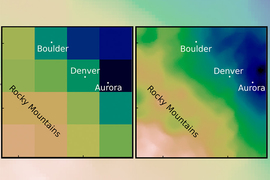
In a process known as downscaling, researchers take large-scale climate projections and turn them into highly detailed local projections. From these hazard maps, Ravela and Saha can estimate the risk of extreme weather phenomena such as flooding, drought, heat waves, and salinity-related stress.
“We kind of simulate what the outcome could be in that region,” Ravela explains. “Would it improve agricultural productivity? Would it reduce agricultural productivity? Would it change certain land use patterns? Would the land be less livable, more livable?”
The team combines surveys, scientific models, and local knowledge to build an impact graph that allows them to explore what might happen to a region during simulated weather events.
Although Ravela knew hazard maps could be useful, he was troubled by how rarely they reached the people whose lives were most affected by the risks they described. “We had clients like insurance companies,” he says. “But I never saw it reach people in a way that made a difference in their lives. And that really bothered me.”
To address this gap, he began thinking about how to help communities engage with hazard maps directly and take part in the decision-making process. In conversations that informed the game’s development, Ravela heard people whose livelihoods are vulnerable to climate events voice immediate concerns about what would happen if a future season failed: “If I don’t plant next season — if I can’t — what would I do?” Ravela wanted to help people think instead about possible choices, different paths, and their respective risks.
When he asked himself what circumstances allow someone to think about risk, the answer began to take shape. “Well, roll a die. Toss a coin,” he thought. “And where do you do these things? In a game.”
How it works
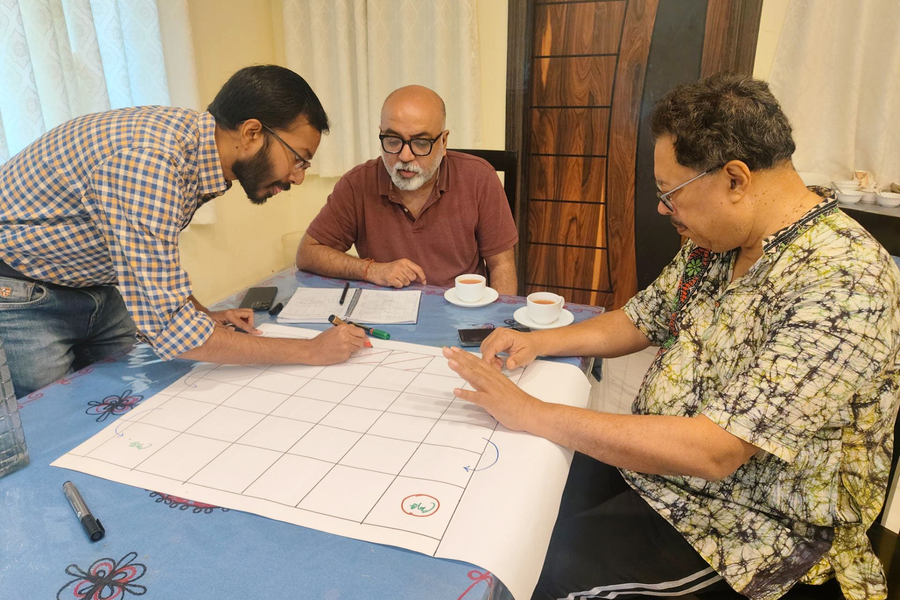
The process the collaborating team developed takes place in three stages. The first is a “snakes and ladders” game, played with physical game pieces and tokens. The second is a mixed game that still uses the gameboard, but a computer generates events and manages portfolios, allowing the system to calculate risk percentages. Once players become comfortable with the mixed game, the final stage, developed by Ravela, abandons the board game and moves fully into a more detailed computer simulation that can be played on a cellphone app.
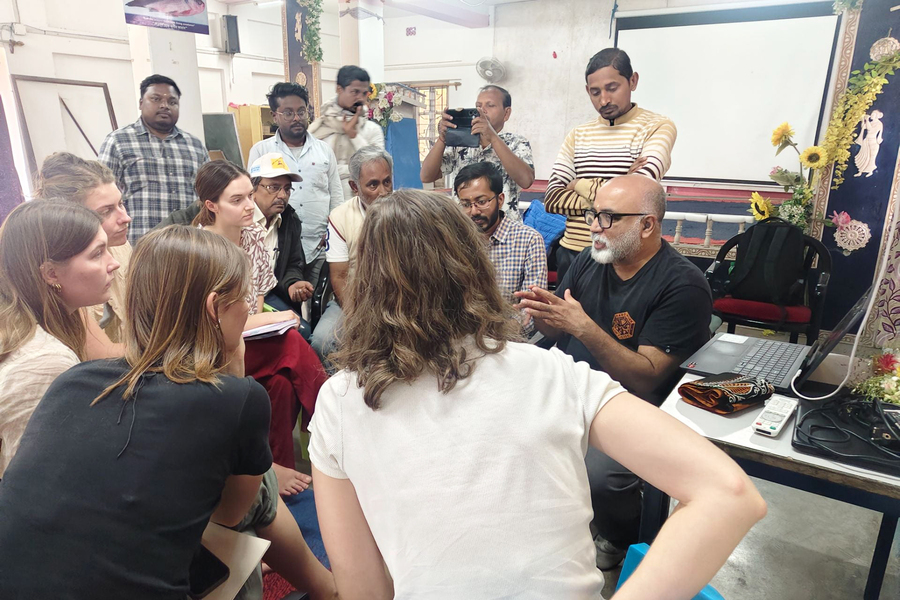
“We tried this in different stages in three places,” says Ravela. Two villages, Bally Island and Joygopalpur, are in India's Sundarbans region. The third is a village in Bangladesh just across the border. In each location, the work depends on collaboration with local residents, community organizers, and regional partners who help shape the game around local land, water, livelihood, and governance conditions. During development, informal community-engagement sessions helped the team refine and adapt the game. Those interactions also led to intriguing observations that are now helping the team formulate hypotheses for future formal research.
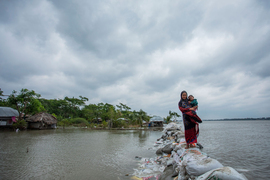
The three villages lie in a coastal region that faces numerous extreme weather events threatening water availability and agricultural productivity. As riverbeds rise from sediment accumulation over time and the land sinks from groundwater extraction, saltwater can more easily intrude into groundwater aquifers, while freshwater drainage, recharge, and flushing become increasingly difficult, intensifying waterlogging and drought.
“There’s a vicious cycle that’s happening with salinization of the soil,” Ravela explains.
One visible result is that Boro rice leaves now often begin browning far too early in the season, as salinity and water stress damage crops before they can mature. This cycle occurs in many coastal communities, suggesting to Ravela that the outcomes of the J-WAFS project could have applications around the world.
That broader potential comes from what the game is able to reveal. Instead of treating potential interventions — such as embankments, canals, recharge, crops, fisheries, and energy — as separate choices, the simulation lets players see how each intervention affects the coupled system of land, water, salinity, and livelihoods. When players test different options, simply raising embankments often proves less effective than expected, because it does not break the underlying cycle that causes the land to flood.
More-integrated strategies — combining mangrove restoration, canal excavation, groundwater recharge, diversified agriculture and fisheries, better water management, and merging solar panels into farming with agrivoltaics or aquavoltaics — can generate better long-term returns while also making the landscape more resilient.
The game also creates space to consider dramatic alternatives to embankment-based protection, including seasonal migration, livelihood shifts, and other difficult choices. These possibilities can be explored safely inside the game, even when they would be almost unimaginable to raise in real life. In this way, difficult questions that might otherwise be avoided can be explored, rather than ignored. And if the game reveals that a difficult choice could lead to better long-term outcomes, that result is not a prescription, but a basis for informed conversation between the community, government, and other decision-makers.
Competition or cooperation?
To make the game effective at developing strategies, Ravela’s team had to understand how many people should play at one time. Too few players may not generate enough diversity of ideas, while too many can slow the process significantly. During game development, groups of roughly ten to twelve people seemed especially workable: large enough to support active interaction, but small enough for practical discussion and learning.
“Once it crosses a dozen people,” Ravela explains, “it becomes very, very viable as a way to solve problems.”
The games have sparked interest and generated new strategies. People are often excited by the prospect of playing, and repeated play reveals different kinds of expertise. Some participants become especially engaged strategy-explorers; others contribute through discussion, critique, memory, and local knowledge. Together, the process helps identify players who are especially adept at thinking across different dimensions of the problem.
Ravela emphasizes the social aspect of the games as central to their efficacy. “Even though the game is on a phone,” he says, “players are within each other’s reach.” An emcee or facilitator encourages players to engage with one another by asking them to explain their gameplay, discuss their reasoning, and learn from one another’s choices.
While competition is not an explicit feature of the game, there can be zero-sum outcomes. One household’s decision about land, water, drainage, or energy may improve its own outcome while making conditions worse for others. Initially, players may aim for individual success. As they explore longer simulated time horizons, they often shift toward cooperative strategies.
After each game, the research team and local facilitators lead an educational session where people can learn from each other’s strategies. At first, players often attempt to copy the previous winner’s gameplay — usually, making as much money as possible and saving it in case of disaster. But some disasters are too large for one person to handle alone.
“That strategy is only optimal up to a certain horizon,” Ravela explains, “because when everyone replicates that strategy, the community doesn’t necessarily thrive.”
As players recognize this, they begin to evolve collective modes of behavior, such as creating a common insurance pool where everyone contributes money to a disaster relief fund. Through multiple iterations of the game, players often appeared to converge on cooperative solutions.
“The community in this way, playing a game against nature, simulated nature, comes upon solutions that work for them,” says Ravela. “We would love to formally explore this in the future,” Ravela adds.
Why the game works
Ravela’s team sees three advantages to game-based decision-making. First, the game brings new perspectives to the table that formal decision-making often misses. Many communities have strong hierarchies that can discourage women or less powerful community members from participating openly. The game allows people to offer insight without necessarily violating cultural norms. One recurring impression was that women — often responsible for managing family affairs — diversified their portfolios earlier, while men more often concentrated on a single livelihood strategy. The observation was striking enough that the team hopes to test and quantify it formally in future studies.
Second, in the game, all players begin on a level playing field, regardless of status, gender, or wealth. “It democratizes the process,” explains Ravela. In the simulation, a wealthy, influential community figure has no intrinsic advantage over a seamstress. The game reduces natural biases by giving everyone’s ideas a chance to be tested under the same conditions.
Third, because the game is a simulation, people can explore choices that might be too risky, too expensive, or too socially difficult to consider in real life. People may not want to discuss a large aquifer management system, a new land-use arrangement, or a difficult livelihood transition if the real-world implications feel too overwhelming. But inside the game, they can test possibilities without immediate consequence. “So, what, you lose? You start again,” says Ravela.
This is where the game becomes more than a communication tool. It turns uncertainty into a shared decision space. Players can test interventions, observe trade-offs, compare outcomes, and discover strategies before real disasters force those choices upon them. The game shifts the conversation from avoiding risk to reasoning about it, and from fatalistic thinking to collective agency.
Ravela and his collaborators also see the games as a way to address roadblocks in policy implementation by allowing community members to own the solutions they discover. Traditionally, donors may give money to a nongovernmental organization (NGO) that has proposed a project, and the NGO then distributes resources in the community. But it is not always obvious what has actually been implemented, or whether the community has had meaningful ownership of the decision. “In seeking solutions to problems, often the difficulty is developing the policy that provides metrics for the effectiveness of those solutions,” Ravela says. “Games enable people to quickly see the policy space, rather than approaching problems only reactively.”
When people test policies in the game, see how they work, and revise them through repeated play and refinement, they can begin to propose those policies themselves. The result is not simply a technical recommendation from outside experts, but a community-informed basis for action.
What's next?
The broader project, developed with collaborators and community partners in India and Bangladesh, has attracted interest in Bangladesh and Thailand, where similar game-based coastal agricultural resilience projects are being explored. Some customization is necessary to adjust the game to local conditions, but the simulations are highly adaptable. Between 75 and 80 percent of the game can remain the same across locations, while the rest can be tuned to local geography, livelihoods, hazards, and governance structures. Although each place brings its own challenges, “the way land and water and people interact is very similar,” says Ravela.
Building on insights from these game-development and informal community-engagement sessions, Ravela hopes the project can eventually expand to other locations, including members of the Association of Southeast Asian Nations and some places in Latin America. But he emphasizes the importance of establishing longitudinal outcomes before scaling. “The critical question is, does it answer real problems?” he says.
Future formal research will test these emerging hypotheses prospectively and longitudinally. The resulting evidence will help determine whether, where, and how to scale the approach.
If computationally assisted decision-making proves useful over time, the impact could spread far beyond the initial development locations. But the work is not only about finding an optimal solution. It is also about helping people work with one another. As Ravela puts it, “the process really is about helping the people work with each other as much as it is about finding an optimal solution, because part of finding the optimal solution is finding people to work with each other.”