Picower Institute for Learning and Memory
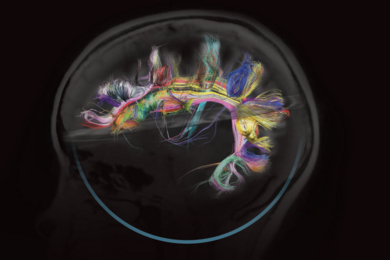
Picower and MIT scientists awarded BRAIN Initiative grants
Researchers will advance our understanding of the human mind and discover new ways to treat, prevent, and cure neurological disorders.
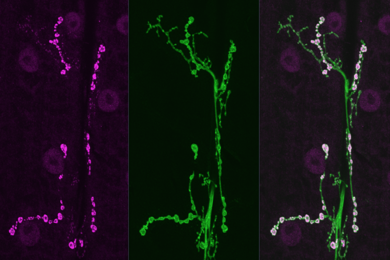
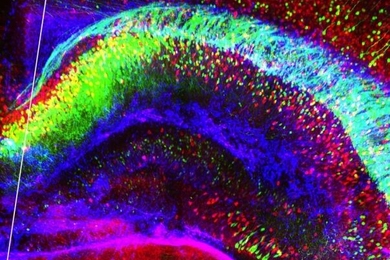
Picower study finds connection between rare muscle disease and autoimmune disorders
Patients with a rare neuromuscular disorder and those with nerve damage tied to autoimmune disorders may share the same faulty synapses.
Neuroscientists reverse memories’ emotional associations
MIT study also identifies the brain circuit that links feelings to memories.

Rett syndrome drug shows promise in clinical trial
MIT neuroscientists report more detail on how the disease arises.
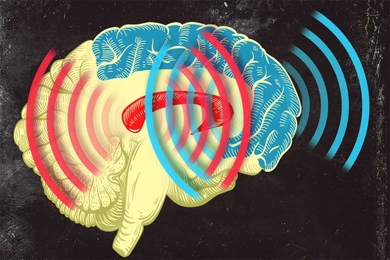
Synchronized brain waves enable rapid learning
MIT study finds neurons that hum together encode new information.

New conversation on sociotechnical systems
On April 30, Li-Huei Tsai will discuss a potential memory-based treatment for PTSD
Pinpointing the 'oops' moment in the brain
MIT research sheds light on how mice "think" when they retrieve correct memories and notice their mistakes.
New respect for primary visual cortex
A previously underappreciated brain region performs complex sequence learning.

Discovering hippocampal connections responsible for episodic memory
MIT neuroscientists map neural circuits involving the CA2 region of the hippocampus.
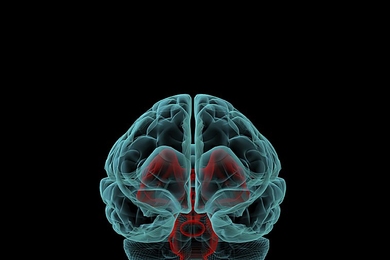
Schizophrenia linked to abnormal brain waves
Neuroscientists discover neurological hyperactivity that produces disordered thinking.
With NIH grant, Kay Tye will take on obesity
The MIT professor has earned a 2013 NIH Director’s New Innovator Award to further her obesity research.
How old memories fade away
Discovery of a gene essential for memory extinction could lead to new PTSD treatments.