Kavli Institute
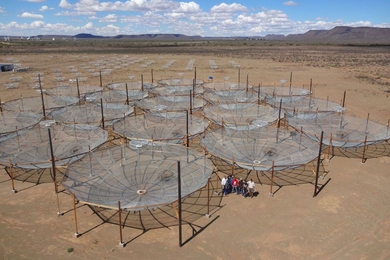
MIT's Jacqueline Hewitt and HERA team given $5.8M boost to detect cosmic dawn
Funding will complete array and measure signals from universe’s first stars.
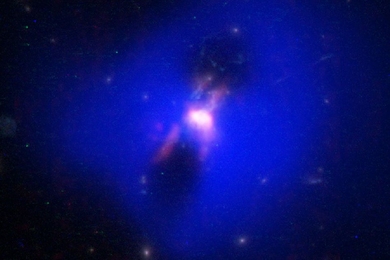
Self-made stars
Astronomers observe black hole producing cold, star-making fuel from hot plasma jets and bubbles.

Scientists make huge dataset of nearby stars available to public
Users can search database of 1,600 stars to find signs of new exoplanets.
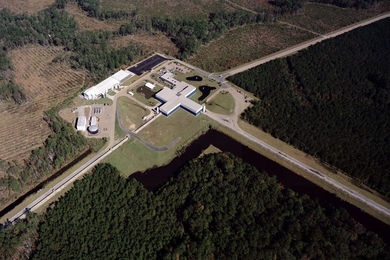
LIGO back online, ready for more discoveries
Upgrades make detectors more sensitive to gravitational waves.
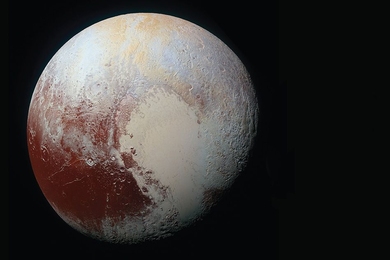
Pluto’s icy, slushy heart
Data from New Horizons mission suggest a water-ice ocean lies beneath Pluto’s heart-shaped basin.
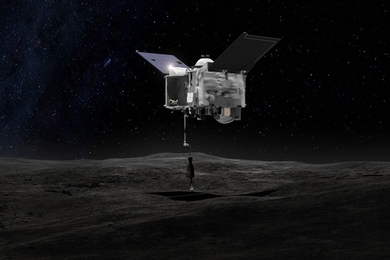
MIT’s REXIS is bound for asteroid Bennu
Instrument will help OSIRIS-REx mission identify locations for collecting an asteroid sample.
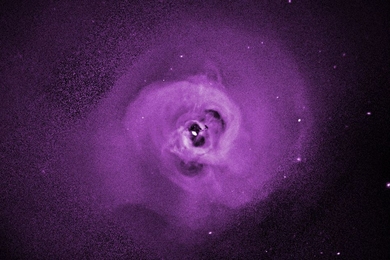
Dead X-ray satellite reveals “quiet” center of massive galaxy cluster
Scientists find gas at center of Perseus cluster travels much more slowly than expected.
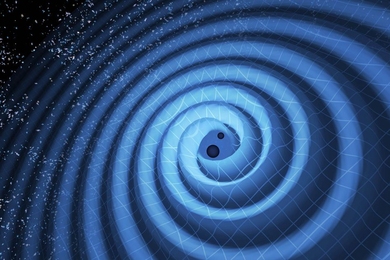
For second time, LIGO detects gravitational waves
Signal was produced by two black holes colliding 1.4 billion light years away.
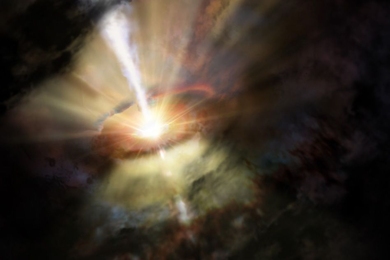
Scientists observe supermassive black hole feeding on cold gas
Findings suggest two dining styles for black holes.
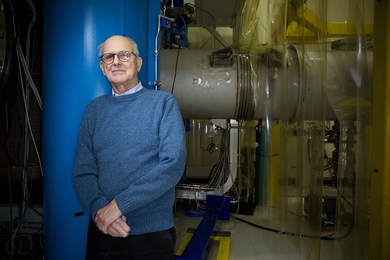
Rainer Weiss wins Kavli Prize in Astrophysics
LIGO inventor shares award for direct detection of gravitational waves.
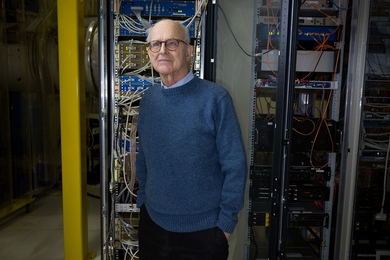
Rainer Weiss awarded the Shaw Prize in Astronomy
Physics professor emeritus shares prize with Caltech's Kip Thorne and Ronald Drever for designing the Laser Interferometer Gravitational-Wave Observatory.
Seven from MIT elected to American Academy of Arts and Sciences for 2016
Prestigious honor society announces 213 new members this year.
3 Questions: The origin of the cosmos’ heaviest elements
Unique galaxy offers clues to the extreme conditions that yield the heavies of the periodic table.