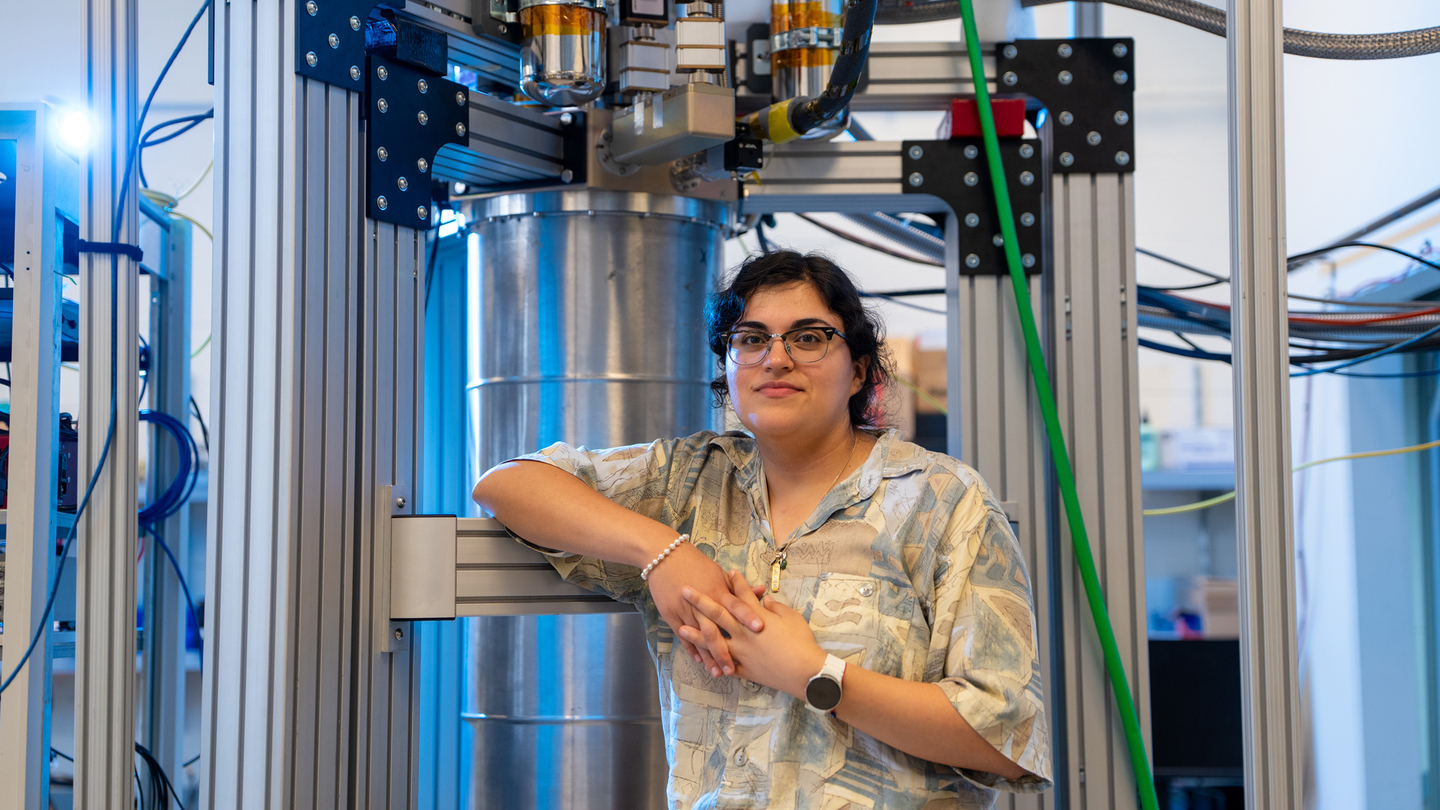
Many people who are successful in STEM fields were lucky to have someone who turned them on to a topic and encouraged their interest. For Faith Reyes, that person was her high school physics teacher, Ms. Bolster.
Whereas Reyes had earlier studied math and science without seeing how those subjects could be applied outside the classroom, her teacher helped her connect those dots and experience the excitement of investigating the physical world. With Ms. Bolster’s help, Reyes started a physics club where students would gather before school and conduct experiments.
“I just sort of fell in love with physics then,” Reyes says. “And luckily, as I began to study it more and more, I found I landed exactly where I wanted to be.”
Reyes has carried that enthusiasm for physics into not only her research but her role as a personal tutor and teaching assistant at MIT, where she works to foster the same love of the subject in first- and second-year undergraduate students.
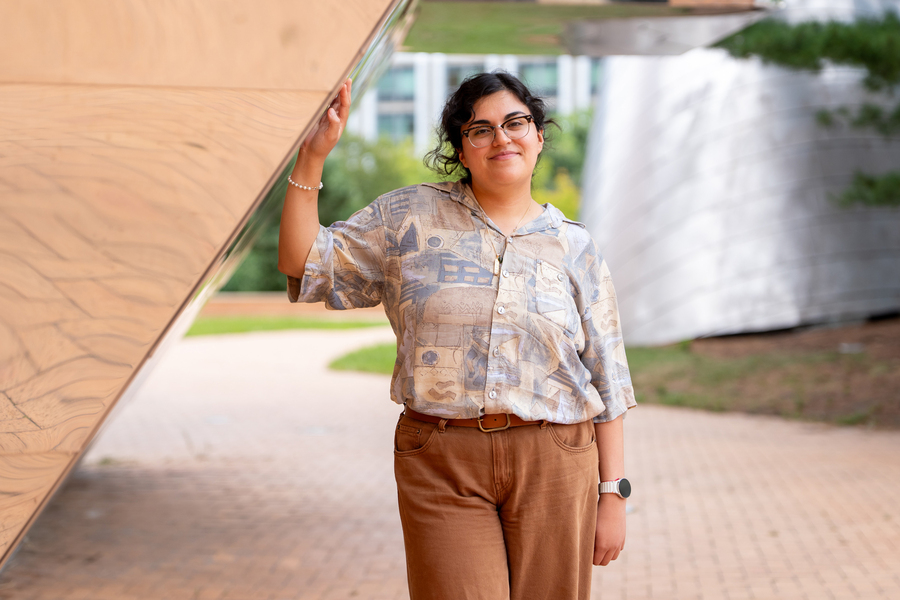
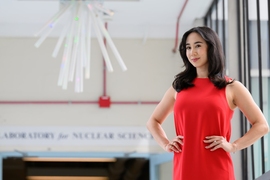
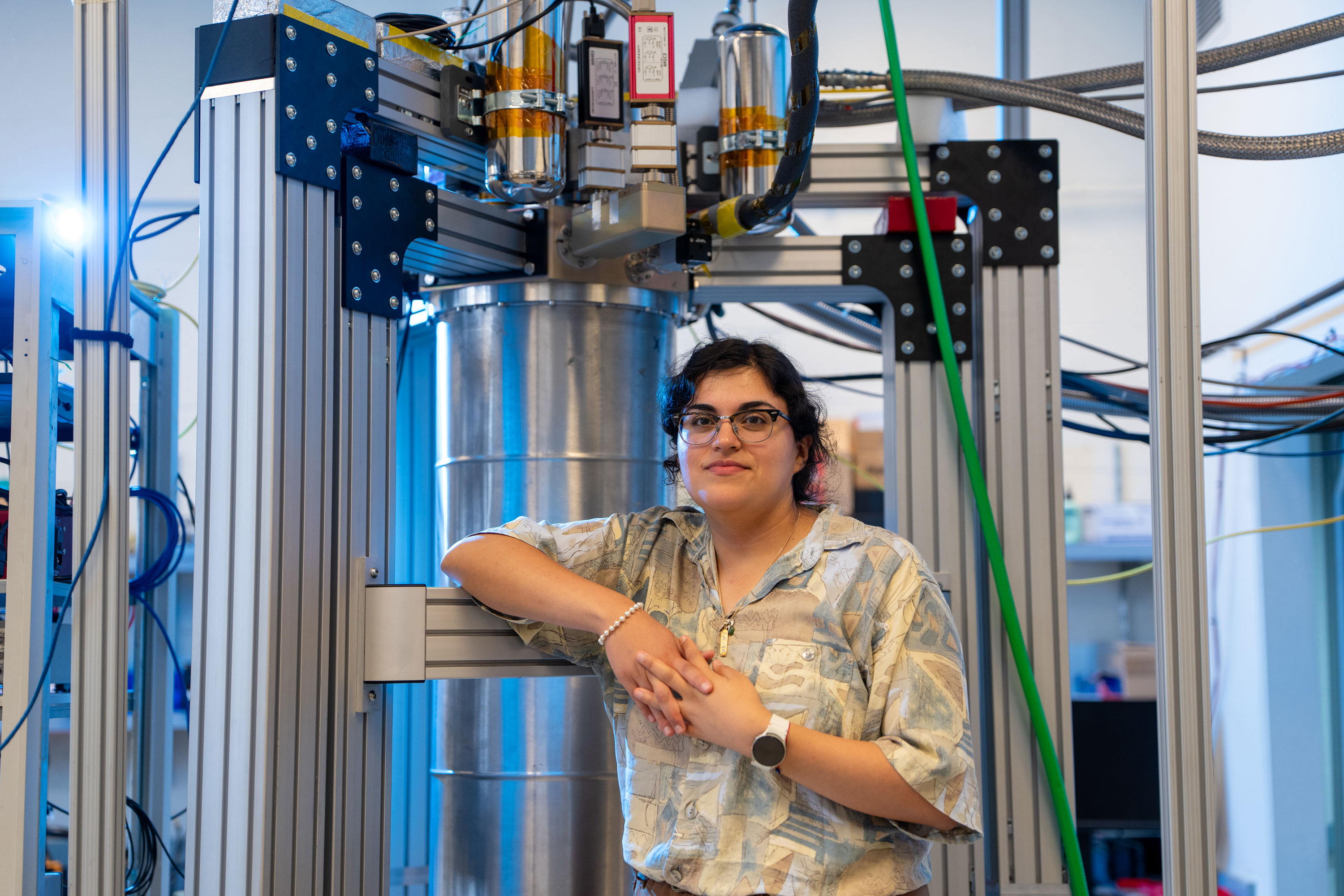
As an experimental particle physicist and sixth-year PhD student in the Formaggio Group in the Laboratory for Nuclear Science, Reyes studies neutrinos, elementary particles that have vanishingly little mass and rarely interact with other matter. Neutrinos are produced during radioactive decay, including the processes taking place inside nuclear reactors. Because they interact so infrequently, detecting them can be difficult. (We can’t feel them, but neutrinos from the sun are streaming through our bodies every minute.) Their unusual behavior makes them valuable to physicists seeking to understand what lies beyond the Standard Model, the framework that describes many of the fundamental particles and forces in nature.
“The Standard Model is extremely accurate and describes most of everything that we see,” Reyes says. “But it’s not complete.”
Reyes is a member of the Ricochet neutrino experiment, an international collaboration studying neutrinos produced by a nuclear reactor at the Institut Laue-Langevin in Grenoble, France. The experiment seeks to observe coherent elastic neutrino-nucleus scattering, a low-energy interaction in which a neutrino scatters off an atomic nucleus.
Through Ricochet, scientists aim to investigate some properties of these elusive particles, and contribute to, as Reyes puts it, “just fundamentally understanding the world in which we live.”
When looking back at her time in graduate school, Reyes’ path has not always followed the plan she initially envisioned.
When she joined Ricochet, she expected to work on a particular project located at MIT. But a few years into her PhD, it was clear that the project would not be ready within her timeline. Reyes instead shifted her focus to work taking place in France, where she began learning the technical details of the experiment’s detectors.
Her first visit lasted three months. At the time, Ricochet had two detectors, and Reyes spent much of her time performing the routine work required to understand how they operated.
As the experiment expanded to nine detectors and eventually 18, the amount of work required to manage the system grew substantially. Reyes and a colleague recognized that many of the repetitive tasks could be automated.
Together, they developed a software framework that could perform much of the low-level analysis and detector monitoring that Reyes had initially carried out manually.
The project became an important part of her development as a physicist. By working closely with the detectors and helping build tools to manage them, Reyes gained a detailed understanding of the experiment’s operations.
“It’s sort of like you’re building your own stuff to replace yourself,” she says. “Which is nice in a way because you can save yourself a lot of time.”
The opportunity was both validating and humbling. As a graduate student, she had moved from learning the basics of the experiment to helping guide the work of other scientists.
“It felt like my collaborators trusted me, and I had something of value to give to the collaboration,” Reyes says.
The people she has met through MIT and the Ricochet collaboration have been among the most rewarding parts of her graduate experience. Students, mentors, and collaborators have helped her think critically and become a better physicist, she says.
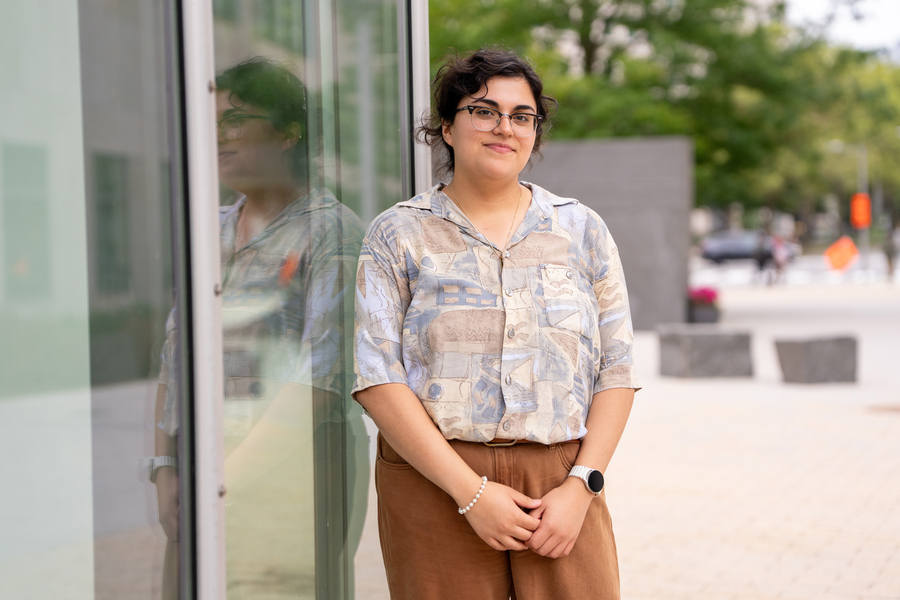
Her increasing leadership responsibilities have also changed how she approaches research.
Earlier in her academic career, Reyes says, she was more comfortable being told what to do than proposing her own scientific ideas. Over time, leading projects and coordinating groups pushed her to become more confident in her judgment.
“I think I was sometimes not really standing up for myself,” she says. “But now I feel more confident in my position and my prowess as a physicist.”
That confidence has become one of the most important lessons of her PhD.
After completing her doctorate, Reyes hopes to continue conducting research. She is considering a postdoctoral position, which would allow her to continue working in physics at another institution.
Her time in France has also influenced her vision of the future. Reyes spent nine months there through the Chateaubriand Fellowship, following two earlier three-month visits. While the latest trip was primarily focused on research, working in the same office as her collaborators made it easier to coordinate across time zones and strengthened her connection to the experiment. She also grew fond of the country’s culture and work-life balance and would even consider living there.
“I fell in love with France and the people,” she says. “And also, the work culture.”
Outside the lab, Reyes enjoys playing video games and crocheting, a hobby she picked up during her time in France. She often crochets while watching movies or television, appreciating the opportunity to work with her hands while thinking about other things.
For a physicist whose work involves investigating some of the universe’s smallest and most elusive particles, the hobby offers a different kind of satisfaction: creating something tangible.
As Reyes moves toward the next stage of her career, she hopes to continue pursuing the questions that first drew her to physics. Her research may help reveal what lies beyond the Standard Model, but her experience at MIT has also shown her how much science depends on collaboration, adaptability, and the confidence to lead.
“I’ve learned a lot of lessons,” Reyes says. “Especially about wrangling people.”