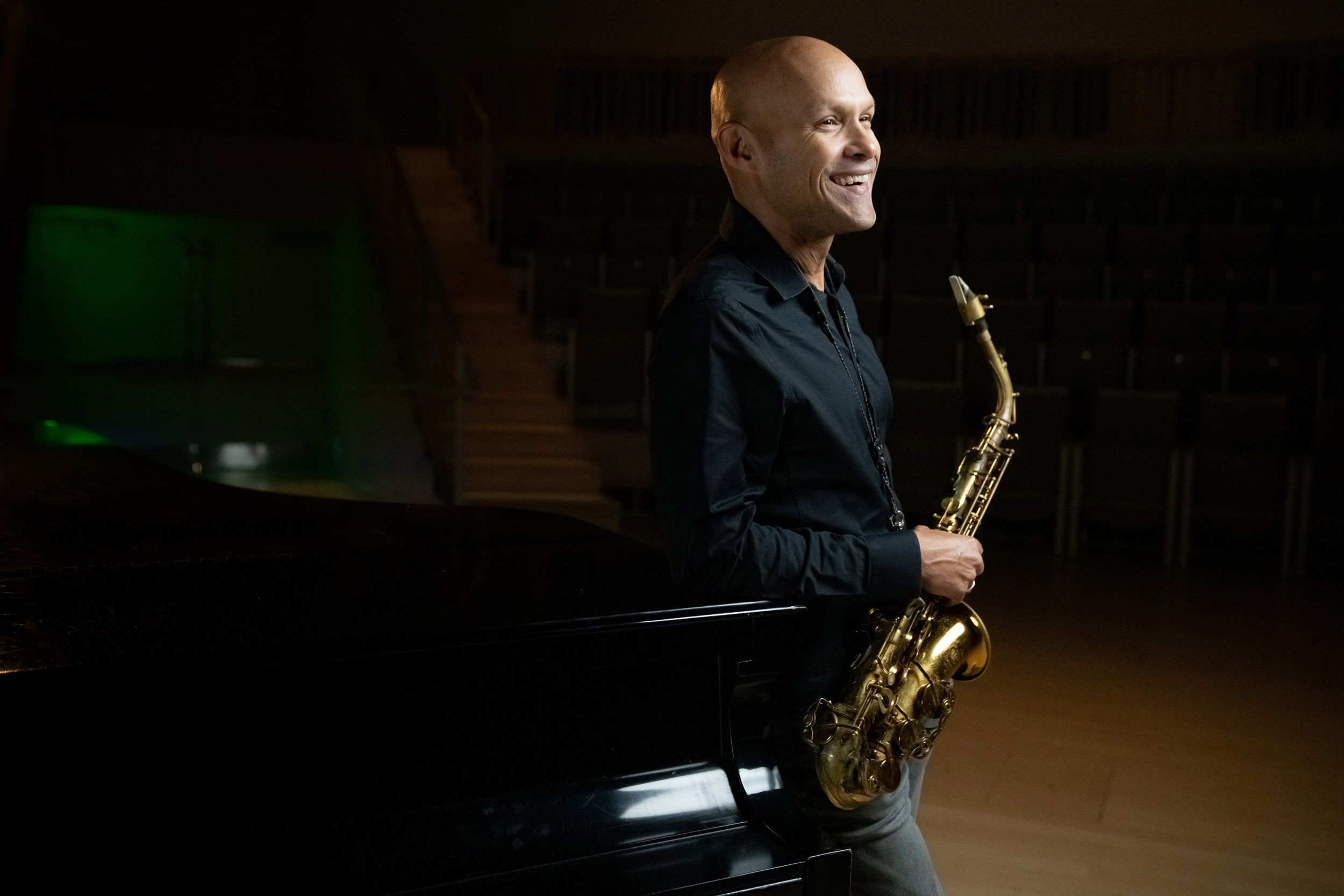
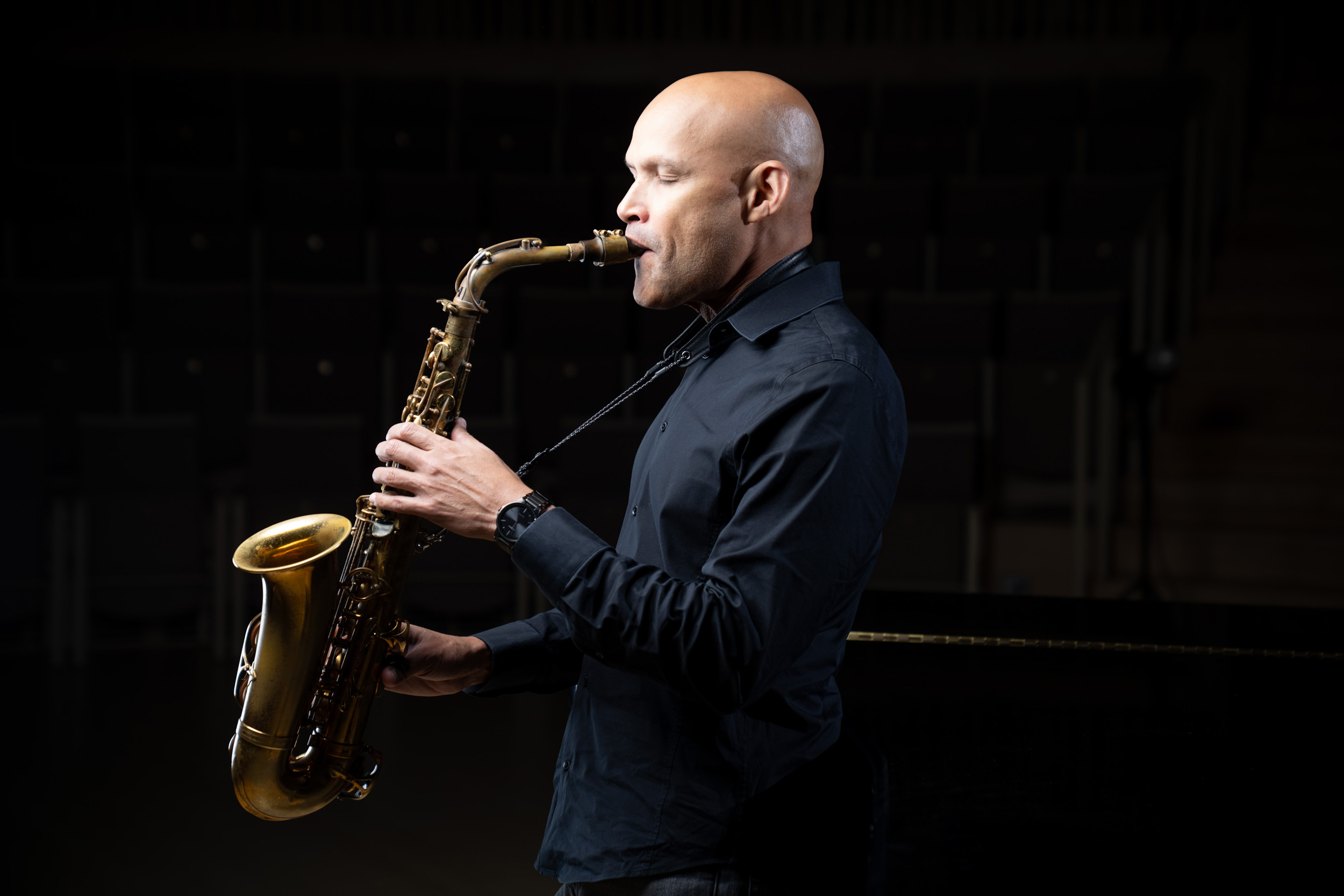
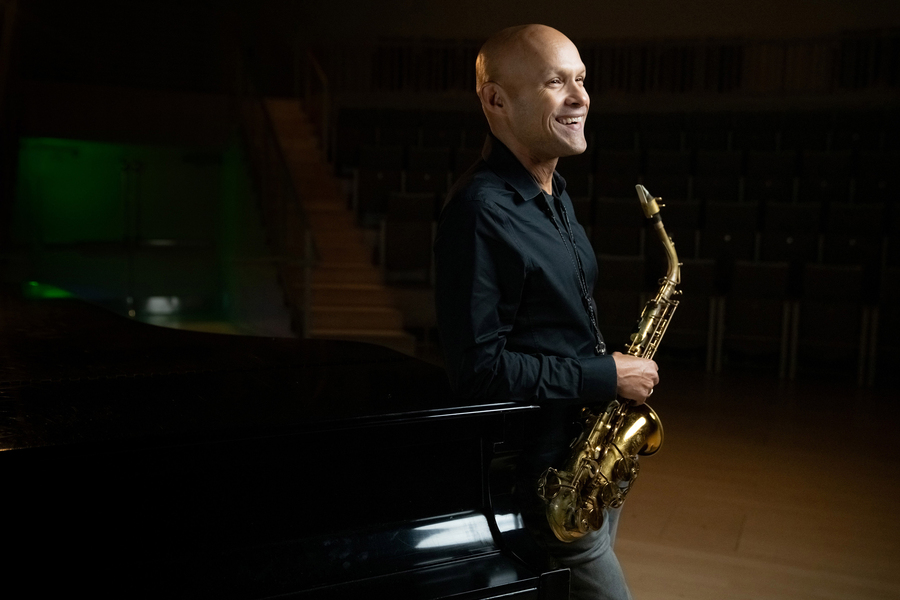
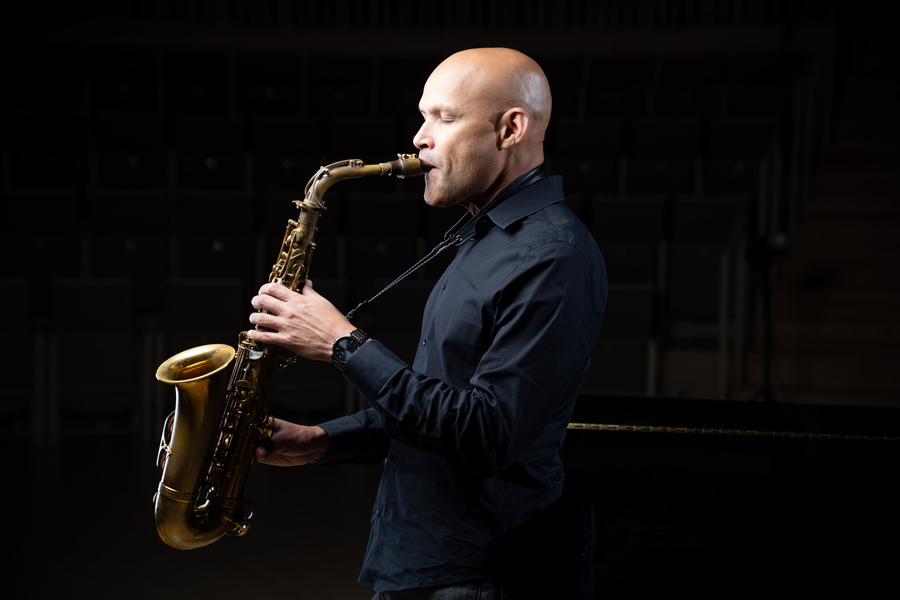
It is not hard to find glowing reviews of saxophonist Miguel Zenón, a creative jazz artist whose compositions incorporate musical elements from his native Puerto Rico.
For instance, The Jazz Times called “Jibaro,” Zenón’s breakthrough 2005 album, “profound yet joyful.” The New York Times called the same music “strong and light,” adding that we have “rarely seen a jazz composer step forward with a project so impressively organized, intellectually powerful and well played from the start.”
In 2009, when Zenón won a prestigious MacArthur Fellowship, the MacArthur Foundation called Zenón’s work “elegant and innovative,” with “a high degree of daring and sophistication.” In 2012, The New York Times reviewed another Zenón work, “Puerto Rico Nació en Mi: Tales From the Diaspora,” by calling the music “deeply hybridized and original, complex but clear.”
As you may have noticed, these notices all contain multiple descriptive terms. That’s because Zenón’s work is many things at once: jazz, combined with other musical genres; technically rigorous, and supple; novel, yet steeped in tradition. Indeed, Zenón has always seen jazz as being multifaceted.
“What I discovered, when I first encountered jazz, was this idea that you were using improvisation to portray your personality directly to your listeners,” Zenón explains. “And it was connected to a very interesting and intricate improvisational language. That provided something I hadn’t encountered in music before, this idea that you could have something personal and heartfelt walking hand in hand with something that was intellectual and brainy. That balance spoke to me.”
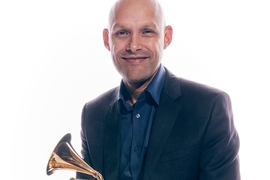
It is still speaking. In 2024, Zenón won the Grammy Award for Best Latin Jazz Album for “El Arte Del Bolero Vol. 2,” a collaboration with Venezuelan pianist Luis Perdomo, a musical partner in the Miguel Zenón Quartet.
Zenón has taught at MIT for three years now. He became a tenured faculty member last year, in MIT’s Music and Theater Arts program, where he helps students find the same satisfaction in music that he does.
“When I first got into music, I was looking for fulfillment,” Zenón says. “It wasn’t about success. I was just looking for music to fulfill something within me. And I still search for that now. And sometimes it still feels like it did 25 or 30 years ago, when I first encountered that feeling. It’s nice to have that in your pocket, to say, this is what I’m looking for, that initial feeling.”
Paradise in the Back Bay
Zenón grew up in San Juan, Puerto Rico. Around age 11, he started attending a performing arts school and playing the saxophone. In his last year of school, Zenón was admitted into college to study engineering. However, a few years before, he had encountered something new: jazz. Zenón’s training had been in classical music. But jazz felt different.
“Discovering jazz music ignited a passion for music in me that had not existed up to that point,” says Zenón, who decided to pursue music in college. “I kind of jumped ship, and it was a blind jump. I didn’t know what to expect, I didn’t know what was on the other side, I didn’t have any artists or any musicians in my family. I just followed a hunch, followed my heart.”
After teachers recommended he study at the renowned Berklee College of Music in Boston, Zenón worked to find a scholarship and funding.
“This was way before the internet. I was looking at catalogs,” Zenón recalls. “I had never been to Boston in my life, I didn’t even know what Berklee looked like. But at Berklee it was the first time I was able to connect with a jazz teacher in a formal way, to learn about history, theory, harmony, and I soaked in it. Also, I was surrounded by young people like myself, who were as enamored and passionate about music as I was. It really felt like paradise.”
After earning his BA from Berklee in 1998, Zenón then moved to New York City. He earned an MA from the Manhattan School of Music in 2001 and began playing more extensively with new bandmates.
“I just wanted to be able to play with people who were better than me, and learn from the experience,” Zenón says. He started generating new ideas, writing music, and performing publicly. With Antonio Sánchez, Hans Glawischnig, and Perdomo, he founded the Miguel Zenón Quartet.
“That led to going into the studio and making an album,” Zenón recounts. “And that led to more experience, and more albums.”
Did it ever. Zenón has now been the leader for about 20 albums, mostly featuring the quartet. (After several years, Henry Cole replaced Sánchez as the group’s drummer.) Zenón has played on many recordings by other artists, and helped found the SFJAZZ Collective.
Not many prolific musicians will name any one recording as their best, and Zenón is the same way, but he is willing to cite a few that were milestones for him.
“Jibaro” draws on the music of Puerto Rico’s jibaro singers, troubadors using 10-line stanzas with eight-syllable lines, something Zenón adopted for jazz-quartet use. “Esta Plena,” a 2009 record, fuses jazz and the structures of “plena,” a traditional percussion-based Puerto Rican song form. “Alma Adentro,” a 2011 album, covers classic songs from Puerto Rico.
“It would be impossible for me to pick one favorite, but what I would say is, there are a couple of albums in the earlier part of my career that explored a balance between things coming from a jazz world and coming from traditional Puerto Rican traditional music and folklore, when I was able to feel like that balance was right, it felt like me,” Zenón says. “This is what I have to give. This is my persona.”
In 2008, Zenón was also honored with a Guggenheim Fellowship, which helped him conduct music research, another facet of his career. Zenón has often extensively interviewed traditional Puerto Rican musicians about the intricacies of their works before writing material in those forms.
And Zenón has made a point of giving back, founding the Caravana Cultural, a project that brings free jazz concerts to rural Puerto Rico.
Work, joy, and love
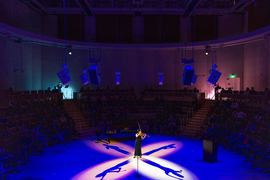
Zenón is now settled in at MIT, which boasts a vibrant music program. More than 1,500 MIT students take a music class each year, and over 500 students participate in one of 30 campus ensembles. Last year, MIT opened its new Edward and Joyce Linde Music Building, a purpose-built performance, rehearsal, and teaching space.
“There are definitely students at MIT who could be at some of the best music schools in the world,” Zenón says. “That’s not in question.”
Moreover, among MIT students, Zenón says, “There is a communal approach to music. Everything they do, they do for each other. They look out for each other, they work together. And that has been one of the most rewarding things to see.”
He continues: “Of course the students are brilliant and the faculty are too. In terms of what I like to teach, it’s been a good fit for me personally, and I couldn’t be happier about the opportunity. There’s more and more interest in jazz, more and more interest in creating things together, and there’s a unique mindset being built in front of our eyes.”
He is also pleased to work in the Linde Music Building: “It’s amazing to have the building, not only in terms of the facilities, but it’s also a symbol of the place music has within the Institute. We’re not just talking about music, we’re creating it. It’s a great commitment from the school and says a lot about our leadership.”
Meanwhile, along with teaching, Zenón’s own recording career continues at full speed. With Luis Perdomo, he is working on “El Arte Del Bolero Vol. 3,” the follow-up to his Grammy-winning album. And Zenón has plans for still another album, to be recorded in Puerto Rico with a large ensemble, based on music he is writing about Puerto Rico’s history and present.
“Things are always linked,” Zenón explains. “Once you finish one project, the next one starts. It feels natural for me to do it that way.”
In conversation, Zenón is engaging, genial, and reflective. So what advice does he have for younger musicians? Not everyone who plays an instrument will become Miguel Zenón. But what about people who want to pursue music, not knowing how far it will take them?
“If you find something you enjoy, just enjoy it for the sake of it,” Zenón says. “Find what brings joy, and make sure you don’t lose that. Having said that, with music, like any art form, or anything else in life, in order to make progress, it takes work and commitment. There’s no hiding that. So if music is something you’re serious about, set goals you can achieve over time, so you always have something to work for. In my experience, that’s key. But I always pair that with the idea of joy and love for music — keeping that love close to your heart.”