The Standard Model of particle physics is a well established theory that describes the fundamental particles and forces that govern the universe. Yet it cannot explain dark matter, the matter–antimatter imbalance, or gravity at the quantum scale, all of which suggest that additional particles and forces beyond the Standard Model may exist.
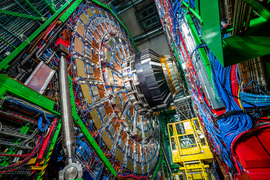
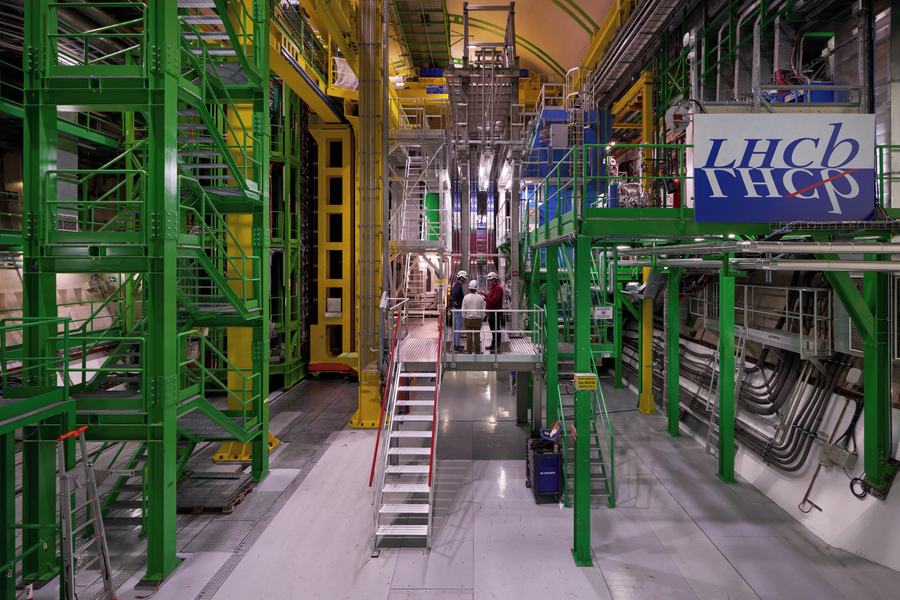
One promising place to look for cracks in the Standard Model is in the decays of particles containing a type of elementary particle called the “beauty quark” or “b quark.” At the European Organization for Nuclear Research (CERN)’s Large Hadron Collider (LHC), the LHCb experiment studies these decays with exceptional precision. Even if new particles are too heavy to be produced directly at the LHC, they could still subtly alter rare beauty-quark decay processes through quantum effects.
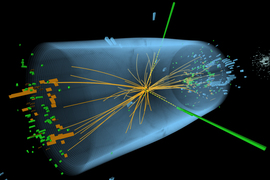
A particularly sensitive channel is the decay of a B meson into a K* meson and two muons. For more than a decade, measurements of this decay have shown intriguing tensions with Standard Model predictions, especially in the angular distribution of the decay products. Now, an open-access LHCb analysis published today in Physical Review Letters finds a four–standard deviation discrepancy in the overall angular distribution of the B → K*μ⁺μ⁻ decay compared with Standard Model expectations.
To ensure robustness, the work was performed independently by two teams, including one led by MIT assistant professor of physics and Laboratory for Nuclear Science researcher Eluned Smith. Here, she describes recent advances on this work.
Q: What does a four–standard deviation discrepancy tell us?
A: In particle physics, deviations are measured in “standard deviations,” or sigma. Five sigma is typically required to claim a discovery. A four-sigma result corresponds to a p-value of about 3 in 100,000, or roughly 0.003 percent. This means that if the Standard Model were completely correct, the probability of observing a discrepancy this large by chance would be extremely small.
This measurement shows that the overall angular pattern of the B → K*μ⁺μ⁻ decay differs from Standard Model predictions. This could indicate contributions from new particles influencing the decay through quantum effects, or it could reflect subtle limitations in our theoretical calculations of strong-interaction dynamics.
The fact that similar tensions have appeared in earlier measurements, as well as in other decay modes governed by similar underlying processes, makes the new result especially compelling.
Q: Why are beauty-quark decays such a powerful probe of new physics?
A: The B → K*μ⁺μ⁻ decay is rare and occurs only through higher-order quantum processes in the Standard Model. Virtual particles briefly appear in quantum loops, shaping both the decay rate and its angular structure.
If unknown new particles were to exist, they could also enter these loops and slightly shift the predicted angular distribution. Because the decay is so rare, even very small contributions from new particles could produce proportionally large and measurable effects. This sensitivity is what makes these processes powerful probes of new physics.
In addition, beauty quarks belong to the third generation of quarks, and are much heavier than the up and down quarks that make up protons and neutrons. Many theoretical models predict that potential new particles or forces would couple more strongly to heavier quarks, enhancing the sensitivity of beauty decays to physics beyond the Standard Model.
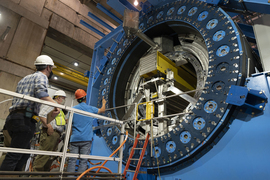
LHCb is uniquely designed to reconstruct beauty-hadron decays in detail, allowing researchers to measure these subtle effects with high precision.
Q: What comes next in the search?
A: Over the next several years, the combination of more data and improved theoretical calculations will determine whether this four-sigma tension is due to physics beyond the Standard Model. The LHC is now delivering new data during its third run, and LHCb has undergone major upgrades, including a fully software-based real-time event selection system, referred to as a trigger, that allows far more beauty decays to be recorded. The larger dataset will reduce statistical uncertainties and test whether the discrepancy strengthens or fades.
Looking further ahead, I and others will be working on the next LHCb upgrade, developing low-latency AI systems that can perform real-time data processing and compression directly in the radiation-intense front-end electronics of the detector readout. These advances will enable the experiment to collect data at rates up to 40 times higher than the original detector and about five times higher than the current upgraded system, dramatically increasing sensitivity to rare decays.