In 2025, MIT’s research community had another prolific year filled with exciting scientific and technological advances. To celebrate the achievements of the past 12 months, MIT News highlights some of our most-read stories from this year.
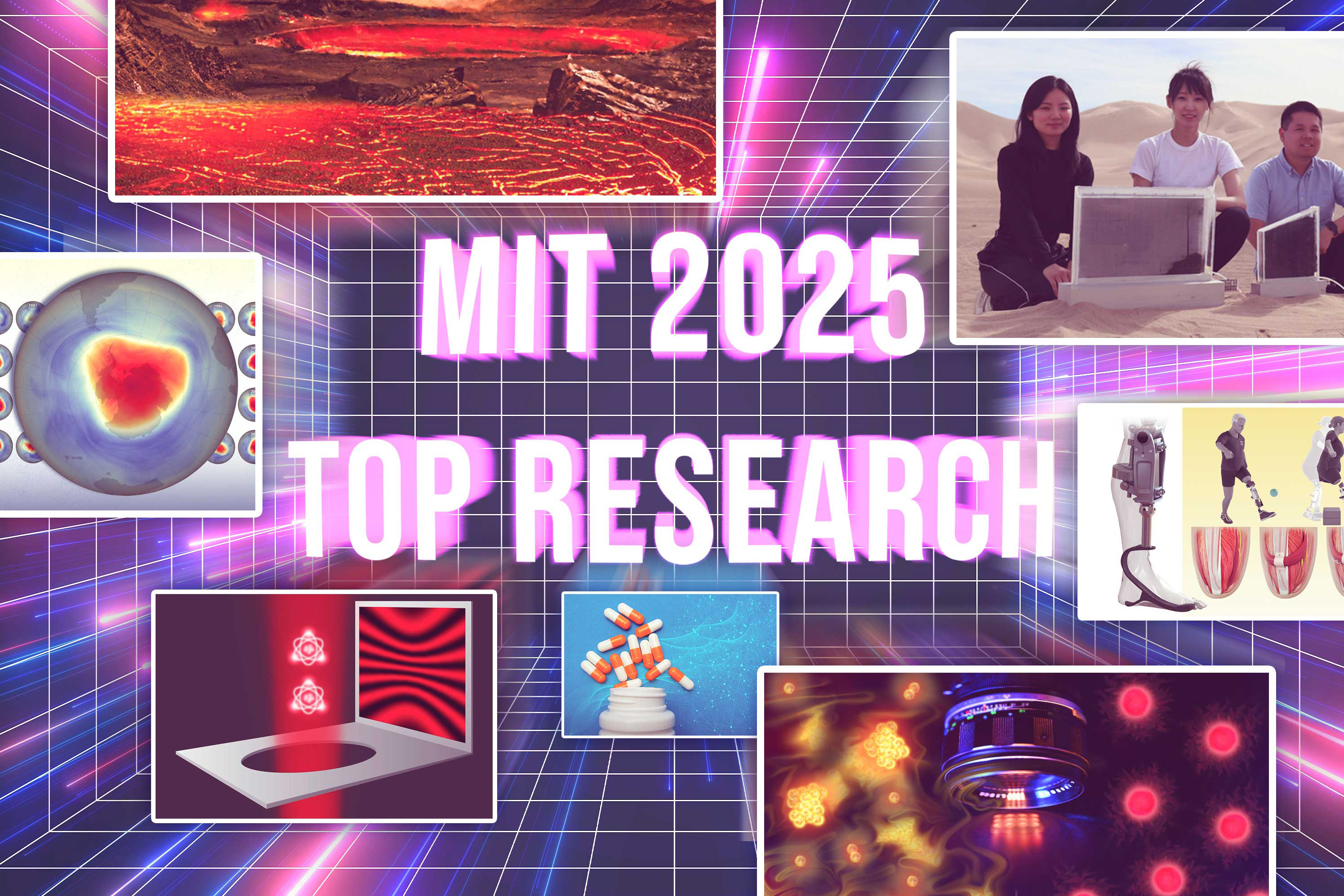
- More powerful concrete “batteries”: MIT researchers combined cement, water, ultra-fine carbon black, and electrolytes to create electron-conducting carbon concrete. The researchers say the material could enable everyday structures like walls, sidewalks, and bridges to store and release electrical energy.
- Confirming the famous double-slit experiment: Physicists performed an idealized version of one of the most famous experiments in quantum physics, demonstrating with atomic-level precision the dual nature of light. The experiment confirmed that light exists as both a particle and a wave, though that duality cannot be simultaneously observed.
- Periodic table of machine learning: Researchers created a table that reveals connections among more than 20 classical machine-learning algorithms. The table stems from the idea that all algorithms learn a specific kind of relationship between data points. The framework could help scientists fuse different methods to improve existing AI models or come up with new ones.
- Photographing “free range” atoms: Physicists captured the first images of individual atoms freely interacting in space. The experiment used single-atom microscopy and ultracold quantum gases to reveal correlations between the particles that had been predicted but never before observed.
- Pulling drinking water from air: Engineers developed a window-sized device that acts as an atmospheric water harvester to produce fresh water anywhere. The origami-inspired device uses a hydrogel material that swells to absorb water — it even works in Death Valley, California.
- Generative AI versus drug-resistant bacteria: With help from artificial intelligence, researchers designed novel antibiotics that can combat two drug-resistant infections. First, a generative AI algorithm designed more than 35 million compounds. Then, the researchers screened them for antimicrobial properties, discovering drug candidates that are structurally distinct from any existing antibiotics.
- Tracking the ozone recovery: A study confirms the Antarctic ozone layer is healing as a direct result of global efforts to reduce ozone-depleting chlorofluorocarbons — chemicals that were used in refrigeration, air conditioning, insulation, and aerosol propellants.
- First evidence of “proto Earth”: Scientists discovered extremely rare remnants of an early version of our planet that formed about 4.5 billion years ago, before a colossal collision irreversibly altered its composition and produced the Earth as we know today. The findings will help scientists piece together the primordial starting ingredients that forged early Earth and the rest of the solar system.
- Restoring movement with a bionic knee: Researchers developed a bionic knee that can help people with above-the-knee amputations walk faster, climb stairs, and avoid obstacles. In a small study, users navigated more easily and said the limb felt more like a part of their body compared to traditional prostheses.
- How people walk in crowds: Mathematicians studied the flow of human crowds and developed a first-of-its-kind way to predict when pedestrian paths will transition from orderly to entangled. The findings could help inform the design of public spaces and promote safe and efficient thoroughfares.