Skip to content ↓

Robotic challenger

MIT team prepares to meet 24 others in $2 million DARPA competition to develop disaster-assistance robots.
Watch Video

Press Contact:

Chad Galts
Phone: (617) 253-9411
Institute Community and Equity Office
Close
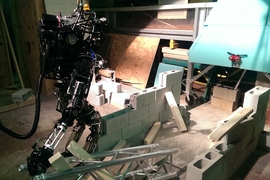
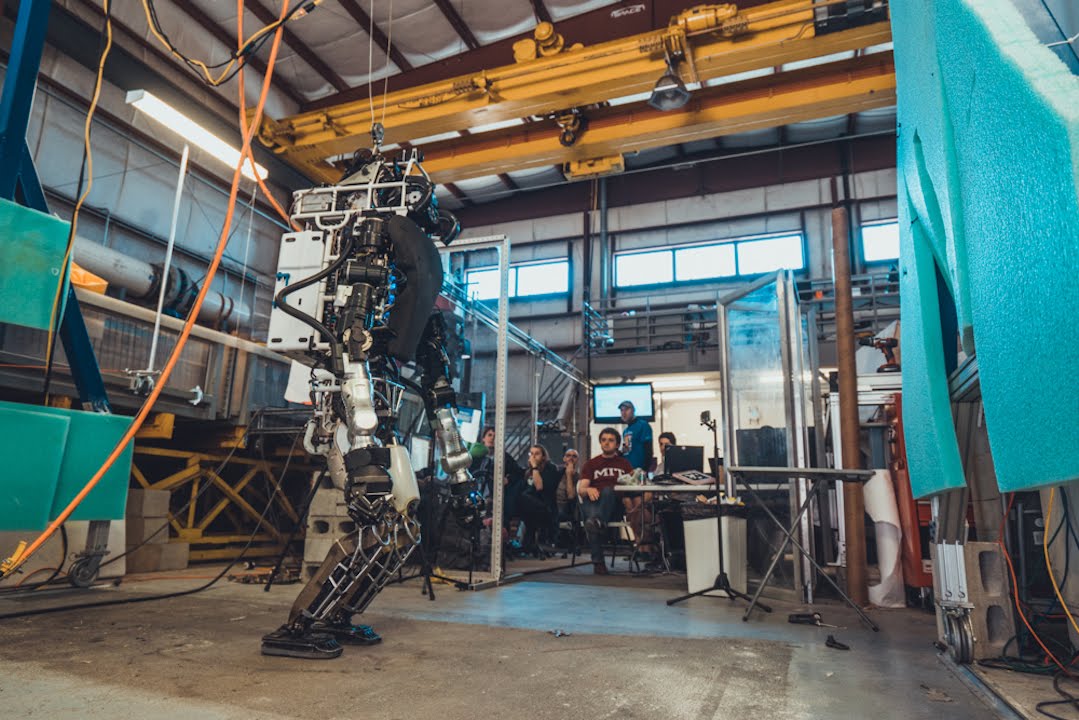
In the DARPA Robotics Challenge finals, <a href="https://www.youtube.com/watch?v=wQIcfKluDTk" target="_blank">MIT's Atlas humanoid robot</a> must demonstrate a number of capabilities, including getting out of a vehicle.
Caption:
In the DARPA Robotics Challenge finals, <a href="https://www.youtube.com/watch?v=wQIcfKluDTk" target="_blank">MIT's Atlas humanoid robot</a> must demonstrate a number of capabilities, including getting out of a vehicle.
Credits:
Photo: Lillie Paquette/School of Engineering

On June 5-6, a team of nearly two dozen MIT students and faculty led by Russ Tedrake from the Computer Science and Artificial Intelligence Laboratory will compete in the DARPA Robotics Challenge (DRC) final in Pomona, California. The DRC is a team competition to develop robot systems capable of assisting humans in responding to natural and human-made disasters.
Video thumbnail Play video
Team MIT prepares for their final showdown at the DARPA Robotics Challenge finals June 5-6, 2015.

MIT will field one of 25 academic and industry teams from all over the country that have developed the hardware, software, sensors, and human-machine control interfaces that will enable a humanoid robot to complete a series of challenge tasks selected by DARPA for their relevance to disaster response.

Successful robots must drive a utility vehicle, get out of that vehicle, open a door, turn a valve, turn on a drill and cut an opening in a wall, perform some surprise tasks, walk over a series of obstacles, then climb stairs.

The winning team will receive a $2 million prize.
Related Links

Related Topics

Related Articles

More MIT News

Globular blue and white orbs "examining" single-stranded RNA products and marking them with green checks or red x's

Why are some bacterial genes high in purines?

In certain species of bacteria, the answer lies in shielding RNA transcripts from a quality-control factor called Rho. Understanding the requirements for expressible sequences is critical for expression engineering of therapeutic agents.

Read full story

Rich Nielsen, Volha Charnysh, Kevin Dorst, and Emily Richmond Pollock seated at a table, talking

Building a scholarly community

The SHASS Faculty Fellows Program, administered by the MIT Human Insight Collaborative, is fostering new research projects and creating space for supportive and interdisciplinary discussion.

Read full story