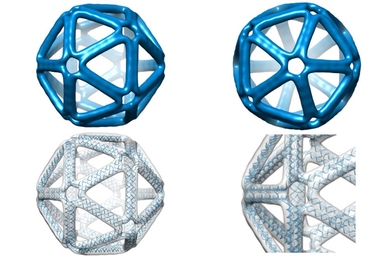
Automating DNA origami opens door to many new uses
Like 3-D printing did for larger objects, method makes it easy to build nanoparticles out of DNA.
Like 3-D printing did for larger objects, method makes it easy to build nanoparticles out of DNA.

In exploring the role of clerics in the Shi’a world, political science PhD student Marsin Alshamary heeds the call of family history.
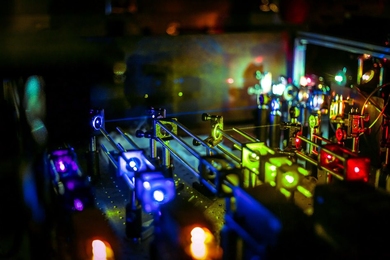
New super-resolution technique visualizes important role of short-lived enzyme clusters.
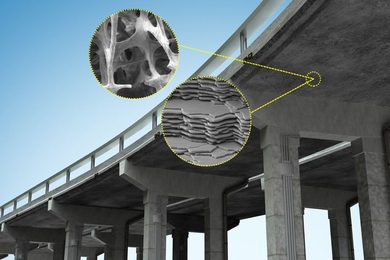
Researchers look to bones and shells as blueprints for stronger, more durable concrete.
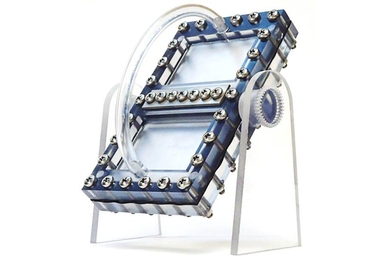
Pump-free design for flow battery could offer advantages in cost and simplicity.
![“[T]oday, if you want to write a program, you go and bring in these huge frameworks and these huge pieces of functionality that you then glue together, and you write a little code to get them to interact with each other. If you don’t understand what that big framework is doing, you’re not even going to know where your program is going to start executing,” says Armando Solar-Lezama.](/sites/default/files/styles/term_page__news_article/public/images/201605/MIT-Symbolic-Execution.jpg?itok=A5FxILHQ)
System could make complex analysis practical for programs that import huge swaths of code.

Researchers are analyzing coal and energy caps as carbon policy instruments for China.

Loss of Shank gene prevents neuronal synapses from properly maturing.

For the first time, women will hold both of the board’s top leadership positions.

Defects in some new electronic materials can be removed by making ions move under illumination.
![“When I came to [MIT’s Campus Preview Weekend], I was just blown away by how everybody was so into whatever they were doing,” Maiko Kitaoka says. “I love that atmosphere.”](/sites/default/files/styles/term_page__news_article/public/images/201605/MIT-Maiko-Kitaoka-A1.jpg?itok=U-pjgQVE)
Once an aspiring ballerina, the MIT senior now studies the earliest stages of life.
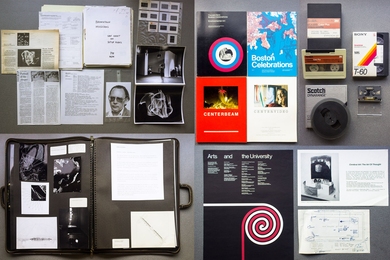
Funding supports the development of a “virtual museum” from an archive of experimental works.
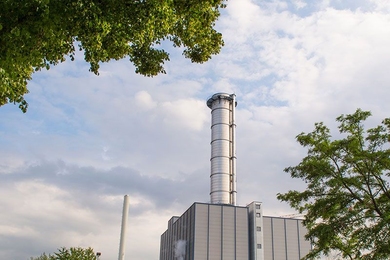
Grad student Jesse Jenkins and professor Valerie Karplus discuss challenges of emissions pricing in a new paper.

System converts solar heat into usable light, increasing device’s overall efficiency.
![A new study finds generally higher prices with occasional sales mixed in will yield more revenue than consistently low prices, at least for fashionable goods. “The high-value customers will still buy the product,” Karen Zheng says. “They want to [avoid] this feeling of regret, which would occur if they wait now and then cannot get it in the future.”](/sites/default/files/styles/term_page__news_article/public/images/201605/MIT-Quantifying-Regret.jpg?itok=qLKeqfIg)