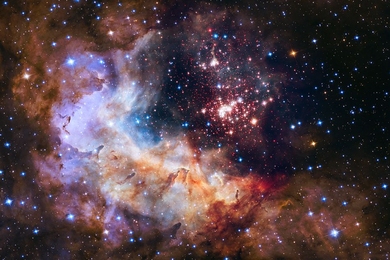
Physicists design an experiment to pin down the origin of the elements
With help from next-generation particle accelerators, the approach may nail down the rate of oxygen production in the universe.
With help from next-generation particle accelerators, the approach may nail down the rate of oxygen production in the universe.
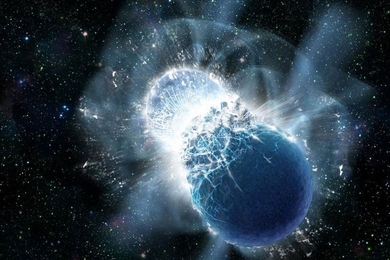
Findings reported just weeks into the network’s latest operating run. (Press release)
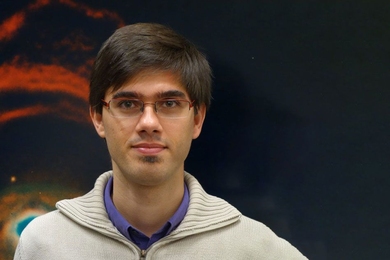
“We will keep listening for these faint and remote cosmic whispers,” says the physics professor.
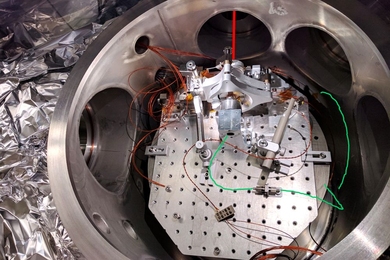
Research could enable a new suite of experiments to measure quantum activity at room temperature.
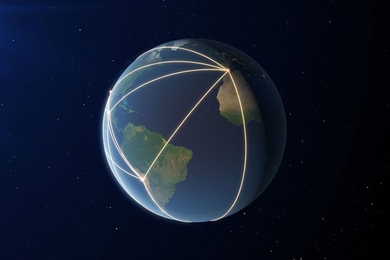
ESO, ALMA, and APEX contribute to paradigm-shifting observations of the gargantuan black hole at the heart of the galaxy Messier 87. (Press release)
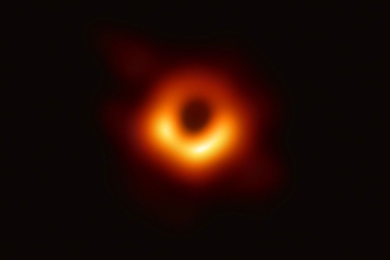
Images reveal supermassive black hole at the heart of the Messier 87 galaxy.
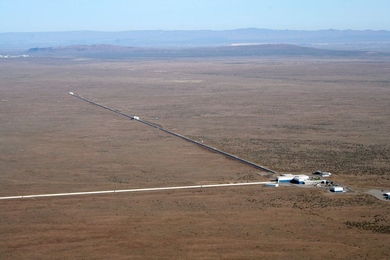
“If we are very lucky, we might observe something new … or maybe even something totally unexpected.”
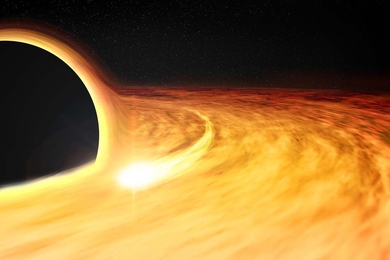
Pulse pattern suggests distant black hole must be spinning at least at 50 percent the speed of light.
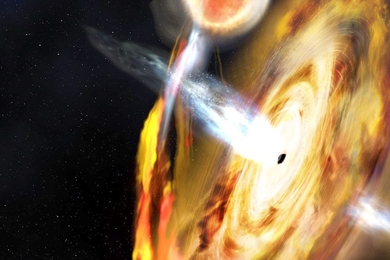
Halo of highly energized electrons around the black hole contracts dramatically during feeding frenzy.

MIT’s Mark Vogelsberger and the Illustris project are honored by Germany's postal service with an official stamp.
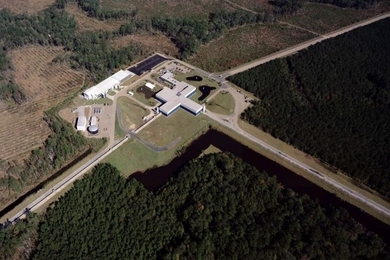
The observatories are also releasing their first catalog of gravitational-wave events.

Senior Radha Mastandrea analyzes data from CERN in search of more information about the universe’s fundamental particles.
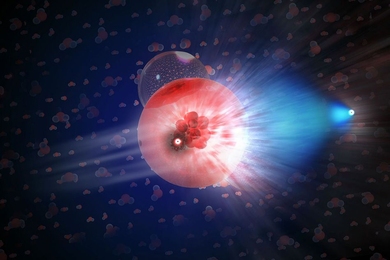
The “ghostly particle” is confirmed to have originated from a blazar, nearly 4 billion light years from Earth.
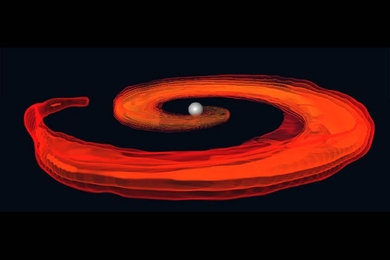
Signals from rare black hole-neutron star pairs could pinpoint rate at which universe is growing, researchers say.
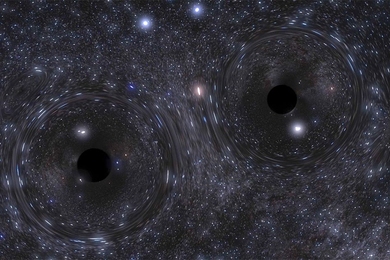
Black holes in these environments could combine repeatedly to form objects bigger than anything a single star could produce.