
Algorithms and AI for a better world
Assistant Professor Manish Raghavan wants computational techniques to help solve societal problems.
Assistant Professor Manish Raghavan wants computational techniques to help solve societal problems.

MAD Design Fellow Zane Schemmer writes algorithms that optimize overall function, minimize carbon footprint, and produce a manufacturable design.

Inspired by the human vocal tract, a new AI model can produce and understand vocal imitations of everyday sounds. The method could help build new sonic interfaces for entertainment and education.

Biodiversity researchers tested vision systems on how well they could retrieve relevant nature images. More advanced models performed well on simple queries but struggled with more research-specific prompts.
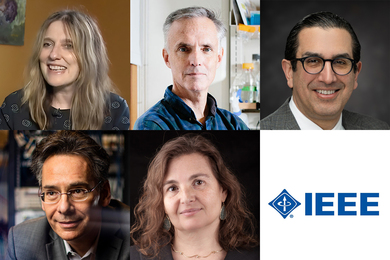
Five MIT faculty and staff, along with 19 additional alumni, are honored for electrical engineering and computer science advances.

A small fleet of autonomous surface vessels forms a large sonar array for finding submerged objects.

The “PRoC3S” method helps an LLM create a viable action plan by testing each step in a simulation. This strategy could eventually aid in-home robots to complete more ambiguous chore requests.

In a recent commentary, a team from MIT, Equality AI, and Boston University highlights the gaps in regulation for AI models and non-AI algorithms in health care.

MIT CSAIL director and EECS professor named a co-recipient of the honor for her robotics research, which has expanded our understanding of what a robot can be.

Researchers develop “ContextCite,” an innovative method to track AI’s source attribution and detect potential misinformation.

Researchers propose a simple fix to an existing technique that could help artists, designers, and engineers create better 3D models.

The technique could make AI systems better at complex tasks that involve variability.

The Tree-D Fusion system integrates generative AI and genus-conditioned algorithms to create precise simulation-ready models of 600,000 existing urban trees across North America.

MIT and IBM researchers are creating linkage mechanisms to innovate human-AI kinematic engineering.

By sidestepping the need for costly interventions, a new method could potentially reveal gene regulatory programs, paving the way for targeted treatments.