
Search Stories
Machine learning for everyone
A new EECS course on applications of machine learning teaches students from a variety of disciplines about one of today’s hottest topics.
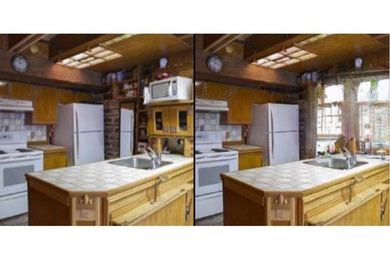
Teaching artificial intelligence to create visuals with more common sense
An MIT/IBM system could help artists and designers make quick tweaks to visuals while also helping researchers identify “fake” images.
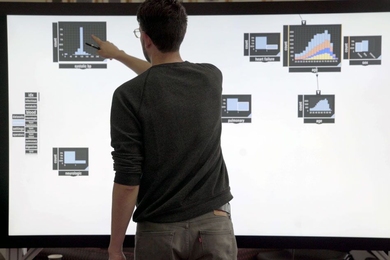
Drag-and-drop data analytics
System lets nonspecialists use machine-learning models to make predictions for medical research, sales, and more.

New AI programming language goes beyond deep learning
General-purpose language works for computer vision, robotics, statistics, and more.
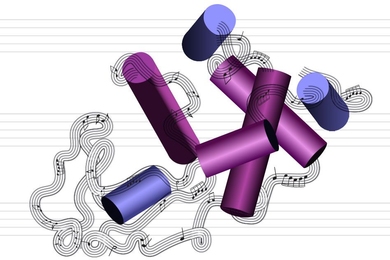
Translating proteins into music, and back
By turning molecular structures into sounds, researchers gain insight into protein structures and create new variations.
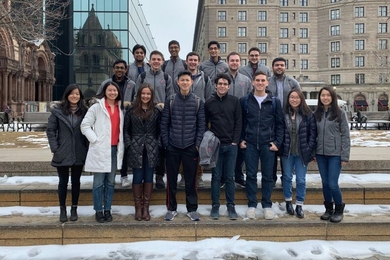
Want to learn how to train an artificial intelligence model? Ask a friend.
MIT Machine Intelligence Community introduces students to nuts and bolts of machine learning.
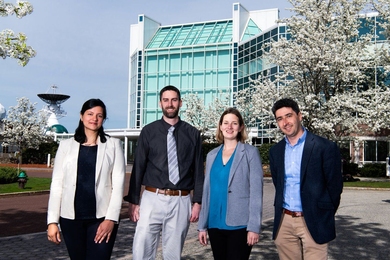
Four 2019 40 Under 40 award winners are from Lincoln Laboratory
The Armed Forces Communications and Electronics Association recognizes innovation and leadership in science and technology.

3Q: David Mindell on his vision for human-centered robotics
Engineer and historian discusses how the MIT Schwarzman College of Computing might integrate technical and humanistic research and education.
Teaching artificial intelligence to connect senses like vision and touch
MIT CSAIL system can learn to see by touching and feel by seeing, suggesting future where robots can more easily grasp and recognize objects.

Toward artificial intelligence that learns to write code
Researchers combine deep learning and symbolic reasoning for a more flexible way of teaching computers to program.

A scholar and teacher re-examines moments in the history of STEM
“I love teaching,” says PhD student Clare Kim. “It’s not that I’m just imparting knowledge, but I want [my students] to develop a critical way of thinking.”
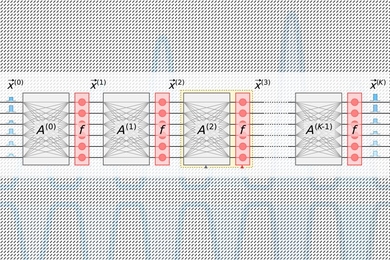
Chip design drastically reduces energy needed to compute with light
Simulations suggest photonic chip could run optical neural networks 10 million times more efficiently than its electrical counterparts.
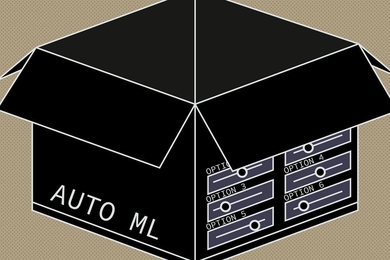
Cracking open the black box of automated machine learning
Interactive tool lets users see and control how automated model searches work.

Q&A: Phillip Isola on the art and science of generative models
Image-translation pioneer discusses the past, present, and future of generative adversarial networks, or GANs.