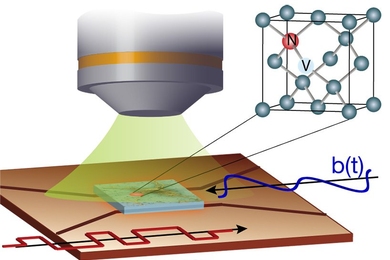
Researchers develop new method to control nanoscale diamond sensors
Technique allows tiny sensors to monitor small changes in magnetic fields, such as when neurons transmit electrical signals.
Technique allows tiny sensors to monitor small changes in magnetic fields, such as when neurons transmit electrical signals.

Ksplice software, which allows for updates without rebooting, became a profitable venture for the MIT alumni who developed it.
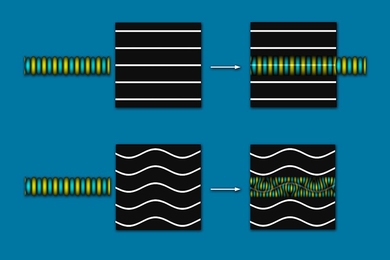
Flexible materials could provide ways to manipulate sound and light.
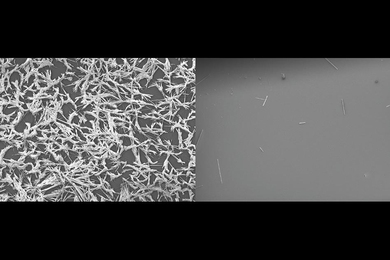
MIT researchers develop a slippery coating that could prevent the scaling that fouls oil wells and power plants.
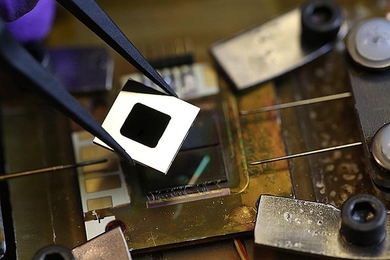
New approach developed at MIT could generate power from sunlight efficiently and on demand.

The MIT professor emeritus earns the BBVA Foundation Frontiers of Knowledge Award for his pioneering work and mentoring role in the field of artificial intelligence.

Langer honored for his discoveries in controlled drug-release systems and new biomaterials; awards ceremony hosted by Kevin Spacey to be broadcast Jan. 27

Marshall Scholar Colleen Loynachan tackles materials science problems with a photographer’s perspective.
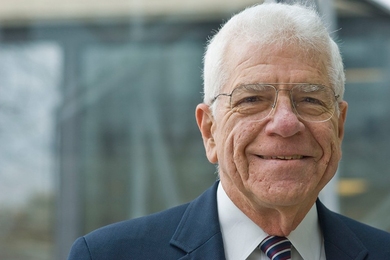
A member of the MIT faculty since 1967, Roberge spent nearly his entire professional career at MIT.
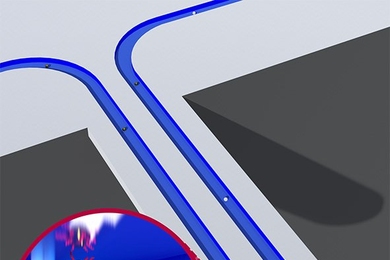
New device from MIT can measure masses as small as one millionth of a trillionth of a gram, in solution.
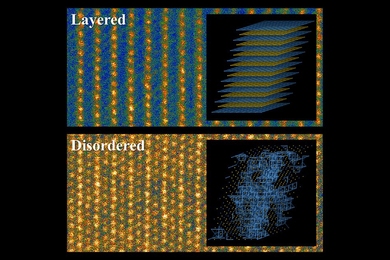
MIT researchers find that contrary to conventional wisdom, cathodes made of disordered lithium compounds can perform better than perfectly ordered ones.
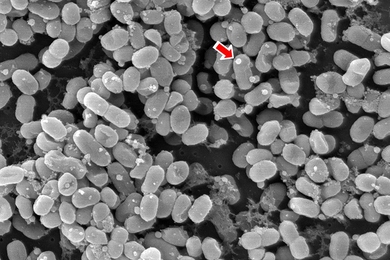
Scientists discover extracellular vesicles produced by ocean microbes.

Large-scale tests in the lab and the South China Sea reveal the origins of underwater waves that can tower hundreds of feet.

Research could boost the efficiency even of huge networks like the Internet.
