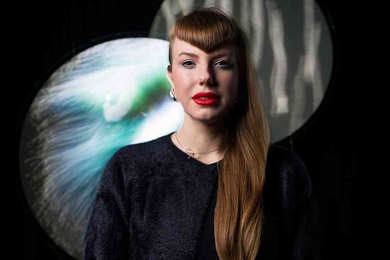
New artist residency program at MIT expands views of the cosmos
Inaugural artist Amy Karle will join astrophysicists at MIT’s Kavli Institute to explore questions about the universe and translate them into an immersive multimedia experience.
Inaugural artist Amy Karle will join astrophysicists at MIT’s Kavli Institute to explore questions about the universe and translate them into an immersive multimedia experience.
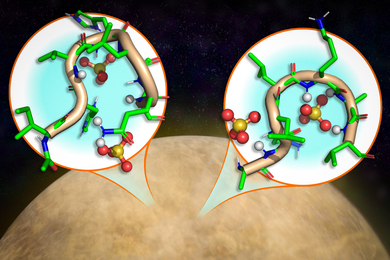
New research offers support for the possibility that complex biological molecules could exist in the highly acidic environment of Venus’s cloud layer.
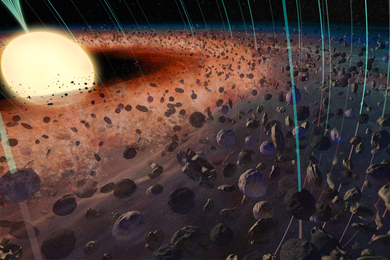
The discovery likely represents the earliest known evidence of a magnetic field in the infant solar system.
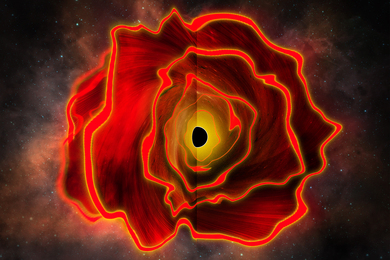
The mashup of a black hole and an enormous star has never been seen before and could explain the mysterious little red dots often found in deep-space images.
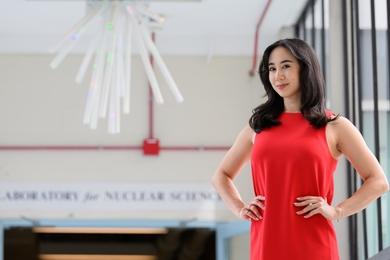
From Broadway to MIT’s Laboratory for Nuclear Science, PhD student Jessica Fry doesn’t do anything halfway. Now she’s hunting for the universe’s most elusive particle.
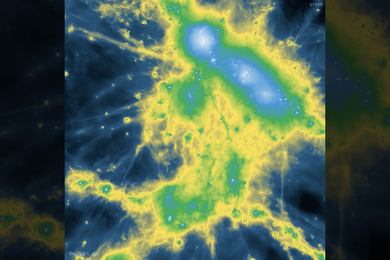
An MIT-led team used bright radio bursts to illuminate a vast source of matter that was previously unaccounted for.
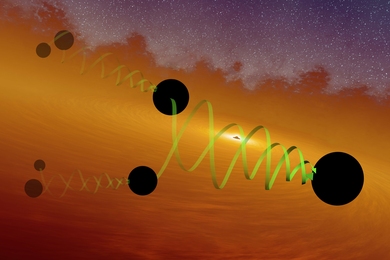
Physicists have found signs of colliding black holes that are themselves products of previous black hole smash-ups.

By analyzing X-ray reverberations and other astrophysical data, Erin Kara seeks to understand the most extreme objects in the universe.
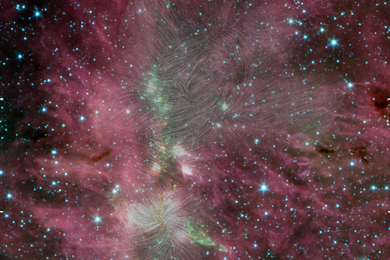
MIT Haystack Observatory researchers use SOFIA observations to reveal how magnetic fields guide the assembly of one of our galaxy's most active high-mass star-forming regions.
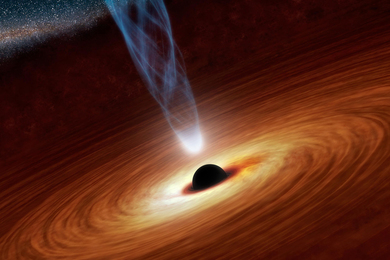
When the universe was just 850 million years old, this voracious black hole was already surprisingly mature, a new study finds.
IAIFI enters its second phase with increased funding, broader ambitions, and a growing community at the frontier of AI and fundamental physics.
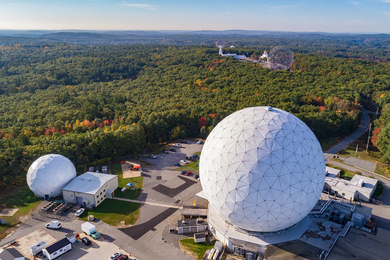
The legendary radio astronomy telescope returns to its science and educational mission at MIT Haystack Observatory.
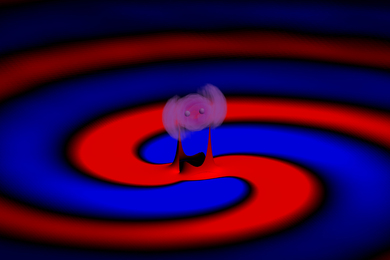
Gravitational waves emitted by colliding black holes may bear imprints of dark matter, which physicists could detect with a new model.
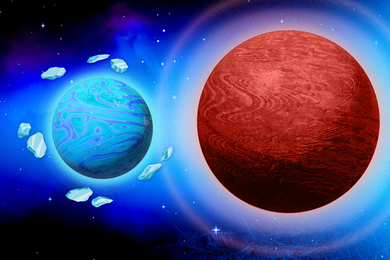
New measurements of a hot Jupiter and its mini-Neptune companion suggest both planets formed surprisingly far away from their host star.
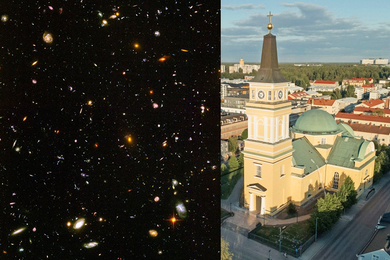
An immersive sound installation at Oulu Cathedral, Finland, co-created by MIT Associate Professor Kiyoshi Masui, transforms more than 4,000 cosmic signals into spatial audio.