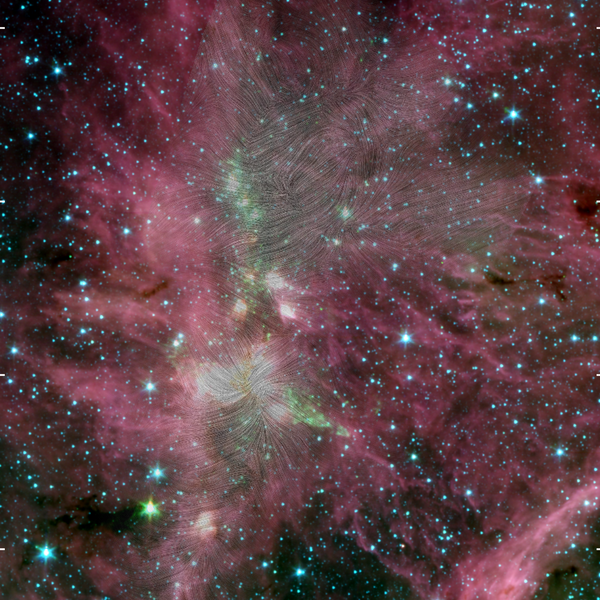
Stars form when vast clouds of cold gas in space collapse under their own gravity. But not all gas collapses, and not all clouds form stars equally efficiently. A long-standing puzzle in astrophysics is what controls this process — and a leading suspect has been the role of magnetic fields, which thread through interstellar gas like an invisible scaffolding.
A new open-access study led by researchers at MIT Haystack Observatory, published in The Astrophysical Journal, has now traced this scaffolding in unprecedented detail in DR21, one of the most active stellar nurseries within 5,000 light-years of the sun. The results show that magnetic fields don't simply exist in DR21 — they actively shape how material flows into the cloud's dense central spine, where new massive stars are being born.
"The magnetic field acts like a set of railroad tracks," says Thushara Pillai, research scientist at MIT Haystack Observatory and lead author of the study. "Gas flows along the tracks toward the central ridge, building it up over time. Across the tracks, the field resists motion. So the field doesn't stop star formation — it channels it."
DR21 sits within the Cygnus X complex, a region teeming with young stars and some of the Milky Way's most luminous objects. Its central structure — the DR21 Main Ridge — is a dense filament about 13 light-years long containing roughly 20,000 times the mass of the sun in cold (less than -424 degrees Fahrenheit) molecular gas. Surrounding it is a network of smaller "sub-filaments" that previous observations had hinted might feed material into the ridge, but no instrument had been able to trace the magnetic field continuously from the dense ridge into these fainter structures.
The new measurements come from SIMPLIFI (the Study of Interstellar Magnetic Polarization: a Legacy Investigation of Filaments), a SOFIA Legacy Program led by Pillai. SIMPLIFI brings together an international team of observers, theorists, and instrument scientists from more than a dozen institutions across four continents. The data reduction was led by Jens Kauffmann, also a research scientist at MIT Haystack Observatory and lead scientist of the astronomy group.
"Working with SOFIA's polarization data was challenging," Kauffmann says. "We had to characterize the data reduction systematics from scratch. But the result was worth it: a homogeneous map of the magnetic field across an entire star-forming complex, at a level of detail that no other facility could provide."
The team compared the directions of the magnetic field, the local gravitational pull, and the gas structures themselves. Gravity and the magnetic field, they found, are remarkably aligned throughout the cloud, independent of where you look. This is the hallmark of magnetically guided accretion: gas streaming inward along magnetic field lines toward the cloud's center of mass. The team estimates that the sub-filaments are channeling material into the Main Ridge fast enough to assemble its massive central structure within roughly a million years.
The results also resolve another puzzle. Earlier observations had seen gas flowing toward the central ridge, but the team found — and explains — that this gas appears to be moving more slowly than gravity alone would predict. Because the magnetic field, and therefore the accretion flow it guides, lies almost entirely in the plane of the sky, only a small fraction of the true motion shows up along our line of sight. The gas isn't moving slowly; it's moving sideways across our view.
SOFIA — the Stratospheric Observatory for Infrared Astronomy — was a Boeing 747SP modified by NASA and the German Aerospace Center to carry a 2.7-meter telescope into the stratosphere. After 12 years of operations, the observatory was retired in September 2022, and no comparable facility currently exists, or is planned.
"To really understand how magnetic fields shape star formation across the galaxy, we need to go further — to fainter emission, larger areas of sky, and clouds at every stage of evolution," Pillai says. "That requires a space-based far-infrared mission with polarization capability. We don't have one. Building one should be a priority for the next decade of astrophysics."
This work was supported by a NASA award issued by the Universities Space Research Association and the National Science Foundation.