Black holes are often misunderstood to be just that: dark and mysterious voids that are somehow akin to Alice in Wonderland’s mind-bending rabbit hole.
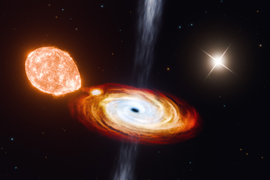
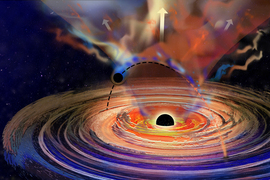
But rather than a tunnel of nothing, a black hole is actually something — and a lot of it. The densest objects in the universe, black holes exert tremendous gravitational pull, gathering in the surrounding fabric of space and time, and generating huge disks of matter that whirl toward a black hole before falling in, past the point of no return.
In recent years, as astronomers have been able to train more telescopes on the sky, for longer stretches of time, they have captured a surprising range of black hole behavior.
“It used to be that we didn’t have eyes on systems all the time,” says Erin Kara, an associate professor of physics at MIT. “Now we’re seeing that they can turn on and off at rates that are much faster than we ever thought possible. We see things are getting sucked in toward black holes faster than we thought, perhaps due to stars whipping around and getting trapped in a black hole’s accretion disk.”
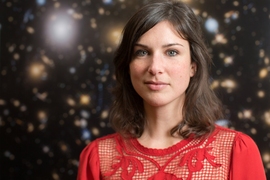
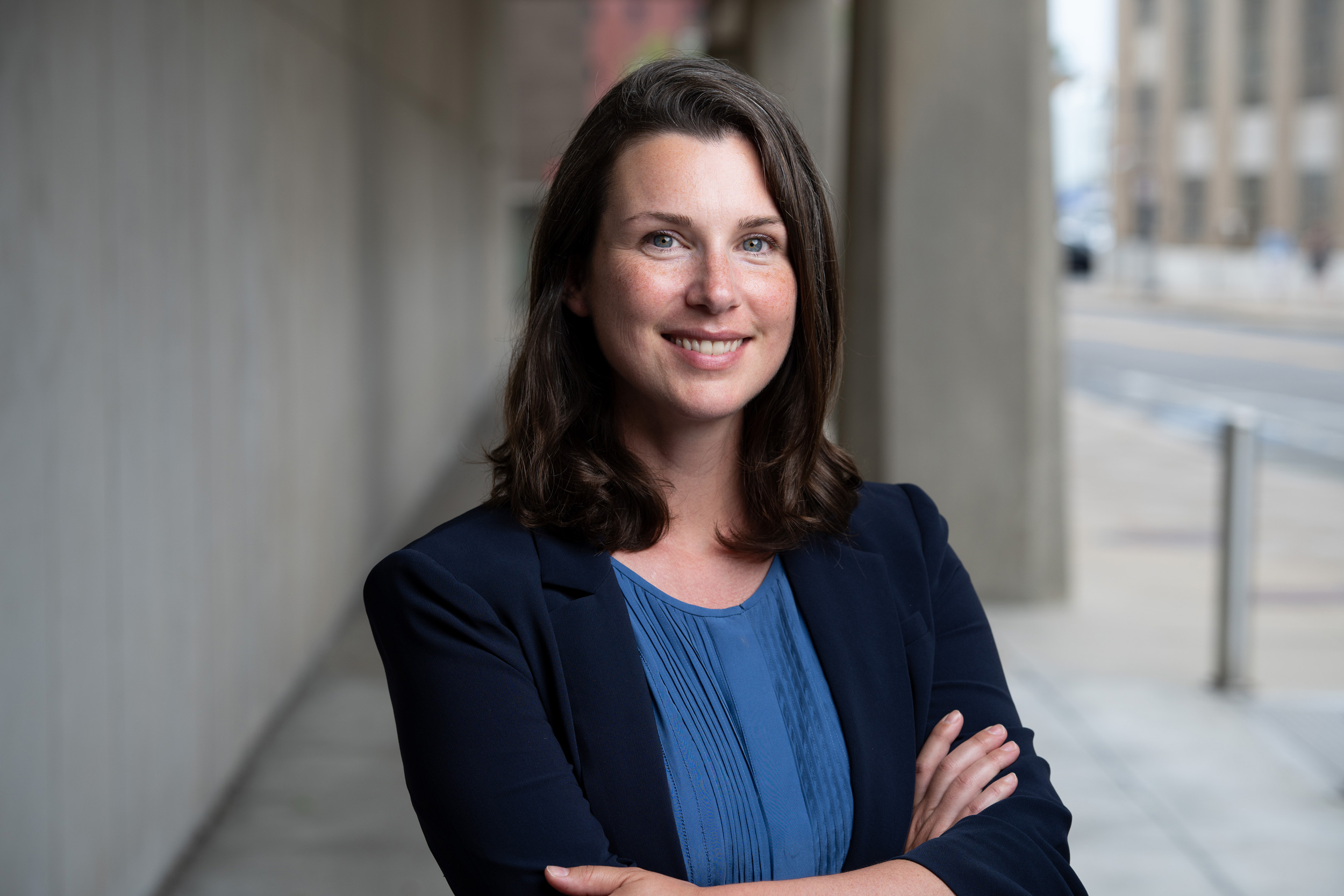
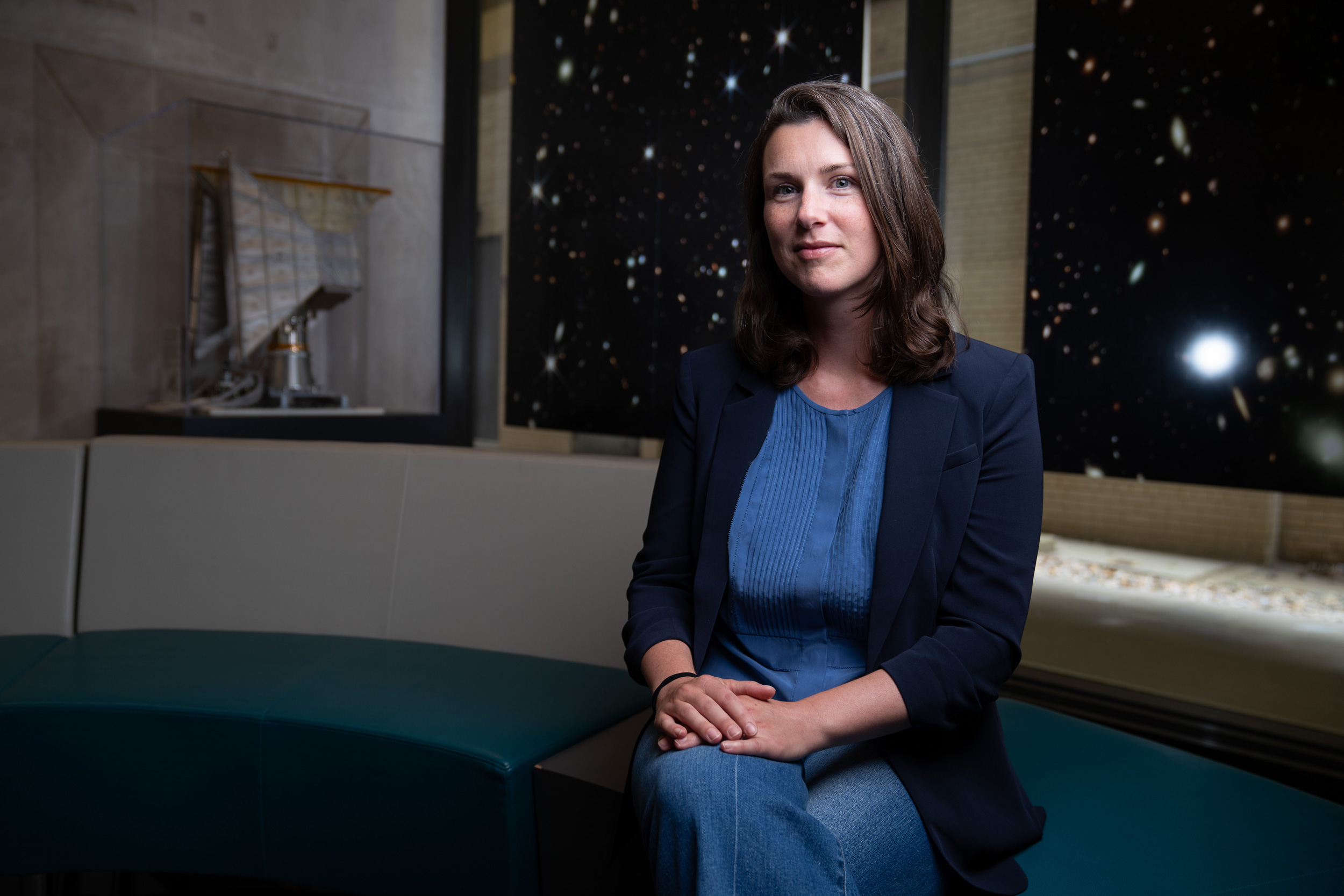
Kara and her group in MIT’s Kavli Institute for Astrophysics and Space Research are at the forefront of black hole physics. She is using data from telescopes in space and on the ground to study the properties of black holes, especially supermassive black holes — the ultradense giants at the centers of galaxies. Supermassive black holes are the engines of galaxy formation. Kara, who recently earned tenure at MIT, seeks to connect the extreme physics of black holes with how galaxies such as our own Milky Way come to be.
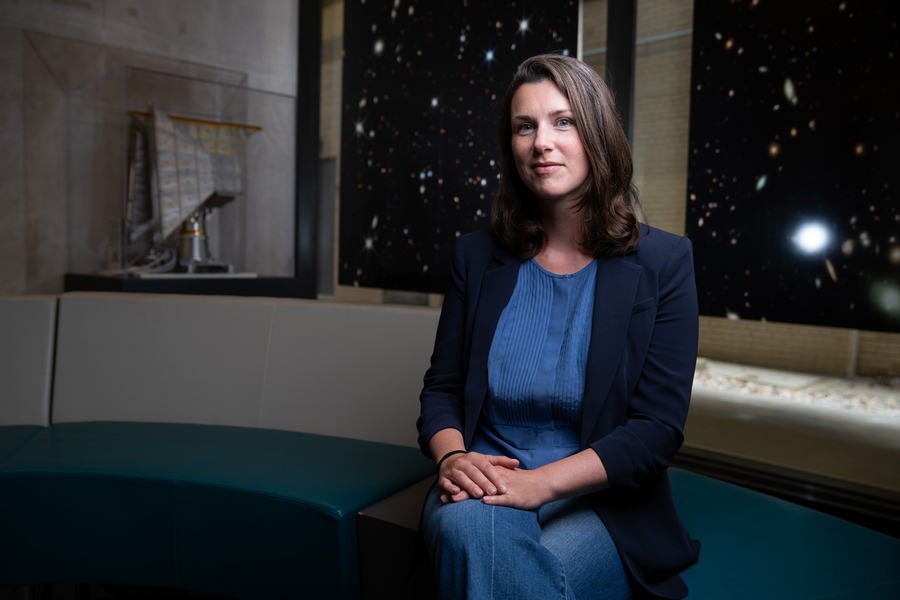
“It’s amazing that we as humans can know anything about what’s happening billions of light years away,” Kara says. “There’s a lot of new open puzzles about supermassive black holes that I’m excited about.”
Early impact
Kara was born and raised in Bethlehem, Pennsylvania, as the youngest of four. Her mother was a nurse, and her father a doctor, so it felt only natural for Kara to follow their lead. She set out on a premed track at Barnard College of Columbia University. As part of the program that first year, she took an introductory physics class and was instantly drawn to the subject’s concrete, fundamental descriptions of the physical world, from the quantum to cosmic scales.
“Physics was always the class that explained things at the ground level,” Kara recalls. “And I thought, wow, this is cool. I have to keep going with this.”
In class, she kept asking questions and wanting to know more. Her professor, astronomer Reshmi Mukherjee, took note and invited Kara to join her research group as a summer intern. The team would be working on new data from a telescope that was readying for launch. That summer, in June 2008, NASA launched the Fermi Gamma-Ray Space Telescope into low-Earth orbit, with the purpose of surveying the sky for sources of gamma rays — high-energy radiation that is produced by black holes, neutron stars, and other extreme astrophysical objects.
When the telescope started sending back data, Mukherjee assigned Kara a project: to characterize two of the telescope’s unidentified gamma-ray signals. Both signals were bright, and the question was whether they came from nearby, within the Milky Way galaxy, or much further away. If the latter was the case, it would mean the sources were possibly quasars — a type of extremely active supermassive black hole that at the time was a rarity in astronomy observations.
Kara got to work on the data and soon confirmed that both sources were indeed quasars.
“It was a small discovery, but it felt awesome,” Kara says. “And I love that about astronomy, that there are so many unanswered questions, and even early on in your career, you can make an impact.”
Needless to say, Kara caught the astronomy bug, and soon opted to switch from premed to physics, though the new path was not always smooth. On Barnard’s all-women’s campus, introductory classes in physics were small, and professors were encouraging and approachable. In contrast, upper-level courses were held at Columbia, where Kara was one of a much larger, co-ed cohort.
“It’s a very unique experience to be with all women in a physics environment, and then to see how my feelings about my own abilities changed, just based on the environment,” Kara reflects. “I went to Columbia and all of a sudden felt like I couldn’t do this. All these guys were much more confident and outwardly understanding of the material. In the end, I did well there too. And that juxtaposition helped me gain confidence and know, yeah, I belong here.”
Black hole reverb
After graduating with a major in physics and a minor in art history, Kara went abroad, to the Institute of Astronomy at Cambridge University. She earned a scholarship there to pursue a one-year master’s degree in physics, but she ended up staying to complete a PhD on a topic that was just starting to grow roots: black hole X-ray reverberation.
In 2009, her thesis advisor, Andy Fabian, and his team were looking through archival data from an X-ray telescope and noticed curious time delays in signals coming from around a black hole. They interpreted the signals as X-ray echoes, or reverberations. It was the first evidence of X-ray echoes around a black hole, and it helped to resolve a debate in the field over the source of the radiation.
Her advisor determined that the reverb was a result of X-rays generated from the black hole’s corona — a crown-shaped aura of high-energy radiation immediately surrounding the black hole — that then bounced, or reverberated, off the swirling disk of gas and dust that circles a black hole, known as an accretion disk.
“They had only found these echoes in one black hole. But the archive was full of data of these reverberation signals that no one had analyzed in this particular way,” Kara explains. “So I had my whole PhD to kind of play with this archive, and it felt very discovery-driven.”
Since that initial exploration, Kara has worked to advance the study of X-ray reverberation as a technique to map regions around black holes and other extreme astrophysical objects.
A pivotal disruption
After earning a PhD in physics, Kara returned to the U.S. for postdoctoral work at the University of Maryland and NASA’s Goddard Space Flight Center. She intended to work on data from a new satellite, Hitomi — a Japanese mission that would detect far-off X-rays to help scientists map the large-scale structure and evolution of the universe. After 40 days, the scientists lost control of the satellite, which ultimately began spinning uncontrollably and broke apart in orbit. Before it failed, the telescope sent back one clean signal.
“It got one really good observation, which was unlike any spectrum we had ever seen before,” Kara recalls.
The data confirmed that the satellite’s detector — a microcalorimeter that was developed at NASA — was sound. That technology is now at the heart of Hitomi’s successor, the X-ray Imaging and Spectroscopy Mission, or XRISM, which has been successfully taking data since its launch in 2023. Today, Kara leads a science group as part of the XRISM mission to analyze X-ray signals from supermassive black holes.
Back then, however, with the end of Hitomi, she had to pivot. She started working with a new group at NASA Goddard that was gearing up for the launch of another telescope — the Neutron Star Interior Composition Explorer, or NICER. In 2017, the telescope, which was developed and built by MIT researchers, was launched and attached to the International Space Station, where it measured the timing of incoming X-rays from astrophysical sources in deep space.
The group Kara joined was analyzing NICER data for signs of tidal disruption events, which are instances when a black hole tears apart a nearby star. This was some of her earliest work on these dynamic sources, and she has since incorporated tidal disruption events — and data from NICER — as a main research area.
At the hub
In 2019, Kara accepted a junior faculty position in MIT’s Department of Physics — a decision that to her was a “no-brainer.”
“X-ray astronomy has its history at MIT,” Kara says. “Bruno Rossi, Hale Bradt, George Clark, Claude Canizares — it all started here. It was always a place that felt like a hub. And that was the draw.”
Today, she and her students regularly analyze data from various satellites and telescopes such as XRISM and NICER to better understand black holes and how they grow, evolve, and affect the galaxies around them. She continues to advance X-ray reverberation mapping, which has helped scientists map the extreme regions immediately surrounding a black hole. Her group is also studying signals from other extreme X-ray sources, including tidal disruption events, quasiperiodic eruptions, and galactic black hole outbursts.
Kara also plans to explore data from future observatories, including the Ultraviolet Transiet Astronomy Satellite (ULTRASAT), which will continuously scan the entire sky for hot, ultraviolet sources; and the Laser Interferometer Space Antenna (LISA), a space telescope that will detect low-frequency gravitational waves from sources such as pairs of lopsided, David-and-Goliath black holes.
And she’s also found time for a bit of black hole fun: In 2022, Kara collaborated with educators and music anthropologists at MIT to convert a black hole’s X-ray echoes to audible sound. As a musician herself — she sings and plays the violin — she was curious how a black hole’s cosmic energy might “sound.” The effect was otherworldly, to say the least.
“One of the reasons that I love black holes is that they are very extreme, and feel very sci-fi crazy, and things don’t make sense, and physics breaks down around them. And at the same time, they’re super foundational to even why we’re here,” Kara says. “For reasons we don’t fully understand, the distribution of stars and gas and dust in a galaxy is dictated in part by the supermassive black hole at its center. Our sun is one of those stars. It’s all intertwined. And untangling some of that is what motivates me.”