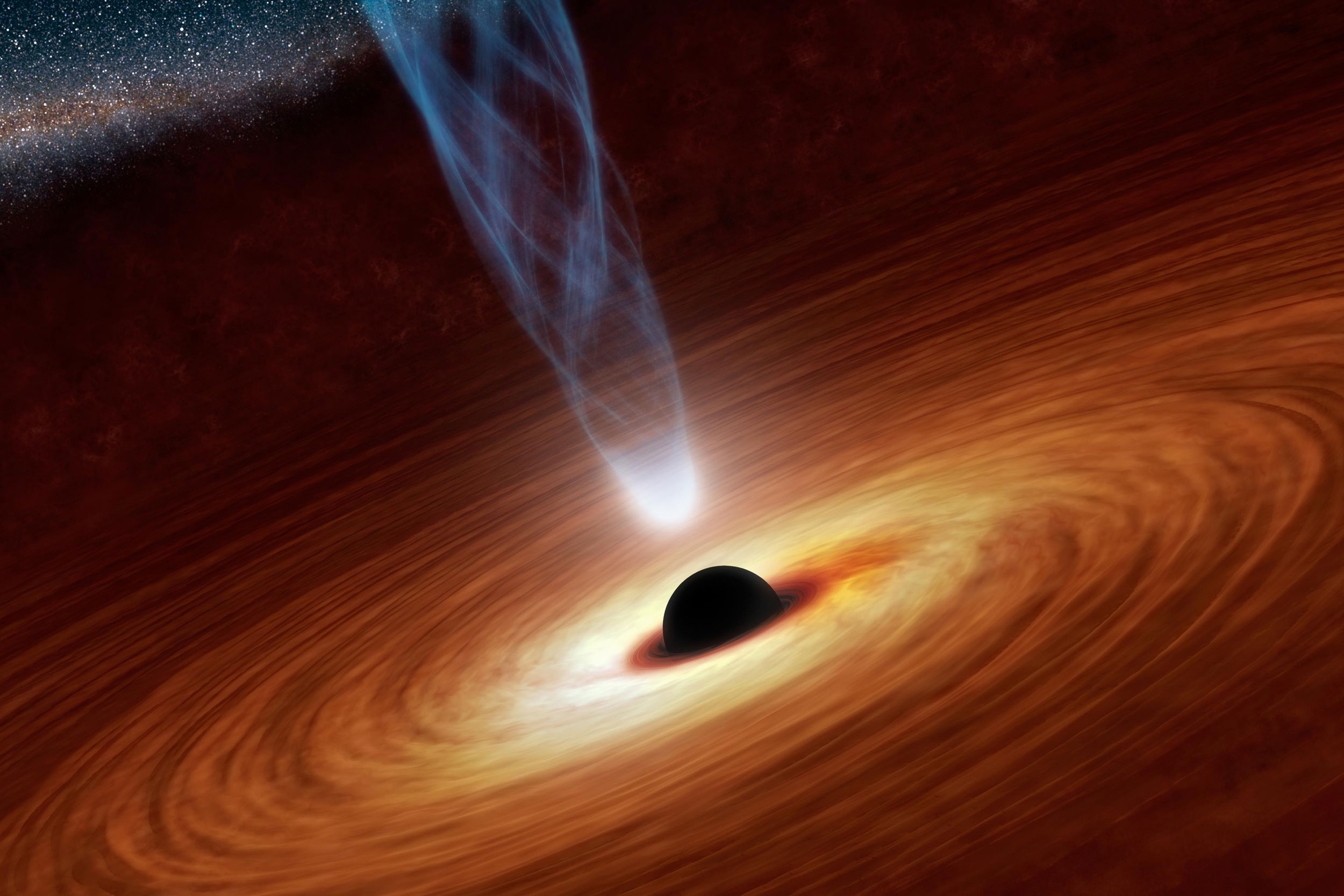
A supermassive black hole lies at the heart of every galaxy, including the Milky Way. When a black hole is active, it pulls material in as a whirlpool of high-temperature gas and dust. As this cosmic material piles up and falls onto a black hole, it lights up its vicinity, radiating a huge amount of energy.
The most energetic supermassive black holes are known as quasars, and they are some of the most active and luminous objects in the universe. These voracious systems take in so much material that the energy they emit can outshine all the light in the surrounding galaxy. The pattern of light from a quasar can give scientists clues to how active supermassive black holes shape the galaxies around them.
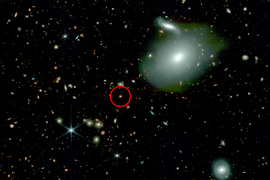
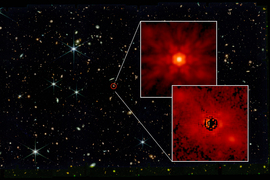
Now astronomers at MIT and elsewhere have detected a quasar flickering from the very early universe. The scientists traced the light from the quasar back to the “cosmic dawn,” just 850 million years after the Big Bang. The discovery represents the earliest flickering quasar detected to date.
“Although there have been a lot of quasars found in the cosmic dawn, this is the first time we actually see one flickering,” says Gene Leung, a postdoc in the MIT Kavli Institute for Astrophysics and Space Research.
The quasar’s flicker enabled the researchers to determine that, surprisingly, the ancient quasar’s whirlpool of gas and dust, known as an accretion disk, resembled a flat pancake, similar in shape to that of more modern-day quasars.
Their findings add to a longstanding mystery in cosmology: Why do supermassive black holes exist so early in the universe’s history? Physicists have assumed that a flat accretion disk reflects a relatively mature black hole that is in a calm and stable state. Black holes that are just starting to form, like those in the very early universe, should be more unsettled systems, with accretion disks that appear more puffy and chaotic.
The flat accretion disk around this very early quasar heightens the mystery of how supermassive black holes can grow and mature in a very short amount of cosmic time.
“I think what this suggests is that all the messy, very rapid growth phases that we expect all black holes to go through at some point happen very, very early on, before we see them as these very bright luminous quasars,” says Anna-Christina Eilers, assistant professor of physics at MIT. “That’s the picture that’s emerging.”
Eilers, Leung, and their colleagues report their results in a paper appearing today in Nature Astronomy. Their co-authors include members of MIT Kavli and multiple other institutions.
Past a pinprick
A supermassive black hole can be billions of times more massive than the sun. These gravitational giants are the central “engines” of most galaxies, helping to regulate a galaxy’s star formation and growth.
“Without supermassive black holes, no galaxy would look the way it does today,” Eilers says. “Black holes play a major role in shaping how galactic ecosystems look.”
It was long assumed that it should take more than a billion years for the first galaxies to settle and mature, so scientists didn’t expect to see supermassive black holes in the very early universe. But observations since the early 2000s showed otherwise. Scientists have spotted more than 200 supermassive black holes in the universe’s first billion years. Such objects were detectable because they were in an extremely active quasar phase, giving off enormous blasts of radiation that could be seen from Earth, 13 billion light years away.
These earliest quasars were observed as pinpricks of light, which signal the existence of a supermassive black hole at early times. But from these bright and distant dots, scientists aren’t able to tell much more about the black holes and their cosmic dawn environments. To do so, they need to catch a quasar’s “flicker.”
“People have known that quasars in the nearby universe can flicker,” Leung says. “The flickering comes from fluctuations in the way the gas is being fed into the black hole. And how a quasar flickers tells us something about the structure of a black hole’s accretion disk, and the kind of ‘bites’ that the black hole is eating.”
Mapping a flicker
Leung and Eilers looked to detect a flickering quasar from the early universe in hopes of learning more about the shape and structure of the earliest supermassive black holes. To do so would be a technical challenge: The further back in time and space an object is, the more distorted its light appears. This effect is due to the expanding universe, which effectively stretches, or “redshifts” light to redder, longer wavelengths. The same stretching occurs in time: Any flicker that naturally occurs over several weeks, for instance, would appear stretched out, flickering only every few months when seen from billions of light years away.
To spot a flickering quasar from the cosmic dawn, the team needed to observe the distant universe at redder wavelengths, and specifically within the infrared spectrum, and over long timescales of many years.
“This was the technical challenge we had to overcome,” Eilers says. “We needed data at longer, infrared wavelengths taken repeatedly over very long timescales.”
The team ultimately found a flicker in data collected by NASA’s Near-Earth Object Wide-field Infrared Survey Explorer (NEOWISE) mission — a space-based infrared telescope that scanned the entire sky over a total of about 14 years. Former MIT postdoc Kishalay De, who is now a faculty member at Columbia University, had launched a project to re-process archival data from NEOWISE. Based on the re-processed data, the team unearthed a signal, from just 850 million years after the Big Bang, which was confirmed to be the earliest flickering quasar.
“We saw the quasar flickering randomly over the 14-year period, much like a candle’s flame flickers without a fixed pattern,” Leung notes.
They estimate that the quasar is as bright as 12 trillion suns, and it is flickering by about 20 percent, meaning that it fluctuates up and down, by a brightness of about 2 trillion suns.
The researchers also tracked how the quasar’s light flickered over several different wavelengths. The wavelength of light reflects a certain temperature of the material that is emitting the light. The closer material is to a black hole, the hotter it is. Researchers can therefore use wavelengths of light to map the shape and structure of material within the accretion disk around a black hole.
Using NEOWISE data, the team analyzed the quasar’s flicker to determine the shape of the accretion disk surrounding the central supermassive black hole. They found that the disk is surprisingly thin and flat — a structure that astronomers mostly see around nearby, older black holes, that have had much longer to settle and mature.
“This provides direct evidence that the same feeding processes and structures observed in the nearby universe were already in place at very early times, despite very different cosmic environments, which had never been seen before,” Eilers says.
“This means something happened even earlier on that led to these systems to look so mature,” Leung adds.
The team hopes to peer even further back in cosmic time to catch a quasar’s earlier, premature development. Then, scientists can start to piece together the conditions that brewed up the first supermassive black holes.
This research was supported, in part, by NASA.