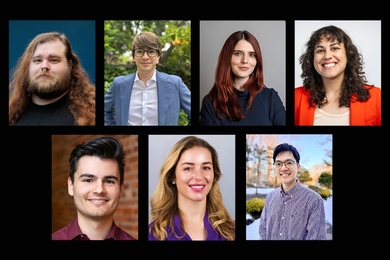
MIT Schwarzman College of Computing welcomes seven new faculty for 2026
Faculty members serve in core computing and shared roles, bringing a wide range of experiences and areas of expertise to the MIT community.
Faculty members serve in core computing and shared roles, bringing a wide range of experiences and areas of expertise to the MIT community.

An MIT faculty member for nearly half a century, Goldstone was a “theoretical physicist of rare talent and impact” who made fundamental contributions to multiple disciplines.
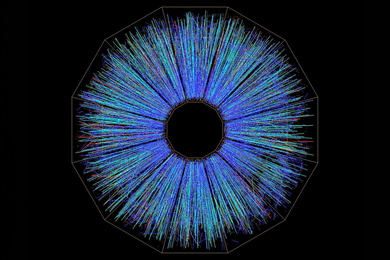
A new method picks up where Einstein left off, to predict how particles move through fluid under extreme conditions.
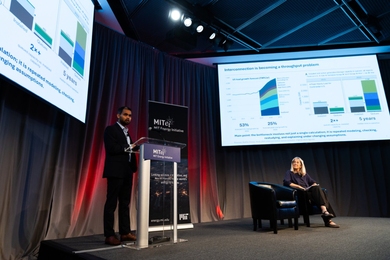
From a nuclear revival to qubits, the MIT Energy Initiative’s annual research conference tracked deployment of today’s technologies to discovery of tomorrow’s breakthroughs.
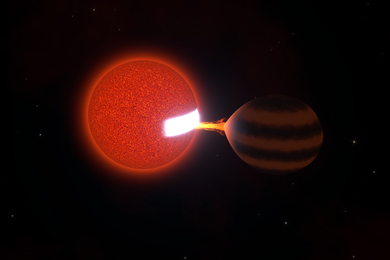
The discovery reveals a new way that stars and planetary companions can interact.
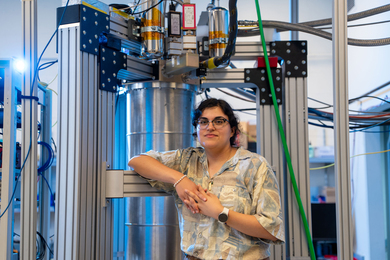
As she became integral to an international particle physics experiment, PhD student Faith Reyes found confidence in herself as a scientist.
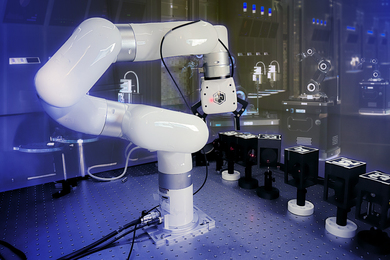
The autonomous system could speed up testing of high-tech materials for applications such as solar cells, sensors, video displays, and quantum technologies.
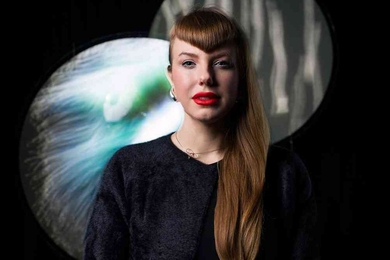
Inaugural artist Amy Karle will join astrophysicists at MIT’s Kavli Institute to explore questions about the universe and translate them into an immersive multimedia experience.

Due to physical and fundamental limitations, an earlier proposal for producing laserlike beams of neutrinos cannot be achieved, scientists report.
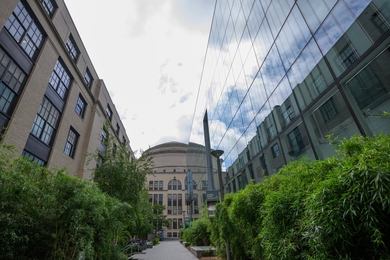
The Institute welcomes its first cohort of QMIT Fellows this fall to advance interdisciplinary quantum research.
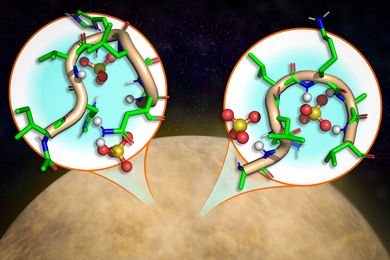
New research offers support for the possibility that complex biological molecules could exist in the highly acidic environment of Venus’s cloud layer.
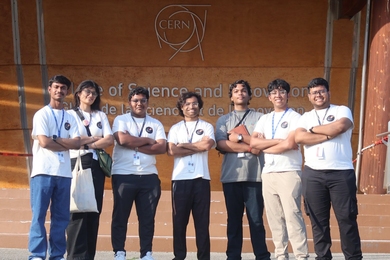
Physics PhD student Manu Srivastava helped high school students in India develop a test that could contribute to one of the world’s largest neutrino experiments.
The “CrysVCD” tool developed at MIT could cut the huge amounts of time and money spent on screening out chemically unstable designs.
The Materials Research Science and Engineering Center unites researchers across disciplines to develop technologies for medical imaging, sustainable metals production, and next-generation electronics.
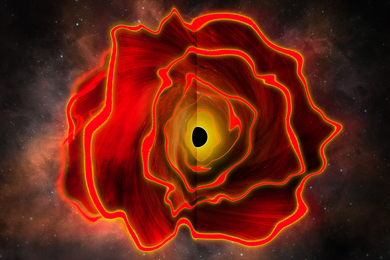
The mashup of a black hole and an enormous star has never been seen before and could explain the mysterious little red dots often found in deep-space images.