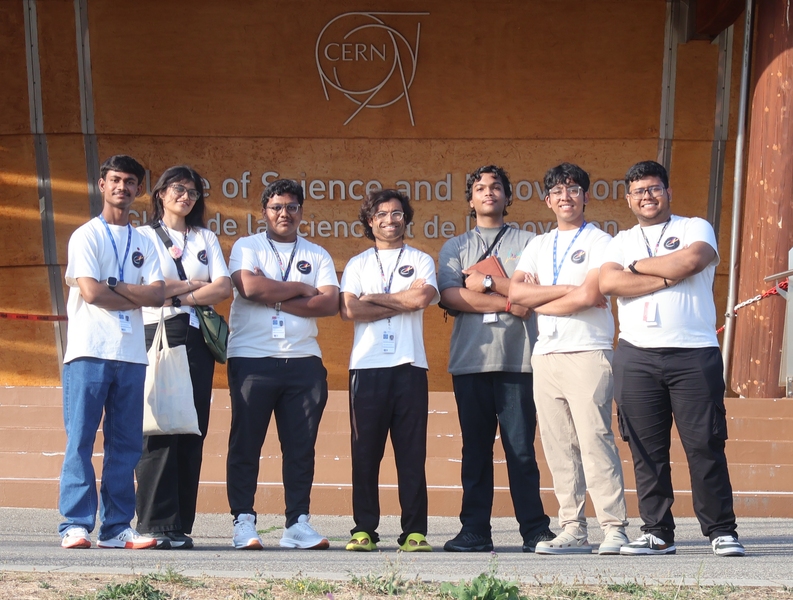
This past spring, MIT physics graduate student Manu Srivastava opened an email from a group of high school students in India he had never met.
They were hoping to enter Beamline for Schools, an international competition that gives secondary school students the chance to design and carry out experiments using particle accelerator beams. And they were looking for a mentor.
Srivastava, who studies quantum gravity as a PhD student in the MIT Center for Theoretical Physics – a Leinweber Institute, with Professor Hong Liu, gets other requests to mentor students, often through companies charging families for access to scientists or students at prestigious universities. He usually declines, but this message came directly from the students.
“I've also cold-emailed a lot in my early career, and it usually never works,” he says. “But this email seemed very genuine. They wanted to do something nice and they just needed some guidance.”
Many months and many more emails and calls later, the students secured a place with Srivastava to attend CERN, in Geneva, where they spent two weeks turning their proposed idea into a real experiment.
Finding an experiment worth doing
Calling themselves Team attoPION, the students are one of five teams selected in the 13th annual Beamline for Schools competition from a record 712 teams representing 89 countries and more than 4,500 students. The six high schoolers met through a combination of science competitions and mutual friends, and attend four schools in four cities across India.
When they first met with Srivastava, the students already had several experimental ideas. His role, he says, was to help determine which directions were practical and scientifically interesting.
They settled on measuring pion charge exchange. Pions are short-lived subatomic particles that can carry positive, negative, or neutral charge. In the process the students want to study, a positively charged pion interacts with a neutron in a target material, producing a neutral pion and a positively charged proton. The team wants to characterize how often that reaction occurs.
Srivastava suspected such a measurement could have relevance to the Deep Underground Neutrino Experiment, or DUNE, a major international experiment designed to study neutrinos.
Dave Newbold, a co-spokesperson for DUNE, says understanding how pions interact with matter helps researchers quantify uncertainties in DUNE’s measurements. In particular, pion interactions can affect estimates of a neutrino’s flavor and energy, which researchers need to measure accurately to determine whether they have observed something new.
And although Beamline for Schools has an educational mission, Newbold says the students aren't simply reproducing a classroom demonstration. “The proposal is real experimental particle physics!” he notes.
If successful, Newbold believes the work could improve scientists' understanding of this particular interaction and potentially lead to a publishable result. Similar “test beam” experiments remain important tools in particle physics: DUNE's detector designs were themselves demonstrated using the (albeit much larger) ProtoDUNE experiments at CERN.
“This [proposal] stands out because of the work the students have put into motivating their measurement, and demonstrating that the experiment is feasible,” Newbold says. “It's certainly at a level far above anything I was thinking about at high school.”
Learning to navigate uncertainty
At CERN, the students worked hands-on with detectors and data-acquisition systems, collected and analyze data, and attended talks by CERN scientists.
In advance of the trip, the team worked with Berare Göktürk, one of the support scientists for Beamline for Schools. In their preparation sessions for the experiment, they realized that the charge-exchange process they hope to observe is extremely rare, forcing them to think through how they might reliably detect it.
With just a few months months to prepare and only 12 days of test-beam time, Göktürk cautioned that producing a result useful to a much larger experiment would be an ambitious outcome.
“We prepare in the best way possible, but we also stay humble and we are aware of the limitations we have,” she says. Her priority is for the students to “understand the journey of a scientist” as they encounter technical problems and work together to solve them.
For Srivastava, mentoring an experiment has also taken him well outside his own specialty. A theoretical physicist, he credits MIT's culture with encouraging him to follow questions beyond the boundaries of his research, including by attending seminars, colloquia, and research meetings across physics.
The experience has been personally meaningful for Srivastava, who grew up in India and sees the mentorship as a way to encourage young people there to pursue fundamental science.
“I didn't even know what CERN was in high school,” he says. “But these students, they are just that good. They deserve all the credit.”