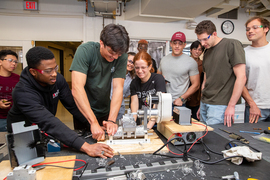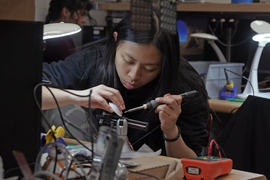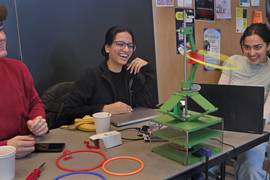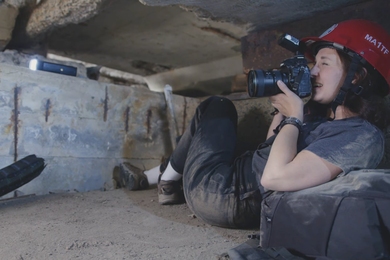
Repeatability in engineering product design ensures that a manufacturing process performs the same way every time and allows for a working prototype to be transformed into a reliable, safe, consistent, and cost-effective mass-market product. For students in class 2.70 (Fundamentals of Precision Product Design), precision and repeatability are the name of the game.
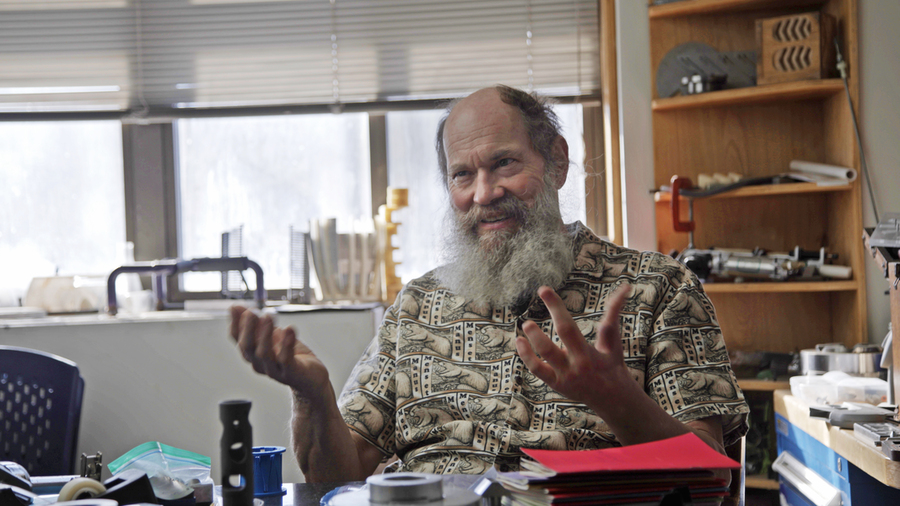
“[As an engineer], you have an extra responsibility to overlook nothing,” says course instructor Alex Slocum, the Walter M. and A. Hazel May Professor of Mechanical Engineering. “If you miss something, someone could be hurt or die.”
Slocum’s message is serious, but his approach to teaching the material is famously fun — in fact, he prefers the spelling “FUNdaMENTALs” for the first word of the class name. His mother, Mariana Polonsky Slocum, was a mathematics professor at MIT. “She taught me, physics doesn't care about your feelings,” he says. “I want [students] to understand that we are governed by the laws of physics, and that is a catalyst for creativity, not a hindrance. It is a hindrance if you forget that.”

Through the course, students learn deterministic design, selection, and assembly of machine elements to create and manufacture robust precision machines, instruments, and systems. They also apply Slocum’s “Functional Requirements, Ergonomics and Environment, Design Parameters, Analysis, References, Risks, Countermeasures” (FRED PARRC, pronounced like “Fred Park”) model, and engage in peer review and evaluation.
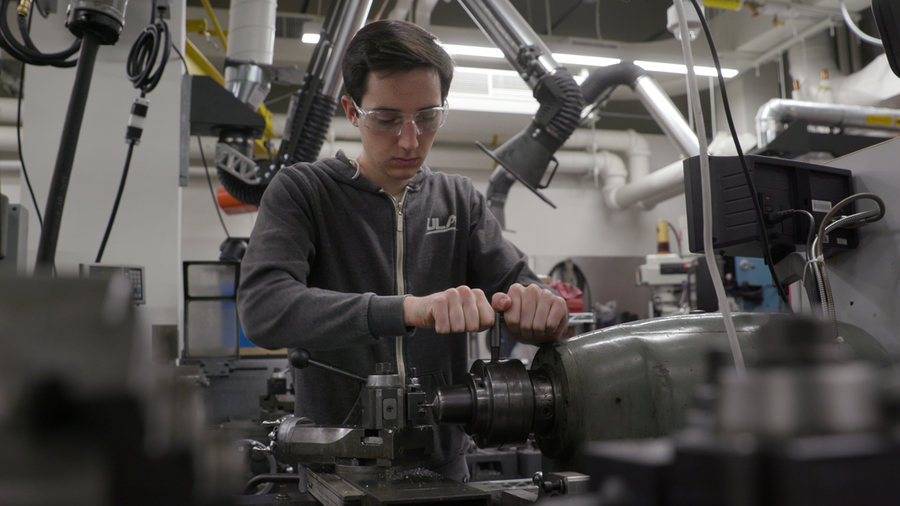
“You get a lot of time working on problems that just pop up in engineering. To me, it felt very [representative] of the grad work that I was doing,” says Mariia Smyk, a graduate student in mechanical engineering.
Some students may describe the course as “creative chaos,” but tend to agree that their learning experience is one that drives home the fundamentals.
“It definitely made me more confident knowing that I can look at what I'm designing and be very deliberate in taking steps toward mitigating the risks that anyone would face when they use a product,” says graduate student Adian Salazar. “I feel like I've been able to apply all those really fundamental concepts that I learned in the more theory-heavy classes to real-world machines.”