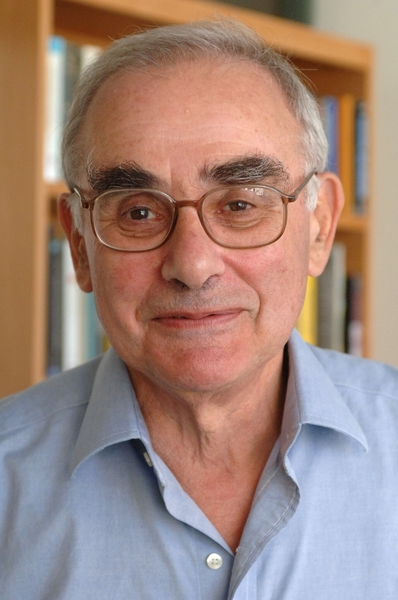
Eminent theoretical physicist Jeffrey Goldstone, an MIT professor emeritus, Dirac Medalist, and holder of the Department of Physics’ Cecil and Ida Green chair, died Oct. 12 at age 93.
A member of the MIT physics community for 49 years, Goldstone was especially known for his influential work in quantum field theory as well as contributions to quantum optimization algorithms. Notably, he is the namesake of the Goldstone boson and the related Goldstone theorem.
“Jeffrey was a giant of theoretical physics who will be long remembered and very much missed,” says Tracy Slatyer, director of the MIT Center for Theoretical Physics – a Leinweber Institute (CTP-LI) and professor of physics. “He contributed greatly to the CTP-LI over the years, and it was an honor to have him as a colleague.”
“Goldstone was a brilliant theoretical physicist and a charming, yet diffident and remarkably humble human being,” says Frank Wilczek, a CTP-LI colleague who is the Herman Feshbach Professor of Physics, Emeritus, and a 2004 Nobel laureate. “He made renowned, fundamental contributions to diverse areas of physics, ranging from condensed matter and quantum computing to string theory. Throughout, you can perceive a consistent style: enormous mathematical talent brought to bear on important, concrete, sharply posed physical problems.”
Goldstone is renowned for his remarkable range of groundbreaking discoveries. He began his career as a nuclear theorist. In his early work on nuclear matter with Hans Bethe, he developed the use of Feynman diagrams for non-relativistic many-fermion systems.
He later turned to particle physics, investigating relativistic field theories with spontaneously broken symmetries. Building on ideas inspired by superconductivity, he demonstrated that spontaneously broken continuous symmetries must be accompanied by massless, spinless particles — now widely known as Goldstone bosons (or Nambu-Goldstone bosons, in recognition of Yoichiro Nambu’s earlier related insights).
In subsequent work with Abdus Salam and Steven Weinberg, Goldstone formalized and generalized this result, which became known as the Goldstone theorem. With Claudio Rebbi, Charles Thorn, and Peter Goddard, he worked out the light-cone quantization of relativistic strings, a foundational result in string theory. Goldstone also worked with Roman Jackiw and Frank Wilczek on solitons in quantum field theory.
Goldstone was born in 1933 in Manchester, England. He earned his PhD from Trinity College at the University of Cambridge in 1958 and completed postdoctoral work at Cambridge, Harvard University, CERN, and Copenhagen University. After shifting his focus to particle theory, he joined the faculty at Cambridge in 1962. He moved to MIT as a professor of physics in 1977 and as a researcher in the Laboratory for Nuclear Science, and was appointed the Cecil and Ida Green Professor of Physics in 1983. Goldstone served as director of the Center for Theoretical Physics (now known as the CTP-LI) from 1983 to 1989.
“Goldstone’s name will always be associated with spontaneous symmetry breaking, where 'Goldstone’s theorem' and 'Goldstone bosons' feature prominently,” Wilczek notes. “His early, seminal papers relating the mathematical concept to physical phenomena gave firm foundations upon which people built fruitful theories of magnetism, meson physics, and eventually the Standard Model and early universe cosmology.
“Jeffrey Goldstone’s ideas are so deeply woven into physics that it takes an occasion like his passing to remind us how much we owe him. I had the pleasure to work with Jeffrey in the early days of fractional charge. The short paper we wrote together is one that I’m especially proud of. It contains the seeds of many later developments. Thank you, Jeffrey, for that fond memory.”
Alan Guth ’69, PhD ’72, MIT’s Victor F. Weisskopf Professor of Physics, Post-Tenure, says, “Jeffrey was a wonderful friend and colleague, and a towering figure in theoretical physics. When I was trying to arrange to come back to MIT after being a postdoc for nine years at other places, it was Jeffrey who I contacted to try to make this happen. When I first learned in 1981 that Andrei Linde had figured out how to make cosmic inflation work, in the form known as 'new inflation,’ I remember that I ran into Jeffrey's office to share my excitement. I have learned a great deal from Jeffrey over the years, and will forever have warm memories of our friendship.”
“Jeffrey Goldstone was a theoretical physicist of rare talent and impact,” says David Kaiser, MIT professor of physics and the Germeshausen Professor of the History of Science. “His landmark article, 'Field theories with superconductor solutions,' published in 1961, helped to launch the modern era of symmetry breaking in high-energy physics. Building on insights from neighboring fields such as condensed-matter physics, Goldstone demonstrated that for any model in which a continuous symmetry is spontaneously broken, there will emerge zero-mass, zero-spin particles now known as 'Goldstone bosons.' His watershed study, and several influential follow-up articles, have become central to our Standard Model of particle physics, with further application as far afield as early-universe cosmology to spin waves in magnetic materials and quantized vibrations in excited fluids. Later in his career, Goldstone turned his attention to quantum information science, helping to construct several novel algorithms for quantum computation.
“Typically reserved, his close friends admired his droll humor. Writing to Harvard physicist Sidney Coleman in November 1976, for example, Goldstone declined Coleman’s invitation to attend an upcoming physics workshop. 'I expect to be in total confusion during January [1977] and wish to simplify my life,’ Goldstone replied. 'Forty-three years in the womb’ — including decades at his alma mater, the University of Cambridge — 'have unfitted me for coping with normal trivial details of survival. It’s probably a good thing I’m coming out, but the birth pangs are hell.’
“The birthing event to which Goldstone referred was his move to MIT to join the Physics Department faculty in 1977. Thank goodness he braved the move. Over nearly 50 years, Jeffrey Goldstone enriched our Department of Physics at MIT, and especially our Center for Theoretical Physics – A Leinweber Institute, with his deep insights and gentle manner.”
Even after retiring from MIT, he remained active in research for the next two decades, working in quantum computation.
Edward Farhi, professor emeritus of physics and a frequent collaborator for over 20 years, describes Goldstone’s contribution to the field from its early stages as “very significant.”
“FFG [Farhi, Goldstone, and Samuel Gutmann] teamed up with Donner Professor of Mathematics Michael Sipser and showed that there was a problem which could not be sped up with a quantum computer, learning parity in the oracle setting,” Farhi says. “This was the first demonstration of this kind of limitation, although the same week another group proved the same thing by a different method. In 2000 FGG, along with Sipser, introduced the concept of Quantum Computation by Adiabatic Evolution. This is an all-purpose approach to optimization and was later shown to be universal, which means that any quantum computation can be encoded as quantum adiabatic. Furthermore, the company D-wave was founded to run this algorithm. D-wave is the progenitor of all of the superconducting hardware efforts such at the ones at Google and IBM. We later showed that using scattering theory a quantum computer could determine who wins a game provably faster than the best classical algorithm for this task.
“FGG introduced the Quantum Approximate Optimization Algorithm. This was the first time a general purpose quantum optimizer could provide worst-case performance guarantees for combinatorial optimization problems. These guarantees as of now (with one exception) do not beat the best classical. Still, this paper has over 6,000 citations, making QAOA one the most-studied quantum algorithms.
“In 2019, FGG and Leo Zhou applied the QAOA to the Sherrington-Kirkpatrick model. We showed how to analyze performance in the infinite size limit at any depth. Our work and others indicated that as depth increases with optimal parameters, the QAOA would approach the celebrated Parisi value. Recently the Open AI math dump, the conjecture that the QAOA would hit Parisi, was proven by the AI. I bet Jeffrey would have been surprised and impressed!”
Jeffrey Goldstone was a fellow of the American Physical Society Fellow, the Royal Society, and the American Academy of Arts and Sciences, and he was an honorary fellow of Trinity College, Cambridge.
His honors included the Guthrie Medal of the Institute of Physics, the Dannie Heineman Prize for Mathematical Physics of the APS, and with Stanley Mandelstam the Dirac Medal (1991) of the Abdus Salam International Centre for Theoretical Physics, awarded for “his fundamental clarification of the phenomenon of spontaneous symmetry violation in relativistic field theory.”
He is survived by his son Andrew Goldstone, associate professor of English at Rutgers University’s New Brunswick campus; his daughter-in-law Anne Dewitt, a clinical associate professor at New York University’s Gallatin School of Individualized Study; and his granddaughter, Helen. His family is planning a memorial in 2027.