The Department of Mechanical Engineering will host the 33rd annual Design 2.007 contest Tuesday, May 6 at 6:30 p.m. and Wednesday, May 7 at 6 p.m in the Johnson Athletic Center.
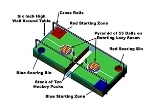
The mother of all robot competitions, 2.007 is an elimination tournament in which robots designed and built during the semester by students in 2.007 (Introduction to Design and Manufacturing) compete in 45-second rounds. This year's contest is titled "Two Tables."
"You haven't lived until you've experienced the Two Tables contest," said MacVicar Fellow Alexander H. Slocum, professor of mechanical engineering, the head instructor for 2.007 and the contest's emcee. "Two tables, separated by a chasm yet spanned by a rod of hope, challenge this year's mechanical wizards. After leaping, charging or flying across the gap, they must score first with balls or pucks before they can seek to confuzzle their co-celebrator's attempts to score."
Offensive tactics to watch for this year include setting up barriers so competitors can't drop balls or pucks into the weigh-in buckets, as well as engaging, covering or encircling the opponent's rotating table, pyramid of balls or puck stack.
A genre of robot action, the "molestabot," brings misery and frustration to its opponent.
At the beginning of the semester, students are given a kit of materials and asked to design a robot to accomplish a certain task.
The first contest was in 1970 and the first to have an official name ("A Better Mousetrap") was in 1972. Since then, Design 2.007 has had titles ranging from political ("Watergater" in 1974) to pop culture ("The Cuckoo's Nest" in 1988) to whimsical ("Ballcano" in 1997 and "MechEverest" in 1998). The robots have had to gather plastic bottles, ping-pong balls or hockey pucks; move glass marbles; and play tug of war.
Kits in the early years included such items as computer cards, Venetian blind slats, plastic spoons, tongue depressors, rubber bands, paper clips, a pencil, and a pound of sand.
For more information on the contest or the course, go to http://pergatory.mit.edu/2.007.
A version of this article appeared in MIT Tech Talk on April 30, 2003.