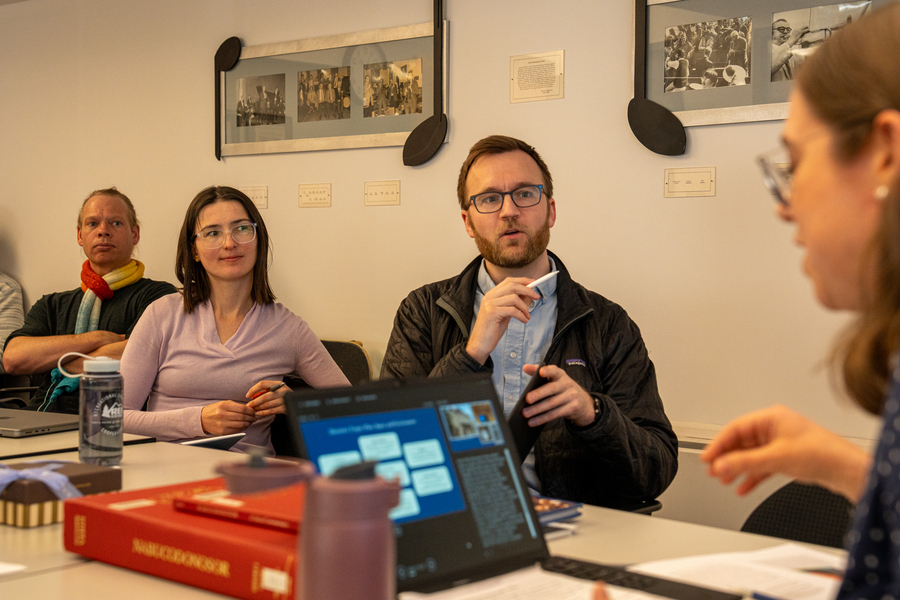
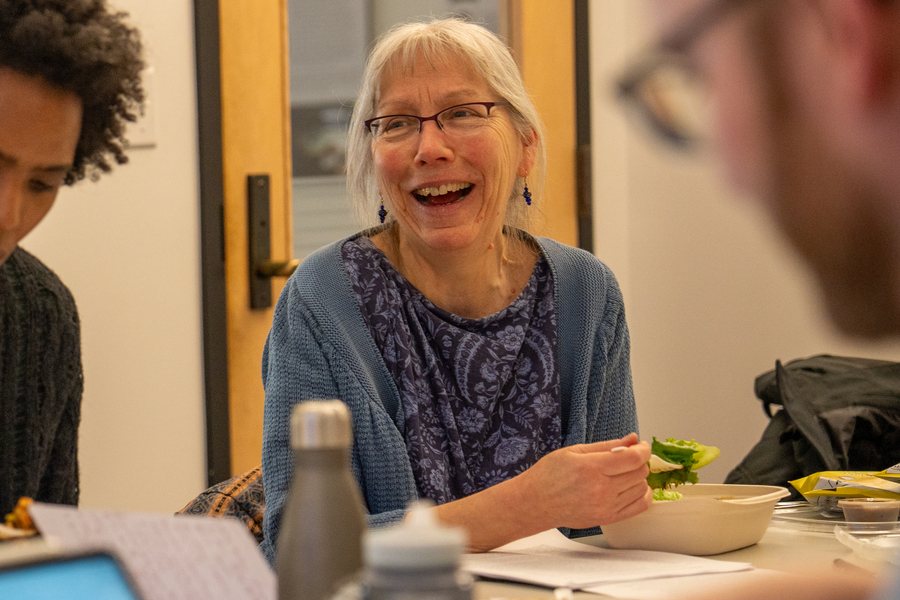
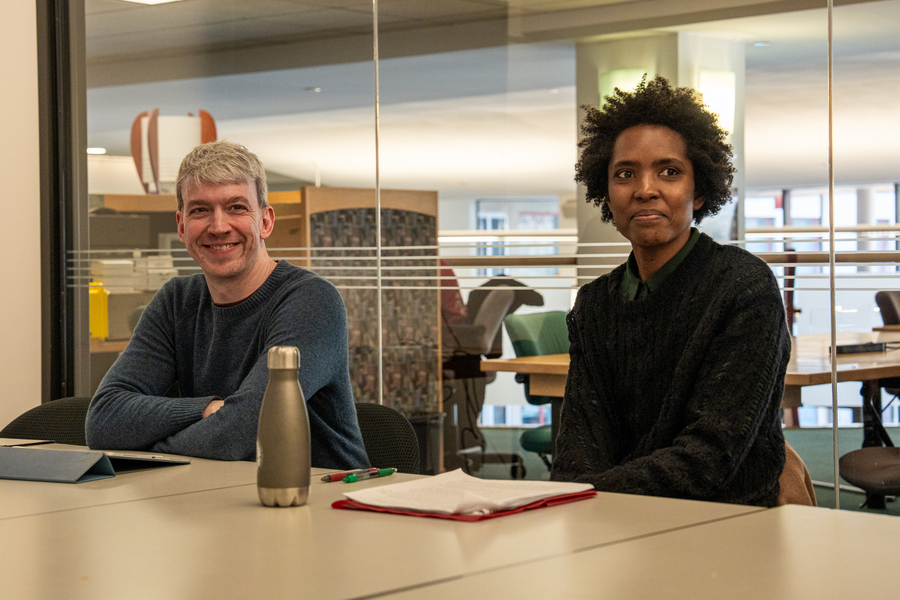
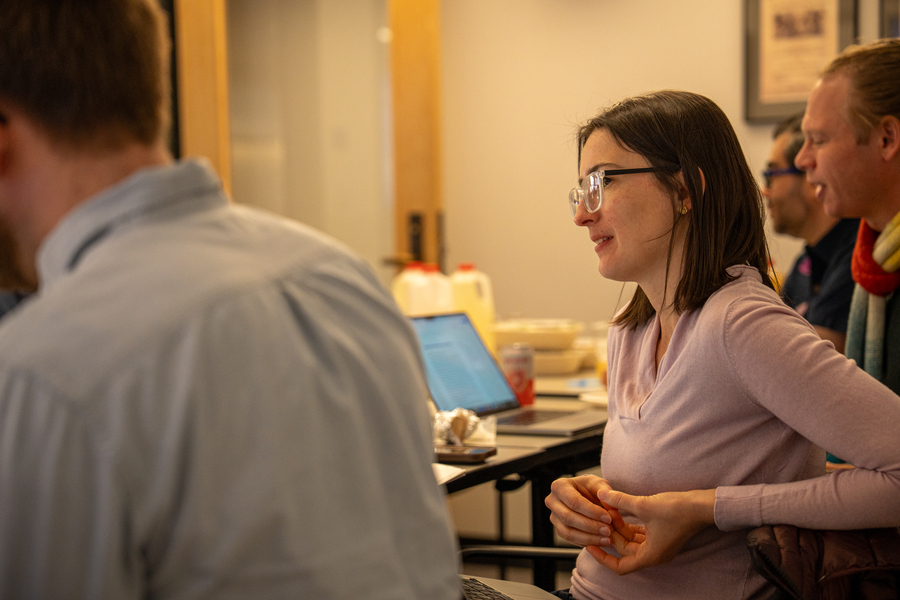
On a Wednesday afternoon in April, a cohort of scholars from the School of Humanities, Arts, and Social Sciences (SHASS) gathered in MIT’s Lewis Music Library.
This group of seven professors are the inaugural SHASS Faculty Fellows, a semester-long program launched this past spring. The faculty represent a variety of disciplines across the school. They met biweekly through the spring to connect over lunch and present updates on their respective research projects.
At this particular meeting, associate professor of music Emily Richmond Pollock presented some of her work — a chapter about an opera festival in Sarasota, Florida — which, she says, started from “my own curiosity about how American institutions relate to opera’s traditions and practices.”
After Pollock’s presentation, the group discussed and provided a sounding board for her work. It’s precisely the type of scholarly environment the SHASS Faculty Fellows program was designed to foster.
“The fellows program is a recognition of the fact that not only do we benefit from being in conversation with other scholars, but even more so when in conversation with scholars who do things differently than we do, who approach problems with different opening questions and methodologies,” says Anne McCants, the Ann F. Friedlaender Professor of History and Faculty Fellows Program Committee chair.
Along with committee member and literature professor Arthur Bahr, McCants serves as a kind of moderator during the discussions, asking pointed questions and interrogating participants’ assumptions.
“A small group of people coming from diverse scholarly backgrounds meeting regularly to share a meal and sustained conversation can have a truly outsized impact on their scholarship,” McCants adds.
Time to focus and connect
Faculty must apply to take part in the program, and are selected by the program committee. The program is administered by the MIT Human Insight Collaborative (MITHIC).
Participants take advantage of opportunities to share and discuss ideas with students, too. Volha Charnysh, a Faculty Fellow and the Ford Career Development Associate Professor of Political Science in the Department of Political Science, presented research on the effects of large-scale humanitarian aid to the Burchard Scholars. The Burchard Scholars program connects faculty and promising MIT sophomores and juniors who have demonstrated excellence in some aspect of the humanities, arts, or social sciences.
Projects can run the gamut. Participants might develop scholarly articles, develop book manuscripts, or dig deeper into existing research.
“The Faculty Fellows Program has two primary aims: to enrich faculty members’ scholarly programs, and to foster collegial community within the school,” says Heather Paxson, associate dean for faculty in SHASS, the William R. Kenan, Jr. Professor of Anthropology, and MITHIC faculty co-lead. “Participants in the program gain a better sense of the breadth and depth of our school’s scholarly contributions, and some may forge lasting connections with colleagues they might not otherwise have gotten to know.”
For Pollock, the fellows program this past spring was an opportunity to focus on her current research.
“I’m working on a book about a set of five opera festivals in the United States,” Pollock says of the project, “Opera on Uncommon Ground: Five American Festivals.”
“These are annual, seasonal opera companies where rare repertoire is often performed alongside canonical works, in places that are outside of major cities, and performed in unusual spaces.”
“I hope that anyone who loves opera will be able to read and enjoy my book,” she says, including “opera ‘superfans’” Pollock says she has in mind while writing.
Pollock says the program gave her the space she needed to continue her project. “This semester [in the program] has been wonderful so I could get back to drafting and really concentrate on a book I am excited to write.”
“I am so inspired each week when we meet”
Faculty Fellow Richard Nielsen, associate professor of political science, faculty director of the MIT-MENA Program, and a Security Studies Program affiliate, is hard at work on his project, “Fighting War with Divine Intervention,” a book about how combatants’ beliefs affect wars. Using material from a diverse set of cases — the Islamic State, the Confederate States of America, and the current U.S. engagement with Iran — he wants to understand when claims about divine intervention motivate fighters and citizens to fight harder and longer for victory, even when the state of the battlefield strongly suggests they have lost already.
“We understand a lot about how religion might shape the conditions for war and peace, but religion matters during wars, too, and we understand surprisingly little about how religious claims affect leaders and fighters in combat,” he says.
Nielsen lauds the collegial atmosphere available in the fellows program, citing the importance of engagement with scholars outside his research area as a significant draw. “The best part has actually been the engagement with a diverse set of fellows,” he notes, “pursuing a dizzying variety of humanist and social science projects. I am so inspired each week we meet, and every single project has me exclaiming ‘I wish I was writing this!’”
“It adds a regular ongoing conversation with scholars not like yourself who will push you, likely accidentally, in unexpected directions,” McCants says of the fellows’ meetings. Conferring with other participants about their projects, meanwhile, helps Nielsen “return to my research with fresh eyes and enthusiasm,” he says.
Pollock appreciates the camaraderie available as a program participant. “I value my colleagues so highly — the other fellows and mentors are people I really admire and respect — and it’s been fun to trade work and get to read work in progress far outside my field,” she says.
Twelve professors have been named SHASS Faculty Fellows for the 2026-27 academic year, with six taking part in the fall and another six in the spring.
The inaugural group of fellows included:
- Héctor Beltrán, the Class of 1957 Career Development Associate Professor of Anthropology;
- Volha Charnysh, the Ford Career Development Associate Professor of Political Science;
- Kevin Dorst, associate professor of philosophy;
- Richard Nielsen, associate professor of political science;
- Emily Richmond Pollock, associate professor of music;
- Jessica Ruffin, assistant professor of literature; and
- Robin Scheffler, associate professor of science, technology, and society.
Applications for the next cohort of fellows will open this fall.