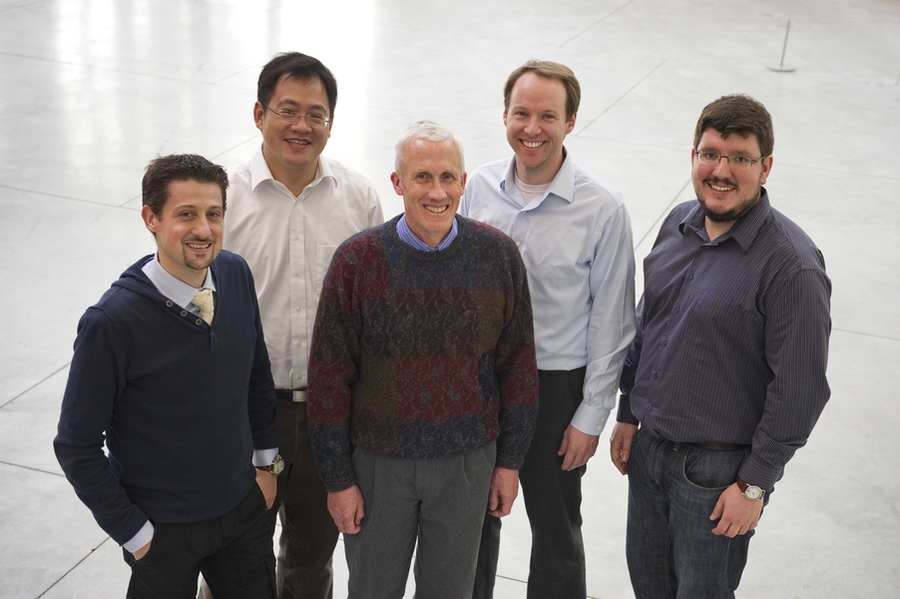
Since the earliest days of science, the interplay of theory and experimentation has been the primary method of creating new knowledge. Today, the affordability of massive computing power has added a third tool to the researcher’s workbench: computational modeling and simulation, which is rapidly being integrated across the Department of Nuclear Science and Engineering (NSE) curriculum by a group of new faculty members with in-depth experience.
“In the past, science and engineering relied on experimentation and theory, aided by relatively simple calculations,” notes Ju Li, who holds professorships in both NSE and the Department of Materials Science and Engineering, and who led the development of a newly offered course, Computational Nuclear Science and Engineering. “Now, computer simulation has become the third leg of scientific inquiry and engineering, which supplements what we find with experimentation and theory.”
The combination of the three brings unprecedented power to bear on challenges such as developing new nuclear materials, designing reactor components and assessing complex system-level interactions, in fission, fusion and radiation technology applications.
Li notes that experimental and theoretical methods are certainly not being replaced, but that computer simulations can address some of their limitations.
“Experimentation often produces only a few critical pieces of measurement, and you typically can’t have perfect initial and boundary conditions. Analytical theory gives big-picture insights, but it has to take a simplified view of the world. So in complex systems, when there are many parameters, or when systems are coupled together, it becomes intractable. Simulation is very data-rich, so one can see how internal states are coupled, and one can do parametric studies, which are sometimes difficult to do experimentally.”
The new computational science and engineering course, 22.107, will give NSE graduate students what Li calls “intermediate-level proficiency” in three core skills: programming, mathematical understanding of algorithms, and construction and interpretation of models. “Our grad students have diverse backgrounds — mechanical engineering, chemistry, physics — and they will enter diverse fields after graduation. But being able to identify problems that are amenable to computer-aided solutions, and then actually implementing the programming and debugging, and interpreting the results, will all be key survival skills.”
Read the full feature
“In the past, science and engineering relied on experimentation and theory, aided by relatively simple calculations,” notes Ju Li, who holds professorships in both NSE and the Department of Materials Science and Engineering, and who led the development of a newly offered course, Computational Nuclear Science and Engineering. “Now, computer simulation has become the third leg of scientific inquiry and engineering, which supplements what we find with experimentation and theory.”
The combination of the three brings unprecedented power to bear on challenges such as developing new nuclear materials, designing reactor components and assessing complex system-level interactions, in fission, fusion and radiation technology applications.
Li notes that experimental and theoretical methods are certainly not being replaced, but that computer simulations can address some of their limitations.
“Experimentation often produces only a few critical pieces of measurement, and you typically can’t have perfect initial and boundary conditions. Analytical theory gives big-picture insights, but it has to take a simplified view of the world. So in complex systems, when there are many parameters, or when systems are coupled together, it becomes intractable. Simulation is very data-rich, so one can see how internal states are coupled, and one can do parametric studies, which are sometimes difficult to do experimentally.”
The new computational science and engineering course, 22.107, will give NSE graduate students what Li calls “intermediate-level proficiency” in three core skills: programming, mathematical understanding of algorithms, and construction and interpretation of models. “Our grad students have diverse backgrounds — mechanical engineering, chemistry, physics — and they will enter diverse fields after graduation. But being able to identify problems that are amenable to computer-aided solutions, and then actually implementing the programming and debugging, and interpreting the results, will all be key survival skills.”
Read the full feature