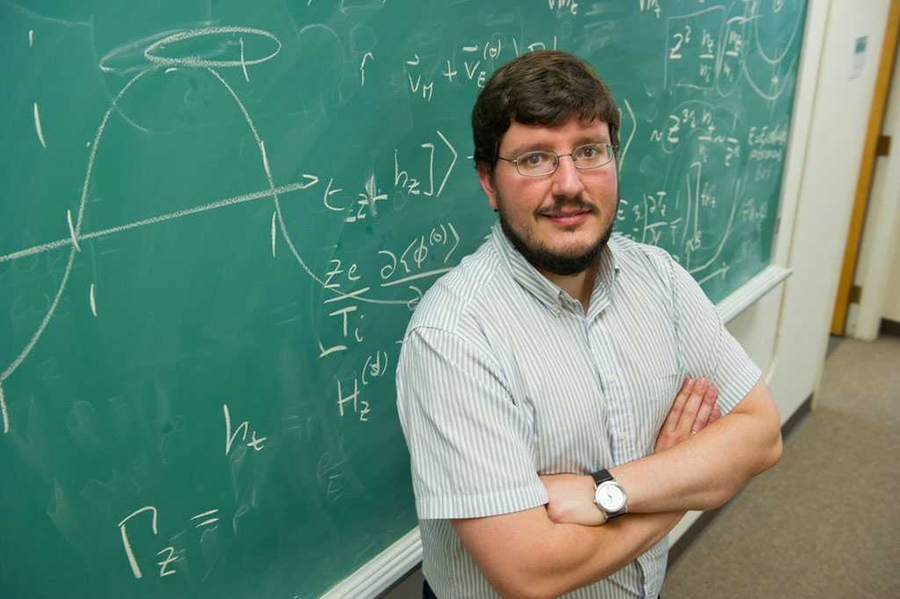
Nuclear fusion has tremendous potential to provide clean, safe power generation on a grand scale, but realizing that potential has challenged researchers worldwide for decades. However, newly appointed Department of Nuclear Science and Engineering (NSE) Assistant Professor Felix Parra says that a convergence of theoretical insights and newly available computing power could enable significant advances toward functional fusion reactors.
Parra will conduct his research in the Theory Group of the Plasma Science and Fusion Center (PSFC), home to a tokamak fusion reactor (Alcator C-Mod) and a central node of international collaboration leading toward the scheduled 2019 startup of the large-scale ITER tokamak in France. The basic challenge: achieve the elusive “burning plasma,” a stable fusion reaction that can maintain its own extremely high temperature and create more energy than it takes in.
“Tokamaks should work quite well,” Parra says. “But they suffer very small-scale fluctuations in the plasma,” where hydrogen isotopes are heated and ionized to create the conditions for them to fuse and release thermonuclear energy. “While the particles should be well-confined, they tend to get pushed out, and the performance is not what we expect. The great thing is, we’ve been able to develop a simplified theory of plasma behavior, and in doing so, achieved the ability to simulate it with much less computing power.”
At the same time, new generations of computing tools are making it possible (and affordable) to run large numbers of simulations, “so we can explore physics that was hidden before,” Parra notes. “The question now is, can we use these new available tools to unravel the secrets of turbulence, and gain control over it.”
Read the full feature at NSE's website
Parra will conduct his research in the Theory Group of the Plasma Science and Fusion Center (PSFC), home to a tokamak fusion reactor (Alcator C-Mod) and a central node of international collaboration leading toward the scheduled 2019 startup of the large-scale ITER tokamak in France. The basic challenge: achieve the elusive “burning plasma,” a stable fusion reaction that can maintain its own extremely high temperature and create more energy than it takes in.
“Tokamaks should work quite well,” Parra says. “But they suffer very small-scale fluctuations in the plasma,” where hydrogen isotopes are heated and ionized to create the conditions for them to fuse and release thermonuclear energy. “While the particles should be well-confined, they tend to get pushed out, and the performance is not what we expect. The great thing is, we’ve been able to develop a simplified theory of plasma behavior, and in doing so, achieved the ability to simulate it with much less computing power.”
At the same time, new generations of computing tools are making it possible (and affordable) to run large numbers of simulations, “so we can explore physics that was hidden before,” Parra notes. “The question now is, can we use these new available tools to unravel the secrets of turbulence, and gain control over it.”
Read the full feature at NSE's website