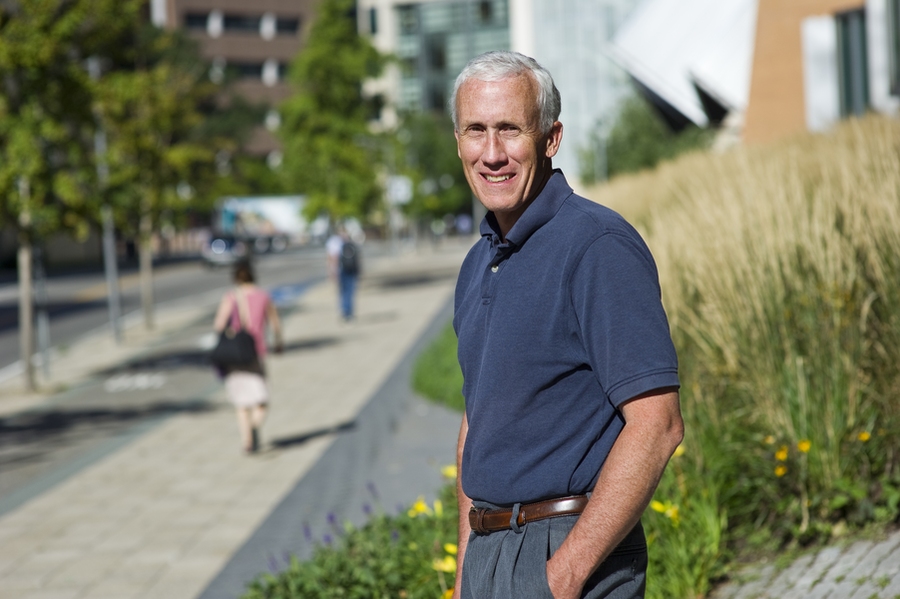
Increasingly powerful computation technology has long been central to the advancement of reactor engineering and nuclear power generation. Few people have played a greater role in that process — or have more knowledge to share — than Kord Smith, the newly appointed Korea Electric Power Company Professor of the Practice of Nuclear Science and Engineering.
Since earning his SM (1979) and PhD (1980) at MIT's Department of Nuclear Science and Engineering (NSE), Kord Smith has not only developed some of the world’s most widely used software for reactor physics modeling and simulation, but also flourished in business, co-founding a successful company — Studsvik Scandpower — which supplies software for reactor core design, analysis and operations to a majority of the world’s nuclear utilities and reactor fuel vendors.
A major recognition of Smith’s skills came this year when he was named chief scientist for the Center for Exascale Simulation of Advanced Reactors (CESAR), an interdisciplinary public-private effort of the Department of Energy’s Office of Science aimed at creating an entirely new generation of nuclear-related computing technology. An especially interesting aspect of the program is its emphasis on parallel co-design of high performance computing (HPC) hardware and software, to ensure that next-generation HPC platforms will be ready for use in diverse disciplines such as advanced materials development, combustion engineering and reactor simulation when machines are delivered in the 2019 time frame.
Read full article
Since earning his SM (1979) and PhD (1980) at MIT's Department of Nuclear Science and Engineering (NSE), Kord Smith has not only developed some of the world’s most widely used software for reactor physics modeling and simulation, but also flourished in business, co-founding a successful company — Studsvik Scandpower — which supplies software for reactor core design, analysis and operations to a majority of the world’s nuclear utilities and reactor fuel vendors.
A major recognition of Smith’s skills came this year when he was named chief scientist for the Center for Exascale Simulation of Advanced Reactors (CESAR), an interdisciplinary public-private effort of the Department of Energy’s Office of Science aimed at creating an entirely new generation of nuclear-related computing technology. An especially interesting aspect of the program is its emphasis on parallel co-design of high performance computing (HPC) hardware and software, to ensure that next-generation HPC platforms will be ready for use in diverse disciplines such as advanced materials development, combustion engineering and reactor simulation when machines are delivered in the 2019 time frame.
Read full article