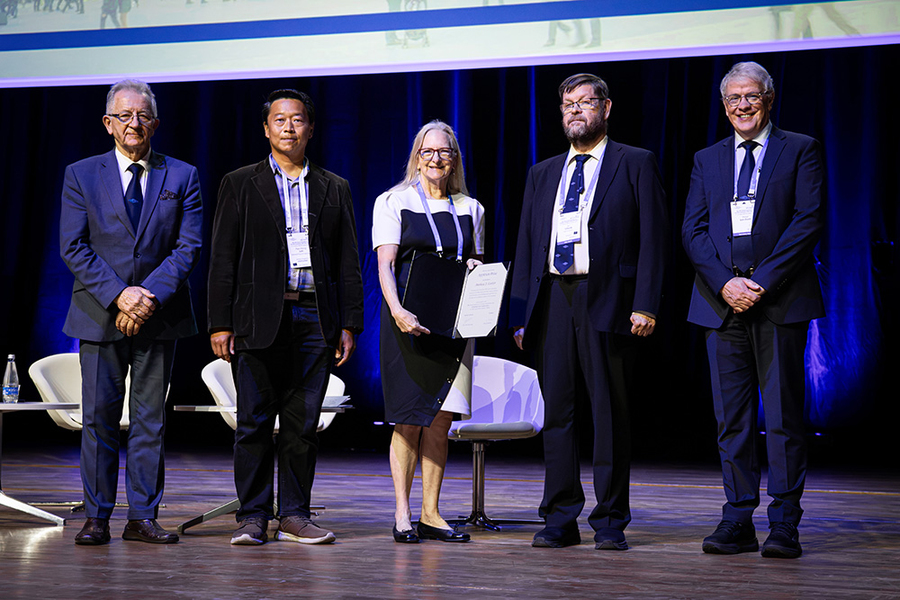
MIT Principal Research Scientist and Haystack Observatory Assistant Director Emerita Anthea J. Coster was awarded the prestigious Appleton Prize at the International Union of Radio Science (URSI) General Assembly and Science Symposium in Krakow, Poland, on Aug. 16.
The Appleton Prize recognizes career achievements and outstanding contributions to studies in ionospheric physics. Appleton awardees are regarded as pillars of the URSI atmospheric science community; the citation for Coster, an URSI Fellow, is for “pioneering research in GNSS [Global Navigation Satellite System] science, developing techniques to provide global-scale view of storm responses in the ionosphere, operationalizing novel algorithms, and providing novel ionospheric products to the community.”
The Appleton Prize honors Sir Edward Victor Appleton, a Nobel Prize–winning physicist and former president of URSI (1934–52) who proved the existence of the ionosphere.
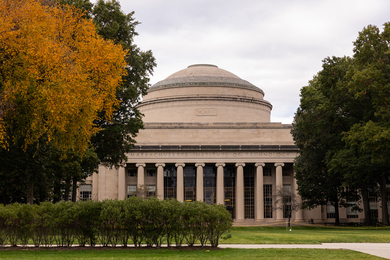
Coster joined MIT in 1984, originally at MIT Lincoln Laboratory, where she worked on satellite tracking applications within the Space Surveillance Complex situated at MIT Haystack Observatory. While at Lincoln, she was introduced to the Global Positioning System (GPS), the first GNSS; her GPS research at Lincoln eventually led to an appointment in Haystack’s geospace and atmospheric science research group. She continued and expanded her Lincoln-based GNSS research, focusing on ionospheric and atmospheric applications. At Haystack, Coster started as a research scientist, becoming an MIT principal research scientist in 2012; she also served as assistant director for the observatory from 2015 until 2024.
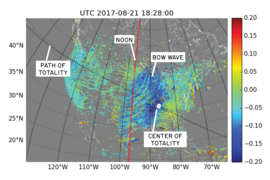
Her career research focus spans the physics of the ionosphere, magnetosphere, and thermosphere, covering space weather and storm-time effects and coupling of these atmospheric regions, with particular expertise on GNSS positioning and measurement accuracy. Coster’s breakthrough contributions in GNSS applications to frontier geospace research span many areas, including ionosphere-magnetosphere coupling and mid-latitude ionospheric dynamics. A selected number of her accomplishments include the first real-time GNSS ionospheric monitoring system, as well as pioneering work in monitoring tropospheric water vapor with GNSS signals. She also was responsible for the first GNSS observations of storm-enhanced density, a bright and important feature that can span the heavily populated continental United States, with significant impacts to the Federal Aviation Administration Wide Area Augmentation System, which supplements traditional GPS navigation systems.
MIT Haystack Observatory director Phil Erickson says, "Dr. Coster's award from the International Radio Science Union is most well-deserved, and reflects her substantial international impact on the field of geospace remote sensing. Coster's pioneering application of GNSS signals to global and precise maps of total ionospheric electron density has produced a rich and insightful scientific output that anchors and greatly complements the multi-messenger, sensor fusion techniques at the forefront of the research field in near-Earth space weather dynamics. These areas are of critical importance to our increasingly spacefaring civilization."
Coster’s career also encompasses a lifetime of professional service contributions to the U.S. and international geophysical sciences community, including many leadership positions with the U.S. chapter of the Union of Radio Science, the Institute of Navigation, and the American Geophysical Union. She has served as co-chair of NASA's Living with a Star Program Analysis Group and is a current member of the U.S. National Academies of Science, Medicine, and Engineering Space Weather Roundtable.
She is an author or co-author on more than 200 peer-reviewed publications, and is the principal investigator of numerous federal scientific grants from NASA, the National Science Foundation, the Office of Naval Research, and the Air Force Office of Scientific Research. Prominent results of Coster’s work are heavily used, including scientifically rich GNSS total electron content (TEC) and scintillation data products available to the research community through NSF's CEDAR Madrigal database and the Millstone Hill Geospace Facility.
Coster has also made a number of notable contributions to science outreach, such as deploying radio instrumentation with MIT graduate students in Brazil and Peru, presenting outreach talks to high school and middle school students in Rwanda and Zambia, and installing GNSS receivers in Inuit villages and along the remote Steese Highway in Alaska. For many years, she has taught U.N.-sponsored GNSS workshops aimed at workforce education and career advancement in disadvantaged countries.
Originally from Texas, Coster attended the University of Texas at Austin as an undergraduate and earned her master's and doctorate degrees at Rice University in Houston, where she was involved with ionospheric experiments at the Arecibo Observatory in Puerto Rico. She moved to Massachusetts in 1984 to join MIT Lincoln Laboratory.
"Anthea Coster has made seminal contributions to the state of the profession, enabling the international science community to conduct ionospheric research at spatio-temporal scales that were previously unachievable," says Larisa Goncharenko, assistant director and head of the atmospheric and geospace group at Haystack. "Her pioneering work on introducing and relating GPS measurements to fundamental research has led the community to employ GNSS as an information-rich sensor for ionospheric remote sensing and space weather monitoring. Her effort enabled countless discoveries in the near-Earth space environment that has become increasingly important for human activities in space. I am truly in awe of Anthea's pioneering accomplishments, and incredibly proud of her receiving the Appleton Prize."
With this award, MIT Haystack Observatory is now home to three URSI prize recipients. Former director and research scientist John Evans received the Appleton Prize in 1975 with a citation for "ionospheric physics, including application of the incoherent scatter technique," and research scientist Alan Rogers received the 2008 John Howard Dellinger Gold Medal for outstanding contributions to radio astronomy.