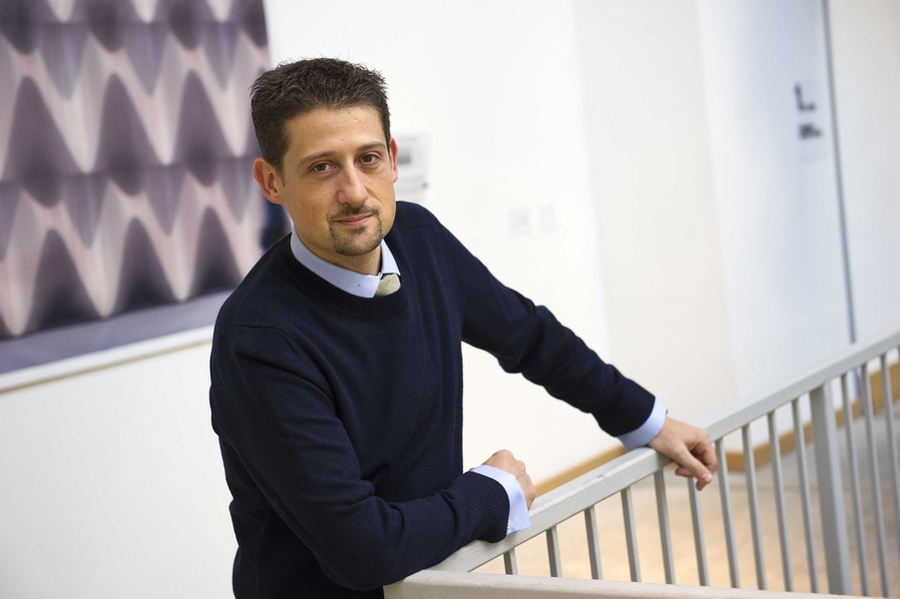
Nuclear fission technology is the only viable grid-scale source of continuous, carbon-free electricity available today — but realizing its potential in the fight against global climate change requires substantial improvements in both the technological and the economic performance of new-generation reactors. Over the last 15 years, computational techniques for modeling reactor behavior on both macro- and microscales have emerged as central tools in this effort, and Department of Nuclear Science and Engineering (NSE) students will have the opportunity to learn about them from a growing faculty group that includes new Assistant Professor Emilio Baglietto, a pioneer in the development of computational fluid dynamics (CFD) technology for the nuclear industry.
Baglietto comes to NSE from the engineering simulation software company CD-adapco, where he was director of nuclear applications. He joins a rapidly growing group of NSE faculty working in the field of advanced computation and simulation, including professors Kord Smith and Benoit Forget, whose research focuses on the development of computational models and simulation tools for reactor analysis, and professors Ju Li, Bilge Yildiz and Sidney Yip, whose fundamental computational studies of materials behavior are shedding light on the performance of materials in the extreme environments of fission and fusion reactors.
Baglietto’s research goals include improving the effectiveness and expanding the reach of 3-D, first-principles computational tools for nuclear reactor design. He notes that this work is applicable at the microscale, to better understand physical interactions; at the component scale, to optimize designs; and at the full-system level, to validate new designs while taking into account complex system interactions. As a result, the technology promises to be a starting point for entirely new generations of innovation in a wide range of areas.
Read full article
Baglietto comes to NSE from the engineering simulation software company CD-adapco, where he was director of nuclear applications. He joins a rapidly growing group of NSE faculty working in the field of advanced computation and simulation, including professors Kord Smith and Benoit Forget, whose research focuses on the development of computational models and simulation tools for reactor analysis, and professors Ju Li, Bilge Yildiz and Sidney Yip, whose fundamental computational studies of materials behavior are shedding light on the performance of materials in the extreme environments of fission and fusion reactors.
Baglietto’s research goals include improving the effectiveness and expanding the reach of 3-D, first-principles computational tools for nuclear reactor design. He notes that this work is applicable at the microscale, to better understand physical interactions; at the component scale, to optimize designs; and at the full-system level, to validate new designs while taking into account complex system interactions. As a result, the technology promises to be a starting point for entirely new generations of innovation in a wide range of areas.
Read full article