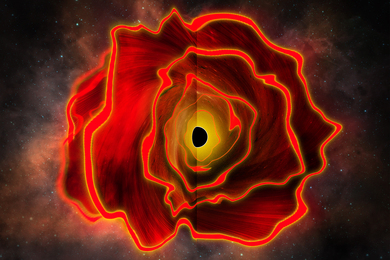
New catalog more than doubles the number of gravitational-wave detections made by LIGO, Virgo, and KAGRA observatories
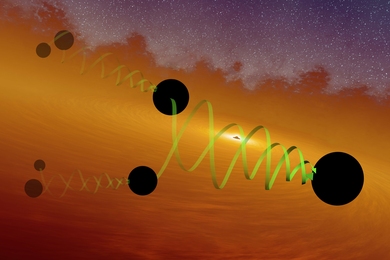
The latest crop of space-time wobbles includes a variety of heavy, fast-spinning, and lopsided colliding black holes.
Annual award honors early-career researchers for creativity, innovation, and research accomplishments.
For the first time, the new scope allowed physicists to observe terahertz “jiggles” in a superconducting fluid.
By leveraging excess heat instead of electricity, microscopic silicon structures could enable more energy-efficient thermal sensing and signal processing.
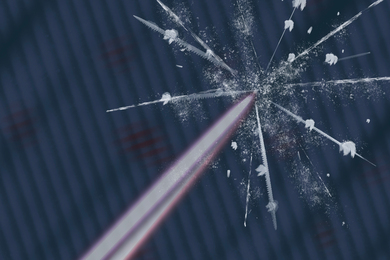
MIT physicists observed the first clear evidence that quarks create a wake as they speed through quark-gluon plasma, confirming the plasma behaves like a liquid.
MIT physicist shares 400,000-euro award for influential work on “magic-angle” graphene.
The program recognizes outstanding mentorship of graduate students.
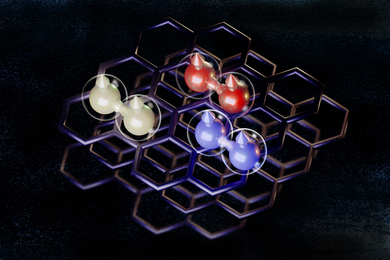
MIT physicists say these quasiparticles may explain how superconductivity and magnetism can coexist in certain materials.
In his 10 years at MIT, Loureiro helped illuminate the physics occurring at the center of fusion vacuum chambers and at the edges of the universe.
Professors Ahmad Bahai and Kripa Varanasi, plus seven additional MIT alumni, are honored for highly impactful inventions.
Eleven new professors join the departments of Biology; Brain and Cognitive Sciences; Earth, Atmospheric and Planetary Sciences; Mathematics; and Physics.
X-ray observations reveal surprising features of the dying star’s most energetic environment.
Faculty recognized for the exceptional professional and personal guidance they provide postdocs.
The MIT Quantum Initiative is taking shape, leveraging quantum breakthroughs to drive the future of scientific and technological progress.
The findings could open a route to new forms of higher-temperature superconductors.