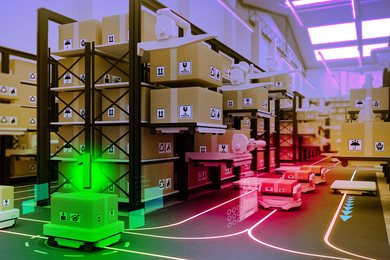
AI system learns to keep warehouse robot traffic running smoothly
This new approach adapts to decide which robots should get the right of way at every moment, avoiding congestion and increasing throughput.
This new approach adapts to decide which robots should get the right of way at every moment, avoiding congestion and increasing throughput.

Professor Jesse Thaler describes a vision for a two-way bridge between artificial intelligence and the mathematical and physical sciences — one that promises to advance both.

By providing holistic information on a cell, an AI-driven method could help scientists better understand disease mechanisms and plan experiments.
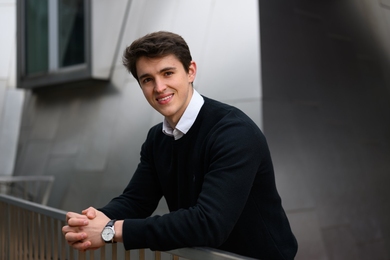
Strahinja Janjusevic brings an international perspective and US Naval Academy education to his graduate research in the MIT Technology and Policy Program.
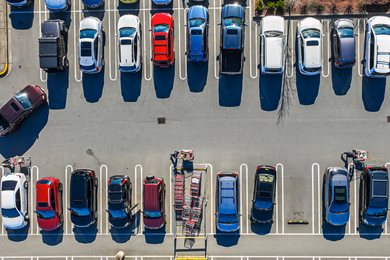
By minimizing the need to drive around looking for a parking spot, this technique can save drivers up to 35 minutes — and give them a realistic estimate of total travel time.

The context of long-term conversations can cause an LLM to begin mirroring the user’s viewpoints, possibly reducing accuracy or creating a virtual echo-chamber.
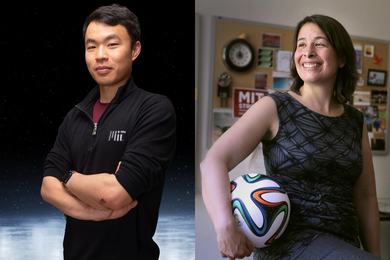
MIT Sports Lab researchers are applying AI technologies to help figure skaters improve. They also have thoughts on whether five-rotation jumps are humanly possible.

Removing just a tiny fraction of the crowdsourced data that informs online ranking platforms can significantly change the results.
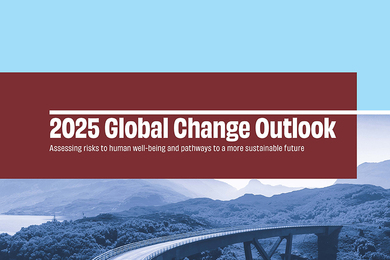
Global Change Outlook report for 2025 shows how accelerated action can reduce climate risks and improve sustainability outcomes, while highlighting potential geopolitical hurdles.

Tools for forecasting and modeling technological improvements and the impacts of policy decisions can result in more effective and impactful decision-making.

The technique can help scientists in economics, public health, and other fields understand whether to trust the results of their experiments.

Using a versatile problem-solving framework, researchers show how early relapse in lymphoma patients influences their chance for survival.
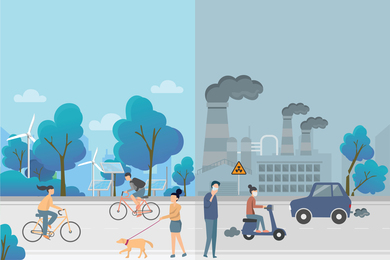
Cutting air travel and purchasing renewable energy can lead to different effects on overall air quality, even while achieving the same CO2 reduction, new research shows.
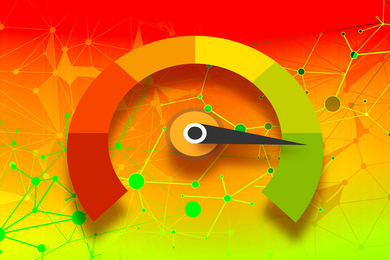
This new technique enables LLMs to dynamically adjust the amount of computation they use for reasoning, based on the difficulty of the question.
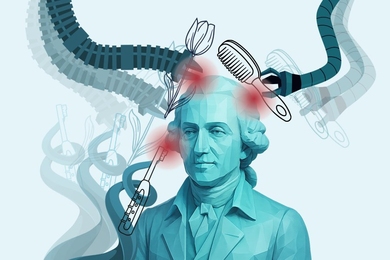
MIT CSAIL and LIDS researchers developed a mathematically grounded system that lets soft robots deform, adapt, and interact with people and objects, without violating safety limits.