Researchers around the world are racing to develop new quantum-based systems for sensing, communication, computing, and control that have the promise of outperforming traditional systems. Creating stable, measurable, distinguishable quantum states, which would be the heart of any such system, is a daunting task.
Quantum states possess unique properties that can be exploited for developing novel information processing systems. Two key properties, stability and distinguishability, are hard to achieve, however. Extracting information from a quantum system depends on the distinguishability of quantum states, an intrinsic property associated with a property known as orthogonality. Nevertheless, no two Gaussian states (a widely studied class of quantum states) are orthogonal, and this yields an unavoidable error when attempting to distinguish them.
In addition, present quantum devices tend to remain stable only for a fraction of a second, and require complex protocols to distinguish states. Now, researchers at MIT and the University of Ferrara have found a new approach for creating easily distinguishable states that could help to enable the development of these new quantum-based devices.
The new approach is described in a paper published today in the journal Physical Review A, by Moe Z. Win and Peter L. Falb at MIT with Andrea Giani and Andrea Conti at the University of Ferrara. The team found a way of translating between quantum states of light and algebraic varieties (a mathematical structure from abstract algebra), making the analysis more manageable by reducing it to solvable mathematical equations.
“Quantum systems can provide performance that is significantly better than classical counterparts,” Win says, “but this doesn’t come for free.” To develop practical devices for producing and detecting different states, “one needs to carefully engineer the quantum states in which they encode information.”
Traditional computers typically use different voltages in a solid-state device to encode ones and zeros, while optical systems may use the presence or absence of a pulse of light. In quantum devices, the states might have to do with the spin state of a single atom, or the excitation level of a group of electrons.
Win adds that “we have been studying how to design distinguishable quantum states, which translates directly into improved performance for sensing and communication.” In the jargon of the field, they are improving the orthogonality — that is, the distinguishability — of different states.
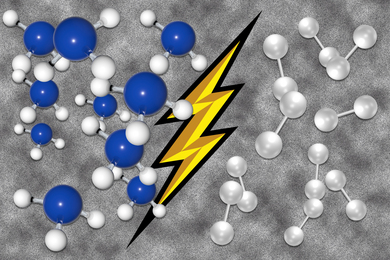
The particular kinds of states studied in this theoretical analysis had to do with energy levels of photons, or particles of light. Giani explains that they used an operation called photon variation. This can take two forms: photon addition, in which photons are excited to a higher energy state, or photon subtraction, in which photons are annihilated (i.e., removed from the system). These operations change the quantum state from Gaussian to non-Gaussian states; it’s the non-Gaussian states that seem most useful, the team concluded.
“The domain of non-Gaussian states is quite big,” Giani says, “but among them, we are looking into non-Gaussian states that are easier to implement with current technologies, because if we want to make the transition to the quantum world, we need to take into account realistic experimental challenges.”
Unlike some kinds of cutting-edge technologies being studied for possible quantum applications, Giani explains, “these kinds of photon-varied states have already been produced in the laboratory, and there is much interest in this kind of operation.”
These types of states are relatively new, Conti says, and so “there was a need for a theoretical characterization for these states,” The theoretical characterization this team derived, based on underlying mathematical properties, makes it possible to design states with higher levels of distinguishability.
With this work, Win says, “we have a theory that gives us a blueprint to go design these non-Gaussian states, rather than just, ‘try this and that, and let’s hope they’re somewhat distinguishable.’ Our theory tells us exactly how to go about designing orthogonal non-Gaussian states.”
The findings result from the connection between the algebraic equations and the underlying physics, Win says, “That was the important connection between different disciplines — bringing algebraic geometry to the table.”
“The equations to be solved for determining the orthogonality” of the quantum states “happened to be polynomial equations,” Falb says. “It just happened that there was the appropriate mathematics to solve them.”
Now that the principles have been established through this work, implementation should be relatively straightforward, the researchers say. There already are some optical setups that can be used to implement these kinds of states.
“In principle,” Giani notes, “you can just put the parameters that you find by solving these equations directly into your physical apparatuses and produce these kinds of states. I don’t think this requires some more-advanced technology.”
Conti adds that “as soon as this paper is published, we hope that experimentalists can try these methods.”
But that’s just the beginning, Win emphasizes. “We are getting momentum, and it’s very exciting,” he says. “The approach that we are taking here is to ask more general questions than just, ‘here’s a particular setup, how do you tune it to get a performance gain?’ Rather, we’re looking at a class of signal design problems, and then finding keys that really unlock these, so that hopefully the answer will not just be applied to only one particular setup, but something significantly broader.”