Skip to content ↓

📬 Want a dose of MIT in your inbox? Subscribe to the MIT Daily and/or MIT Weekly newsletters.

Top News

Looking for audio? Listen to the MIT News podcast

Recent Highlights

More MIT News articles

In the Media

Boston Globe

Boston Globe reporter Robert Weisman spotlights how MIT is “working to drive artificial intelligence forward in sectors where the region is strongest, from biotechnology and robotics to defense and clean energy. It’s also trying to broaden entrepreneurship through a ‘dorm-to-startup’ push, creating a pipeline of support services — from hack-a-thons to venture funding — to help students to start companies between classes.” 

Nature

Nature reporter Jyoti Madhusoodanan features Prof. Regina Barzilay and Prof. James Collin’s work developing AI tools aimed at accelerating the process of drug discovery and tackling the growing problem of antibiotic resistance. Barzilay notes that the goal of AI-based drug design is not to have the perfect method, but to find working solutions to the antibiotic-resistance crisis. “To me, the art is really in taking the tools we currently have, which are already doing quite a bit, and translating them into something which is useful in clinic,” she explains. 

Boston Globe

Honorees on The Boston Globe’s 2026 Tech Power Players list shared their reasons for having optimism about the future of the Greater Boston area’s tech and innovation scene. President Sally Kornbluth says opportunities abound in what she calls “AI + X” — integrating AI into fields such as manufacturing, life sciences, and energy. “Massachusetts can absolutely lead in this next wave,” says Kornbluth. “The ecosystem has the building blocks,” shares Bob Mumgaard SM ’15. “Massachusetts is the strongest in the nation in innovation in energy.”

GBH

GBH "Particles of Thought" host Hakeem Oluseyi interviews Prof. David Kaiser about the puzzling nature of dark matter and how its explanation may be inconsistent with our assumptions of gravity. “If we assume we really know the laws of gravity, which Einstein wrote down beautifully just over a hundred years ago in his general theory of relativity...we have reason to be confident. But what people are saying is could dark matter be the first exception to that,” says Kaiser. 

New York Times

Prof. Daron Acemoglu joins New York Times reporter Bill Wasik for a panel discussion about the impact of AI on job security and its potential to supplement work. “The current view is that somehow [AI] agents are going to do a lot of the work and we just need to supervise them,” says Acemoglu. “I find that very unrealistic. But if it was realistic, it would be a horrible thing.”

Associated Press

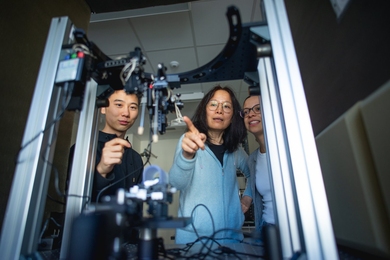
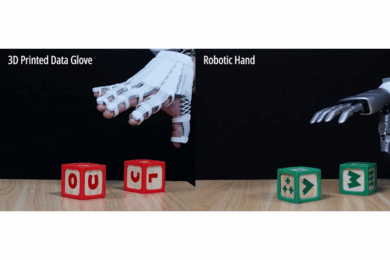
Associated Press reporter Rodrique Ngowi visits MIT to learn about how researchers in Prof. Xuanhe Zhao’s lab developed an ultrasound wristband that gathers data on human hand motions as part of an effort to help train humanoid robots to undertake complex tasks, from housework to surgery. “Imagine people doing housework,” says Zhao. “We can use the data obtained by our system to train a robot to do exactly (that) housework with this dexterous hand motion.” 

Boston Globe

Boston Globe reporter Aaron Pressman spotlights MIT startup Liquid AI, along with the various AI efforts underway at MIT as part of The Globe’s 2026 Tech Power Players special section. Pressman notes that: “President Sally Kornbluth is reinvigorating the school’s support of the local innovation ecosystem, unveiling new online classes dedicated to AI — with free entry-level classes for anyone — and encouraging more entrepreneurship on campus.” 

WBUR

In a WBUR article, arts writer Maddie Browning names the new MIT List Visual Arts Center exhibit, “DEAD PIXEL,” by artist and comic book illustrator Pap Souleye Fall, as a highlight to check out this summer. The exhibition, inspired by the black spots that materialize on-screen from technological error, is an ongoing story depicted through performance, sculpture and video. Browning notes that “Fall visualizes the empty spaces as ‘portals to hidden realms of autonomy.’” 

Community Updates

Featured Multimedia

Video thumbnail

Researchers at MIT are developing a new kind of sensor that detects cancer-related signals inside the bladder and emits a fluorescent light to reveal their presence. By using these nanosensors to map bladder cancer biomarkers in real time, this approach could transform how we monitor and diagnose the disease.

Video thumbnail

A new storytelling project titled Curiosity on a Mission champions the long-horizon science that powers American innovation. The MIT effort highlights how basic research sparks enormous advances in medicine, technology, national security, and economic growth.

Video thumbnail

Explore the origin and global impact of MIT OpenCourseWare, a pioneering initiative that challenged traditional educational models. Discover how the commitment to making knowledge accessible to everyone has shaped online learning and inspired a worldwide movement toward open education for learners everywhere.

Video thumbnail

In MIT's Elements of Mechanical Design course, students apply theoretical concepts from core engineering classes to build high-precision machines. Through lab work and shop time, they bridge the gap between academics and practical application, developing the hands-on expertise and confidence necessary to excel as professional engineers.

Video thumbnail

What if time could be measured with near-perfect precision? Atomic clocks do exactly that, using atoms as nature’s most reliable timekeepers. Here’s how they work and why modern life depends on them.

More News