
MIT researchers have overcome a major challenge holding back the real-world deployment of microwave quantum technologies for advanced signal processing and secure communications.
The team developed a scalable platform that generates pairs of highly correlated radio frequency waves, without the need for bulky and expensive cooling equipment. In quantum technologies, these linked radio waves can be used for noise-resilient communication or high-precision radar and sensing. However, they’re usually only generated in research labs, under extremely cold conditions.
The MIT researchers fabricated a small, electronic device that can generate the same type of highly correlated signals at room temperature.
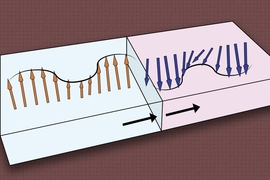
The device incorporates a magnetic film, which interacts with microwave energy inside a metal cavity to split an incoming signal into two linked output signals. The researchers used the device to demonstrate secure communications by encoding information in a signal that could only be recovered using its partner signal.
“We’ve shown how the quantum properties of magnets can be leveraged to realize new communication and detection technologies. I hope our demonstration of this platform will enable further development of room-temperature quantum simulators, which have huge potential to enable many future discoveries,” says Qiuyuan Wang, an electrical engineering and computer science (EECS) graduate student and lead author of a paper on this technique.
Wang is joined on the paper by Aravind Karthigeyan, a graduate student at the University of Illinois at Urbana-Champaign; Chung-Tao Chou, an MIT postdoc; and senior author Luqiao Liu, an associate professor in EECS and a member of the Research Laboratory of Electronics. The research appears today in Nature Electronics.
Synchronized signals
Microwave photons are fundamental particles that form the signals used for wireless communication and sensing.
Scientists can split one microwave photon into two tightly correlated photons using a device called a Josephson junction, which is an element of a superconducting circuit. These linked microwave photons can be used in applications like secure communications or high-performance radar systems that can detect extremely faint signals.
To enable secure communications using these correlated signals, engineers could design electronic devices that encode data in one signal by altering the signal’s properties, such that the information could only be decoded at the other end of the transmission using the matching signal. But to operate effectively, superconducting circuits must be kept at temperatures below 273 degrees Celsius, usually inside a bulky, expensive, and energy-intensive cryostat machine.
While pursuing a different line of research, the scientists in Liu’s group realized they could generate the same highly correlated microwave signals using magnets instead of cryogenically cooled superconducting circuits.
By putting a magnetic film into a microwave resonator, which is a metal cavity that traps electromagnetic energy, they could split one incoming microwave photon into a pair of perfectly synchronized signals with distinct frequencies, at room temperature.
“On its own, each signal looks random, but their phase relationship remains strongly correlated,” Wang explains.
Their device relies on magnons, which are tiny packets of magnetic energy. Typically, pumping microwave photons into a magnetic system generates a pair of correlated magnons with the same frequency.
Even though both magnons are correlated, because they have the same frequency, scientists can’t separate them. They would need to separate the magnons to use one signal for transmission and the other for detection in secure communications.
A hybrid system
By coupling a magnetic film with a microwave resonator and carefully controlling the energy they pump into the device, the researchers could form hybrid magnon-photon waves. These hybrid waves output a pair of synchronized signals with distinct microwave frequencies.
The signals remain strongly correlated, but since the frequencies are always different and random, an attacker can’t recover the information encoded in one signal without having the matching one to use as a key.
The researchers demonstrated this by encoding a small image in the frequency of one microwave signal. They successfully decoded the signal and extracted the image using its partner.
“Magnonic systems exhibit a remarkably rich range of nonlinear dynamics, but these nonlinearities have not yet been harnessed for practical applications as extensively as those in nonlinear optics and other dynamical systems. In this work, we address one important challenge: the spectral overlap between a pair of ‘twin’ magnons generated by the same pump photon. By using the level repulsion arising from coupling between magnons and microwave photons, we were able to separate the two magnons in frequency,” says Liu. “We believe this demonstration could provide a foundation for technologies such as quantum radar, secure communications, and quantum-limited sensing, all of which rely on correlated — and ultimately entangled — microwave sources.”
This hybrid magnon-microwave system could also be used in noise-resilient communication by enabling the receiver to decode a message that has been garbled by random data that interfere with the transmission.
Correlated microwave signals are also a key element of a quantum simulator, which is a device that can emulate the complex behavior and interactions of subatomic particles that classical computers can’t handle. Scientists are developing quantum simulators to discover new drugs and materials.
By generating correlated signals at room temperature, this new technique can improve the scalability and reduce the costs of quantum simulation. In the future, the researchers want to develop a scalable architecture for their platform, moving it one step closer to real-world deployment. They also want to explore additional applications for the process and use their platform to study the underlying physics of correlated microwave signals.
“The creation of a non-degenerate parametric magnon-polariton platform marks an important milestone for cavity magnonics, extending the field beyond coherent microwave generation to the production of multichannel correlated microwave photons,” says Can-Ming Hu, a distinguished profess or physics and astronomy at the University of Manitoba in Canada, who was not involved with this paper. “This breakthrough will broadly impact secure microwave communications, hardware random number generation, correlation-based signal processing, and intelligent microwave sensing — all operating within the classical regime at room temperature. Looking ahead, this platform could well be remembered as the starting point for realizing quantum-inspired microwave sensing and communication technologies based on nonlinear cavity magnonics.”
This research was supported, in part, by the National Science Foundation and the U.S. Department of Energy.